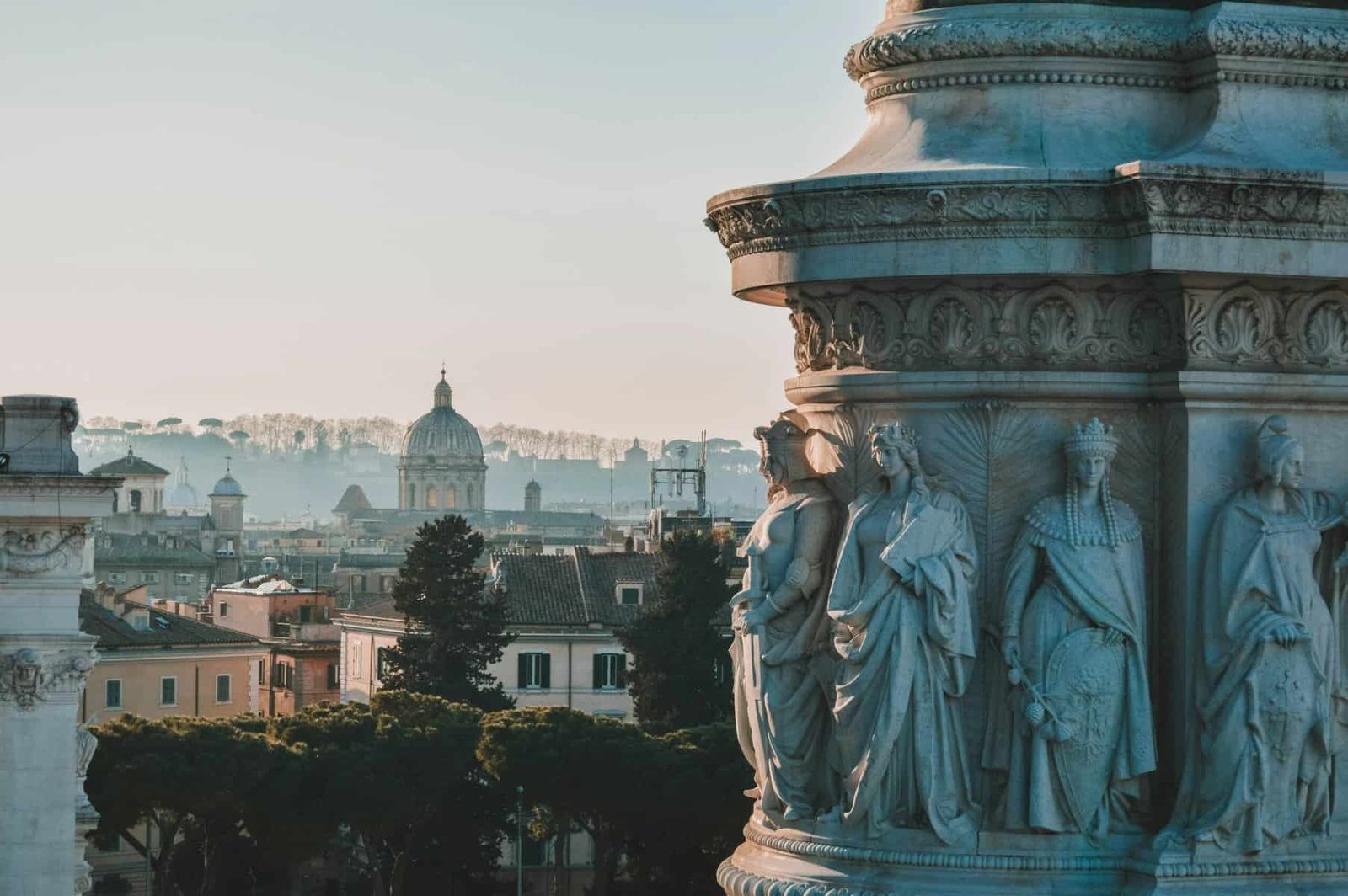
Why does nobody seem surprised by the church built into a bathhouse?
Santa Maria degli Angeli sits inside what used to be the tepidarium of the Baths of Diocletian. You walk in expecting a museum exhibit, maybe some roped-off stonework, and instead you find a working basilica with Mass schedules and confession booths installed among columns that date to 298 CE. Michelangelo redesigned the interior in the 1560s. The marble floor includes a meridian line for solar observations. Old women pray the rosary near walls where Romans once scraped oil off their skin with strigils.

Nobody treats this as unusual. The ticket booth guy at the adjacent museum barely glances up. Tourists photograph the meridian and leave. The locals who attend evening services sit in Renaissance pews surrounded by imperial brickwork and concrete, and the incongruity doesn’t register because Rome is full of these collisions.
You see the same thing at San Clemente, where they’ve excavated four layers under the current church: a medieval basilica, a fourth-century church, a Mithraic temple, and below that a Roman apartment block with the sound of an ancient stream still running through the foundation. You descend through centuries on a metal staircase. At the bottom level the air is cool and you hear water moving somewhere behind brick that predates the Colosseum.
The city didn’t preserve these layers for tourists. People just kept building on top of what was already there because the ground was stable and the location was already cleared. The strangeness is that this seems normal now.
What do you mean the apartment buildings have columns in the lobby?
The residential block on Via di San Paolo alla Regola has two Corinthian columns framing the entryway to a 1960s apartment building. Not replicas. Actual columns, probably from a temple, integrated into the structure when they poured the foundation. The building super waters plants next to them. Someone has parked a Vespa between the bases.
In the courtyard behind a supermarket near Largo di Torre Argentina, you can see a section of the Porticus Minucia through a chain-link fence. It’s not open to the public. There’s no plaque. The fragments sit there behind the loading dock where delivery trucks reverse in with produce shipments. The supermarket is called Simply and their shopping carts sometimes get pushed up against the stone.
This is what I mean about missing the strangeness. The guidebooks send you to the Forum and the Pantheon, which are spectacular, but they don’t prepare you for the casual presence of antiquity in ordinary contexts. You’re walking to a farmacia for motion sickness tablets and you pass a chunk of the Aqua Virgo aqueduct embedded in the side of a tobacco shop.
Via del Portico d’Ottavia runs through the old Jewish Ghetto and is lined with restaurants where you can eat carciofi alla giudia (fried artichokes, around €8). Behind the outdoor seating area is the actual Portico of Octavia, built in 27 BCE, with medieval houses constructed directly into the arches. People have been living inside this monument for a thousand years. You eat artichokes ten feet away from stonework that predates the fall of the Western Empire.
Is the Colosseum actually the best example of this layering?
No. The Colosseum is impressive but it’s been isolated, cleaned up, turned into a monument. They cleared the medieval fortifications and the houses that had filled the interior. It’s too obviously ancient now.
Better examples are the markets at Trajan’s Forum, where the semi-circular brick structure built in 113 CE houses the Museo dei Fori Imperiali. The museum displays artifacts inside the original Roman shopping arcade. You stand in a space that once sold spices and silk, looking at cabinets of coins and pottery, and the building itself is the exhibit. The Via Biberatica ran through here as an ancient shopping street. Now it’s a museum hallway.
Or the Theater of Marcellus, started by Julius Caesar and finished by Augustus in 13 BCE. The top two levels were converted into a Renaissance palace in the 1500s. The Orsini family lived there. You can still see the apartments built into the upper arches, with shutters and laundry lines and satellite dishes attached to stone that is older than the Colosseum. The ground floor arches remain exposed. At night they light it up and people walk past on their way to dinner in Trastevere.
This is what Rome does. It doesn’t preserve ruins as isolated artifacts. It absorbs them into the living city until the boundaries blur.
How much of the layering is visible without paying for tours?
Most of it. You need tickets for the major sites like the Forum (€16, includes Colosseum and Palatine), but the ambient strangeness costs nothing.
The Pyramid of Cestius is a 36-meter tomb built around 18 BCE, sitting next to the Porta San Paolo metro station. You exit the train and there’s a pyramid. People wait for the bus in its shadow. You can’t go inside without a pre-booked tour, but the exterior is right there on the sidewalk, wedged into the Aurelian Walls like it’s the most normal thing to build a pyramid at a traffic intersection.
The Bocca della Verità (Mouth of Truth) is in the portico of Santa Maria in Cosmedin, free to enter. Tourists line up to stick their hands in the carved marble face, but if you skip the line and walk into the church you’ll find a floor made of colored stone in geometric patterns, Cosmati work from the 1100s, and a baroque ceiling installed in the 1700s. Three major artistic periods in one room and nobody’s charging admission.
Walk the length of Via dei Fori Imperiali and you’re walking on Mussolini’s road, built in the 1930s by demolishing a medieval neighborhood and cutting straight through the ancient forums. On both sides you see exposed ruins: the Forum of Augustus, the Forum of Trajan, sections of brick and marble that used to be administrative buildings, temples, courthouses. The city didn’t bury the road or move it. It’s still the main route to the Colosseum. Buses run over forums.
What’s the thing that finally made the strangeness click for you?
The trash strike. I was there when the sanitation workers went on strike and garbage piled up on corners throughout the centro storico. Black bags stacked next to a fountain designed by Bernini. Overflowing bins beside a column that once held up a temple to Hadrian.
And the city kept functioning. People still went to work, still ate dinner at restaurants with refuse heaped outside, still walked their dogs past baroque churches and ancient walls with trash accumulating against the foundations. It was ugly and frustrating, but it also made clear that Rome is not a museum. It’s a working city where normal problems happen amid extraordinary surroundings.
That’s when I understood what you miss if you only see the postcard version. The strangeness isn’t that Rome has ancient ruins. The strangeness is that the ruins are so embedded in daily life that a garbage strike becomes the notable event, not the fact that the garbage is piling up next to a temple older than most European cities.
You won’t get this from the hop-on-hop-off bus or the guided tour that ships you from monument to monument. You get it by staying long enough to buy groceries, get lost in Monti, argue with a taxi driver who won’t turn on the meter, sit in a park where mothers push strollers past statuary that belongs in a textbook. The city stops performing and you see the layering for what it is: not preservation, but continuous use.
If you liked this, you might like: Riga, Warsaw, Paris.
Planning the trip? compare hotel deals from Stavanger, Oslo, Bergen, and Trondheim.