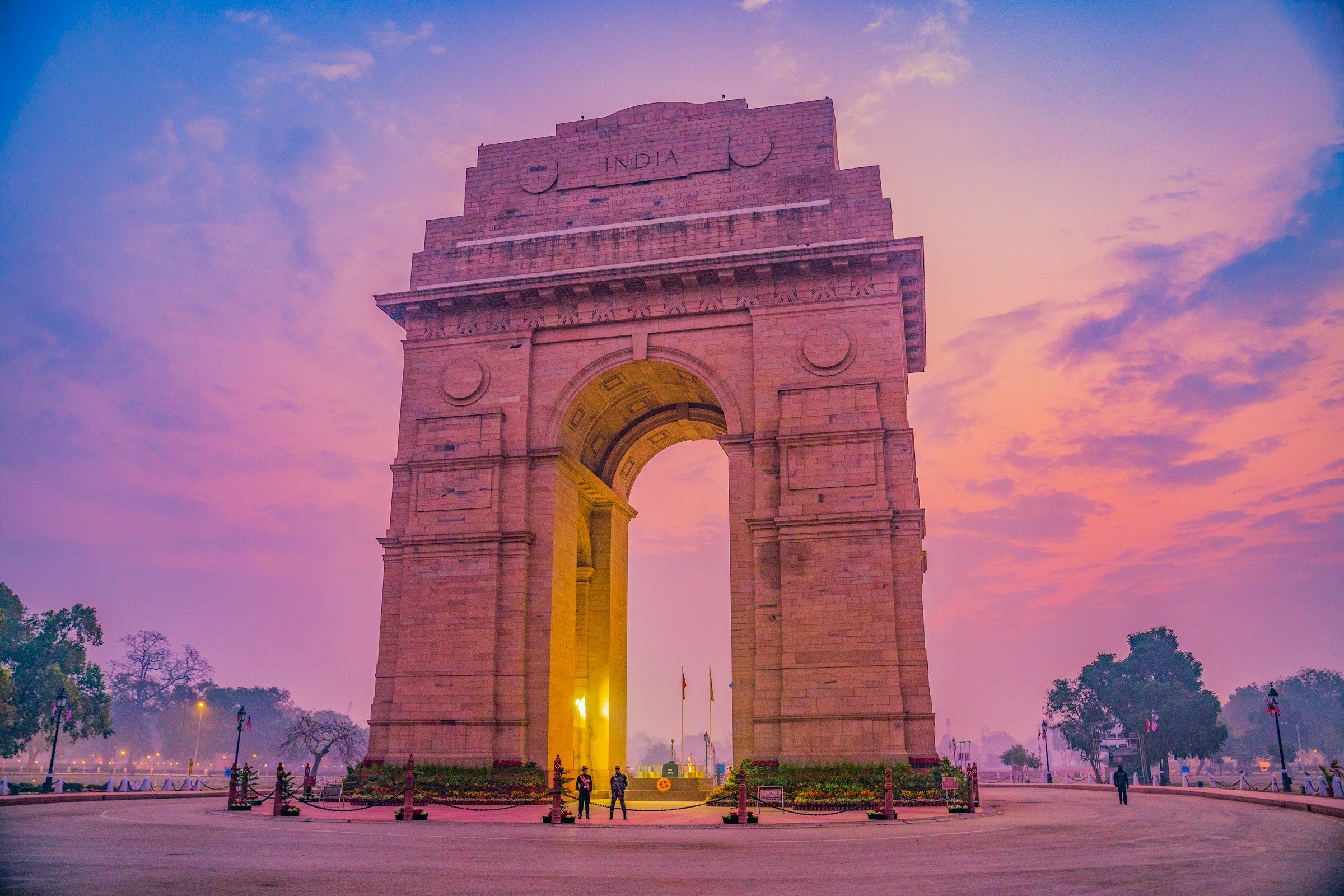
India Gate and the Rajpath Axis
You start where Edwin Lutyens wanted you to start, at the 42-meter war memorial he dropped into what used to be scrubland. India Gate sits at one end of a two-kilometer boulevard so wide that monsoon water sheets across all eight lanes before the drains catch up. The British built Rajpath (then Kingsway) to impress, and it still does, but now the geometry serves a different republic. The tanks roll down this exact line for Republic Day, but on a regular morning you get street vendors selling corn and balloons where the imperial processions used to pass.

The lawns on either side flood when the monsoons hit. Not decorative puddles but ankle-deep water that turns the manicured grass into a temporary wetland. The drainage system Lutyens designed assumed a lighter monsoon than Delhi actually gets. You will see office workers in Nehru Place wading through similar floods, briefcases held overhead, because the rains don’t care about urban planning.
Rashtrapati Bhavan at the Western Anchor
Walk west on Rajpath and the presidential estate rises at the far end, all 340 rooms of it. Lutyens put the Viceroy’s house on Raisina Hill so it would dominate the sightline, and it worked. The building is a strange hybrid: classical Western columns supporting Buddhist dome elements that were meant to signal imperial sympathy for Indian tradition without actually ceding power. It reads as architecture trying too hard.
The Mughal Gardens open for a month each spring (check the official schedule, it shifts). You walk through manicured lawns and fountains that owe more to Versailles than to the actual Mughal tradition of Paradise gardens. Real Mughal design, the kind you see at Humayun’s Tomb, uses water as a symbolic axis with less fuss and more geometry. Here it is ornamental. The British version of what they thought Mughal style should be.
The Grade That Hides the Palace
Stand at India Gate and look west toward Rashtrapati Bhavan. You cannot see the building’s base because Lutyens miscalculated the gradient of Raisina Hill. He wanted a dramatic upward slope but made it too steep, so the central dome appears to float without foundation when viewed from the memorial. Herbert Baker, who designed the flanking Secretariat buildings, got blamed for the error. Architects still argue about whose fault it was. The effect is accidentally surreal.
Connaught Place and the Circular Logic
Cut north to Connaught Place and the geometry shifts from axial to radial. Robert Tor Russell designed it as a series of concentric circles with colonnaded shop fronts, finished in 1933. It was supposed to be the commercial heart of New Delhi, and it still functions that way, though now the corridors smell like paan spit and photocopied documents. The Central Park in the middle floods worse than Rajpath because it sits in a natural depression.
The outer circle (technically Connaught Circus) houses everything from Punjabi dhaba stalls to the global bank branches that moved in during the 1990s liberalization. The inner circle has bookstores where you can buy pirated textbooks for 150 rupees ($1.80) and restaurants serving butter chicken that costs 400 rupees ($4.80) for a portion meant for two people. The waiters will not split the bill evenly if you ask. They will calculate each person’s exact order and bring separate checks with the service charge already added.
Jantar Mantar and Older Geometry

New Delhi
Walk southwest from Connaught Place and you hit Jantar Mantar, which Maharaja Jai Singh II built in 1724 when Delhi was still under Mughal control but fracturing. It is an observatory, a collection of massive masonry instruments designed to track celestial positions without lenses. The central sundial (Samrat Yantra) is accurate to two seconds.
The site now borders a protest zone where farmers and labor unions camp for weeks when they want the government to hear demands. The farmer protests filled the adjacent streets for months a few years back. The juxtaposition is sharp: 18th-century astronomy equipment next to tarpaulin tents and hand-painted signs demanding loan waivers. Both are trying to read power, just on different scales.
Jama Masjid and the Mughal Counterpoint
Head northeast into Old Delhi and you reach Jama Masjid, which Shah Jahan finished in 1656. This is the structure that makes Lutyens’ work look tentative. The mosque holds 25,000 people in a courtyard framed by red sandstone and white marble, and it does not apologize for its scale. The British built New Delhi six kilometers south partly because they did not want to compete with this.
The stairs on the southern side flood during heavy monsoon because the 17th-century drainage cannot handle modern runoff from the surrounding buildings. You will see water pouring down the steps like a temporary waterfall. Shopkeepers in the Meena Bazaar below keep their lower shelves empty during the wet months.
Climbing the Minaret
You can pay 300 rupees ($3.60) to climb the southern minaret if you are not local. The stairs are narrow and uneven, and halfway up you start passing pilgrims coming down who will not yield space. At the top you see both the old city’s dense lanes and New Delhi’s wide avenues in one sightline. The British wanted to separate the two geometries, but from up here the division looks arbitrary.
Humayun’s Tomb and the Real Mughal Template
Circle back south to Humayun’s Tomb, built in 1572 by the emperor’s widow. This is the prototype for the Taj Mahal: red sandstone with white marble accents, charbagh garden layout with water channels dividing the space into quadrants, central dome over a square base. The proportions are exact. The building sits on a raised platform so it reads as a geometric form before you register the decorative details.
The garden floods in the same spots every monsoon because the 16th-century drainage system still works but only at 16th-century water volumes. Now the runoff from the surrounding neighborhood overtops the channels. The Archaeological Survey of India puts up signs warning visitors not to walk on the submerged pathways, but people ignore them. The water is warm and moves slowly, more inconvenient than dangerous.
The tomb complex includes several smaller Mughal-era graves scattered in the garden. Nobody famous, just relatives and nobles who wanted to be buried near power. Some of the graves are open to the sky because their domes collapsed decades ago and restoration funding goes to the main structure first. You can see rebar rusting in the unfinished repairs.
If you liked this, you might like: Hanoi, Tokyo, Hong Kong.
Planning the trip? Compare hotel deals before you book.