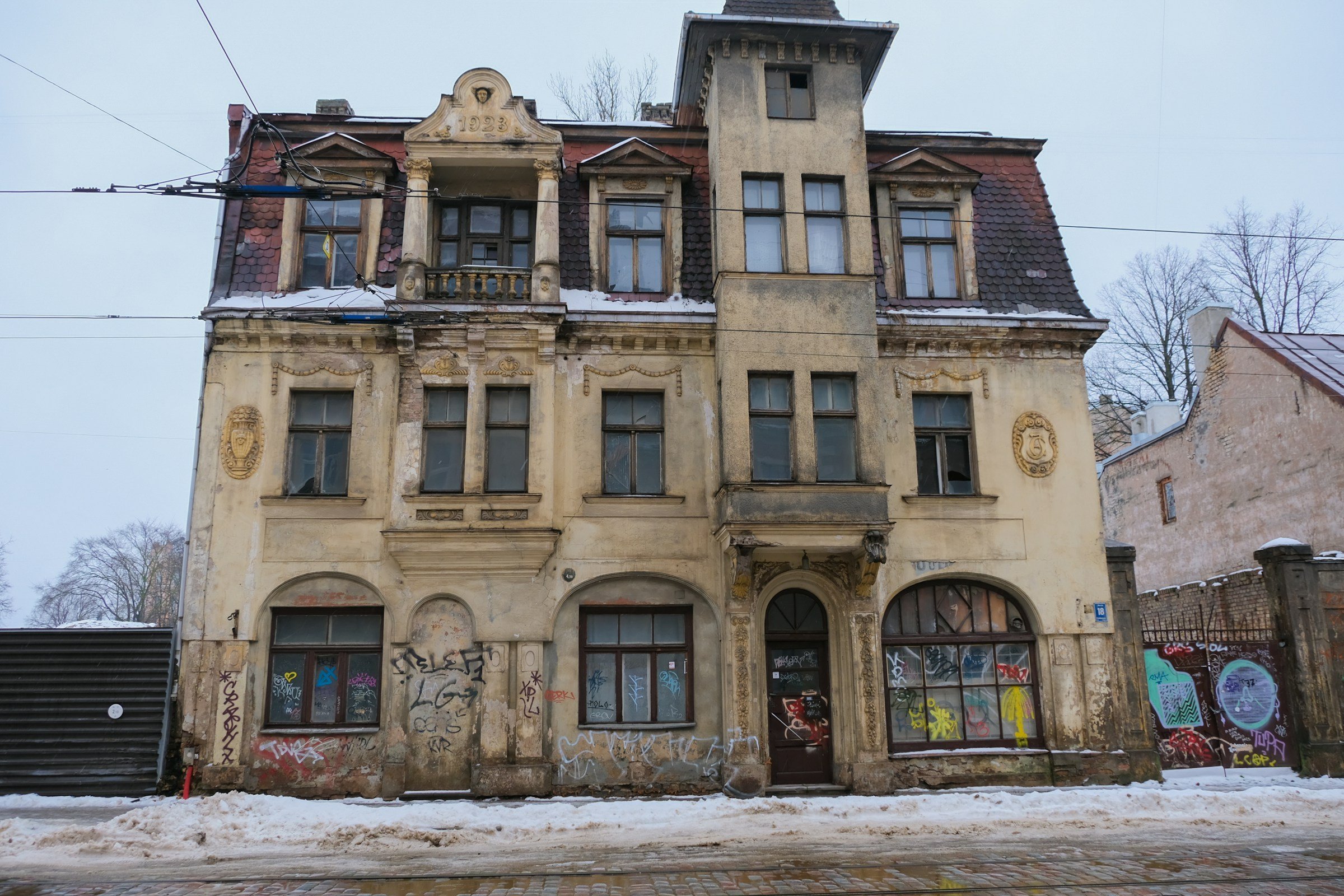
1. The Facades Keep Score
You step off Krišjāņa Barona iela into Alberta iela and the air changes. The buildings lean in, six stories of sculpted heads and geometric flowers and stone peacocks that weigh more than a car. This is the Art Nouveau district, built when Riga was the fifth-largest city in the Russian Empire and German-speaking merchants wanted everyone to know it. They hired Mikhail Eisenstein (father of the film director) to design tenements that announced wealth in cubic meters of carved limestone.

Riga
Walk one block south. The facades flatten into Soviet brutalism. Gray panels. Balconies that sag. Windows that never quite fit their frames. No transition, no warning. This is the overlay: Art Nouveau money met centralized housing policy and nobody bothered to pretend they belonged in the same photograph.
The unease is architectural. The German merchant class imported Jugendstil from Vienna and München while Latvian dock workers lived four families to a room. After independence in 1918 the city tried to reconcile it. After Soviet annexation in 1940 the reconciliation stopped. The fancy buildings became communal apartments. Eight families sharing one kitchen in a place designed for a timber magnate and his staff.
Alberta iela 13 has a screaming mask above the third-floor window. I watched a woman hang laundry on that balcony. The mask was screaming at her towels.
2. The River Cuts Through Every Excuse
The Daugava splits Old Town from Pārdaugava, which translates to “across the Daugava” because Latvians do not waste syllables. The left bank is where tourists photograph the cathedral. The right bank is where the Soviet-era housing blocks start and where cab drivers live and where you can eat pork shank with sauerkraut for six euros instead of sixteen.
Take tram 10 across Akmens tilts. The bridge is stone, rebuilt after Germans blew it up in 1944. On the Pārdaugava side you will see Kipsala, an island neighborhood of wooden houses painted yellow and blue. They were workers’ cottages. Now they rent to diplomats, but the paint colors remain and the streets are still unpaved in sections.
The riverfront promenade on the Old Town side is called 11. novembra krastmala, named for the 1919 independence date. It is lined with renovated warehouses that became office buildings when Latvia joined the EU. The promenade on the Pārdaugava side has a fish market and a shipping container someone turned into a bar. The Daugava does not care about your development plans.
I walked both sides in the same afternoon. On the left bank a man tried to sell me amber jewelry at three times the market rate. On the right bank a different man sold me smoked fish and told me to avoid the amber sellers. The river kept moving west toward the Baltic while both men worked angles older than the Soviet Union.
3. Central Market Runs on Hansa Logic

Riga
Five Zeppelin hangars from World War I now house the largest market in the Baltics. The Germans built the hangars in Vaiņode for airship patrols. After the war they were disassembled, moved to Rīga, and reassembled to shelter vegetable stalls and fish counters. This is the Hanseatic League brain at work: waste nothing, repurpose everything, charge rent.
The fish pavilion smells like the coast. Smoked sprats in wooden boxes. Live eels in plastic tubs. Baltic herring that women gut on metal tables while negotiating prices with restaurant buyers who arrive before dawn. The floor is wet year-round. Your shoes will smell like brine for two days.
The meat pavilion sells pork in every legal configuration. Hocks. Ears. Blood sausage so dark it looks like tar. Vendors wrap purchases in brown paper, not plastic. The German efficiency survives in the transaction speed: point, pay, leave. No small talk. The hangars are unheated and winter is long.
Outside the hangars the open-air section sells Soviet nostalgia and Chinese kitchen tools. Matryoshka dolls next to Teflon spatulas. A woman tried to sell me a USSR Navy uniform hat for forty euros. I asked if it was real. She said it was real enough. The Central Market operates on the principle that someone will buy anything if you put it under a roof that once sheltered a Zeppelin.
4. The Wooden Suburbs Got Saved by Accident
Kalnciema iela, west of Old Town, is a street of wooden houses painted green and blue and rust-orange. They are single-story, sometimes two-story, with carved window frames and tin roofs. They were built in the 1800s for workers at the lumber mills that made Riga a timber export hub second only to Arkhangelsk.
Soviet planners wanted to demolish them. Concrete panel blocks were more efficient. But independence came in 1991 before the bulldozers, and suddenly the wooden houses became heritage architecture. They got protected status. Some became shops. Some stayed residential. All of them survived because a political system collapsed at exactly the right moment.
The Kalnciema Quarter now hosts a weekend market where vendors sell organic honey and hand-knit socks and other things wooden houses were never designed to shelter. Tourists photograph the buildings and do not know they are looking at an accident. The woman selling goat cheese in the courtyard of Kalnciema iela 35 works in a house that should have been rubble by 1995.
I bought a loaf of rye bread from a baker who operates out of a blue house that was scheduled for demolition in 1989. He said the Soviet planners had already drawn the new building layouts. Then the occupation ended and the layouts stayed drawings. The bread cost two euros (about $2.10 USD). It weighed more than a brick.
5. Occupation Museum Keeps Receipts
The Museum of the Occupation of Latvia sits at Latviešu strēlnieku laukums in a Soviet-era building that looks like a bunker. Inside are the receipts: deportation orders, ration cards, KGB interrogation transcripts, a boxcar used to transport Latvians to Siberia in 1941. The museum does not editorialize. The documents speak.
There is a room of suitcases. These belonged to people who were told they could bring one bag to their new home in the east. Some packed winter coats for a journey that began in warm weather. Some packed photograph albums. The Soviets kept the suitcases when the trains arrived. The contents are labeled with names and deportation dates.
The German occupation floor is smaller but no less specific. Forced labor rosters. Execution site photographs. A map of the Riga Ghetto with street names that still exist. You can walk from the museum to Maskavas iela, which was the ghetto’s southern boundary, in under ten minutes.
The museum’s exit deposits you back onto a square surrounded by Art Nouveau buildings and cafés selling cinnamon rolls for three euros (about $3.15 USD). The whiplash is intentional. The architecture keeps score but does not explain the math. That is your job.
If you liked this, you might like: Dublin, Bratislava, Warsaw.
Planning the trip? Compare hotel deals before you book.