The Old Town square that didn’t exist eighty years ago
You stand in Rynek Starego Miasta and every cobblestone is a lie. The pastel facades, the merchant houses with their peaked roofs, the Mermaid fountain at the center: all of it was rubble in 1945. The Nazis spent three months systematically demolishing Warsaw after the uprising, block by block, and the Old Town vanished. What you’re looking at is a reconstruction so meticulous that UNESCO added it to the World Heritage list anyway. They used Canaletto’s paintings as blueprints. Eighteenth-century cityscapes became architectural plans. The irony is thick enough to choke on. This is the most authentic fake place you’ll ever visit, and that contradiction defines Warsaw more than any single monument could.

Warsaw
The cafes here charge 35 PLN ($9) for mediocre pierogi because tourists expect Old Town prices. Skip them. But walk through at dusk when the tour groups thin out and look at the brickwork. The Poles who rebuilt this spent decades matching mortar colors to paintings. That obsessive precision matters. It’s not nostalgia. It’s defiance.
Pałac Kultury i Nauki looming over everything
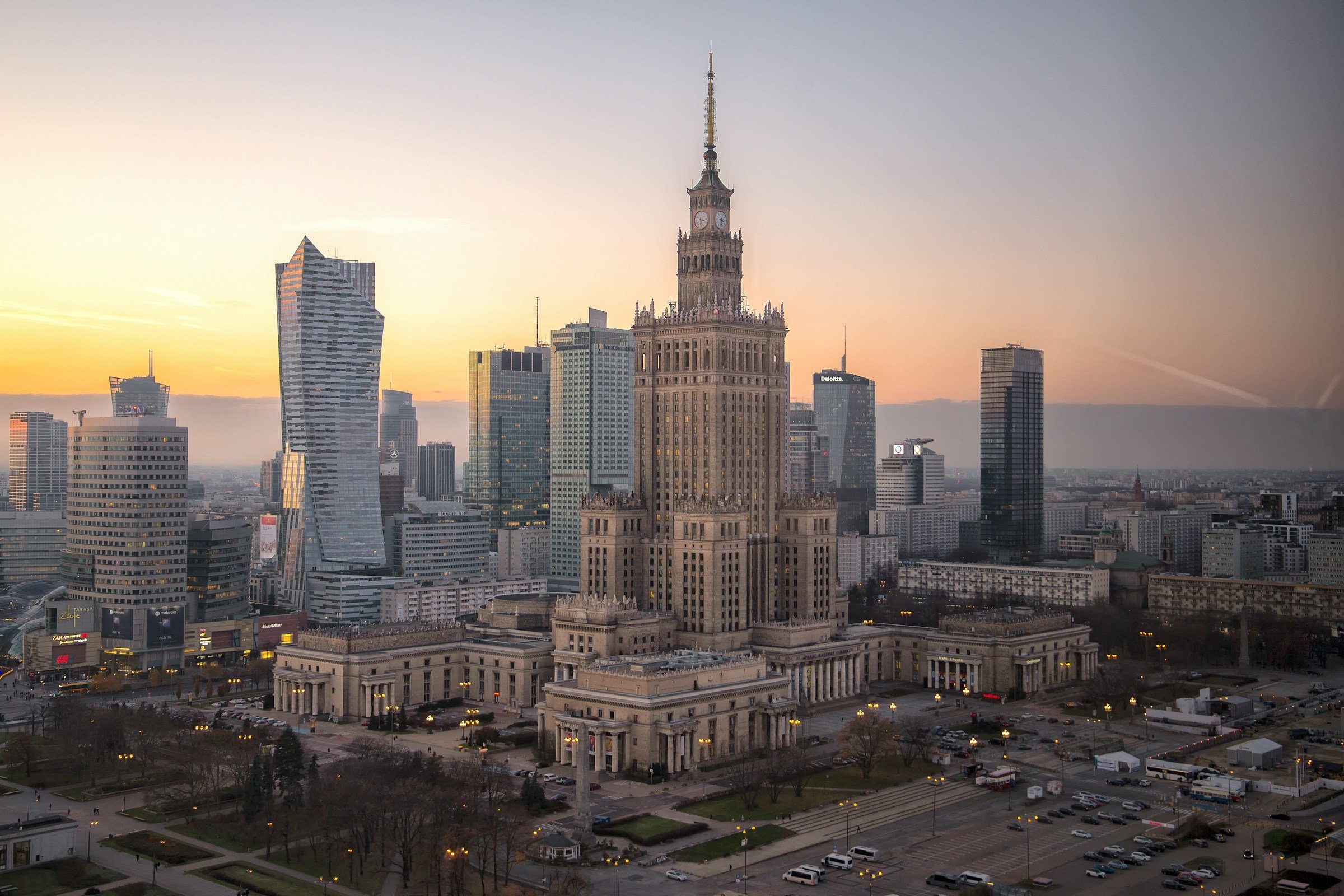
Stalin’s gift to Warsaw is a 237-meter middle finger in the center of the city. The Palace of Culture and Science dominates the skyline the way he intended: impossible to ignore, Soviet wedding-cake architecture with spires that look like they wandered off a Moscow postcard. Varsovians hated it immediately. There’s an old joke that the best view in Warsaw is from the top of the Palace because it’s the only place you can’t see the Palace. They still tell that joke.
The thing is 3,288 rooms. Soviet planners included theaters, a swimming pool, and congress halls, all of it designed to make the Poles feel small. Now it houses a cinema, museums, and office space. You can take the lift to the observation deck on the 30th floor for 25 PLN ($6.50). The view matters less than the building itself, this stubborn monument to occupation that Warsaw can’t demolish and won’t embrace. Glass skyscrapers have gone up around it in the last twenty years, corporate towers trying to dwarf Stalin’s palace. They don’t succeed. The Palace sits there like an unwanted relative at every family gathering, Soviet and immovable.
The human cost nobody mentions
Sixteen workers died building it between 1952 and 1955. The Soviets brought their own laborers and worked them in shifts around the clock. That detail isn’t on the plaques.
Praga on the east bank where reconstruction never arrived
Cross the Vistula on most bridges and you’re in Praga, the district the war mostly spared and urban renewal mostly forgot. The pre-war buildings still stand here, pockmarked and crumbling, the kind of genuine decay that Old Town eliminated with its reconstructions. Bullet holes in some facades. Art Nouveau details on apartment blocks nobody has repainted since 1939. This is what Warsaw actually looked like before the war, and it’s falling apart in real time.
The hipster reclamation started maybe a decade back. Soho Factory on Mińska Street turned old industrial workshops into studios and event spaces. Cafes opened in basements that still smell like coal. You can get excellent coffee at W Oparach Absurdu on Ząbkowska for 12 PLN ($3) and sit in a courtyard where the plaster is peeling off in sheets. The neighborhood walks a line between authentic grit and performative ruin. Some blocks feel like a set. Others feel like nobody’s coming to save them.
The Bazaar Różyckiego has operated since 1901. It survived the war, survived communism, survived gentrification so far. You can still buy used tools, bootleg electronics, and vegetables from vendors who’ve held the same stall for thirty years. The market sprawls across several blocks near the Wileński metro stop. It’s chaotic, occasionally sketchy, and more honest about Warsaw’s actual economy than anything in the center.
The ghetto boundary markers you’ll walk past without noticing

Warsaw
Small bronze plaques embedded in sidewalks throughout Wola and Muranów mark where the ghetto walls stood. Each one says “GETTO” and nothing else. No explanation, no context, just a line tracing the boundary of the largest Jewish ghetto in occupied Europe. Most tourists miss them entirely. You’re looking for grand monuments and these are four inches across, level with the pavement.
The Germans crammed 400,000 people into 1.3 square miles and built a wall. The uprising came in 1943. The Germans responded by razing every building inside the ghetto boundaries. After the war, the Poles built a housing estate called Muranów on top of the rubble, literal apartment blocks on the compressed debris of the ghetto. The street level is higher now than it was before the war. You’re walking on layers of destruction.
POLIN Museum on Anielewicza Street is the official memorial, opened in 2013, architecturally striking with exhibitions covering a thousand years of Polish Jewish history. Entry is 30 PLN ($7.80). It’s comprehensive and necessary and feels like an attempt to memorialize a world that Warsaw helped erase. The small plaques feel more honest. They don’t explain. They just mark absence.
The milk bars serving communist-era lunch for $3
Bar mleczny means milk bar, cafeteria-style diners the communist government subsidized to feed workers cheaply. Most cities let them die after 1989. Warsaw kept them, partly nostalgia and partly because seniors on fixed incomes still need cheap meals. You order at a counter where the menu is handwritten on a board: żurek (sour rye soup) for 8 PLN, pierogi ruskie for 12 PLN, kompot (fruit drink) for 3 PLN. Total lunch: under 25 PLN ($6.50).
Bar Prasowy on Marszałkowska has been open since 1954. The interior is fluorescent-lit function, plastic trays and Soviet-efficiency seating. You bus your own dishes. The food is heavy and unfussy, designed to fill you up for a full shift, not to impress. This is what daily life tasted like under communism, and it’s still here because the economics work. The irony is that Instagram discovered milk bars. Now you sit next to retirees and tourists photographing their trays of cabbage.
The apartment blocks where nobody renovates the exteriors
Communist-era housing projects ring the center in every direction. Gray concrete towers, often ten stories, balconies stacked with junk and satellite dishes. The Poles call them blokowisko. They’re ugly in that specific socialist-realism way: minimal ornament, maximum density, built to warehouse workers. The interiors get renovated. The exteriors stay gray.
These blocks aren’t picturesque ruin like Praga. They’re just housing stock nobody has money or motivation to prettify. You ride the metro out to Kabaty or Ursynów and it’s bloc after bloc of this stuff, punctuated by convenience stores and bus stops. This is where most Varsovians actually live, not in reconstructed burgher houses or glass towers. The disconnect is complete. The center performs history. The periphery houses the present. The city never reconciled them.
If you liked this, you might like: Belgrade, Paris, Copenhagen.
Planning the trip? Compare hotel deals before you book.