Cobblestones and glass towers two streets apart
You walk through Grand Place at midday when the gold leaf on the guild houses catches whatever weak sun breaks through the Belgian clouds, and the square feels like a movie set. Tourists stand in the center with phones raised. A waffle stand pumps out sugar smell. The Maison du Roi looks like it was built by someone who had never seen restraint. Then you turn down Rue de la Colline, pass a chocolatier with a window display that costs more than your flight, and three blocks later you’re staring at the Berlaymont building. Glass and steel. Security barriers. Revolving doors swallowing people in dark suits carrying leather folders.

Brussels is a city where the thirteenth century and the regulatory apparatus of 27 nations occupy the same few square kilometers. The EU quarter around Schuman metro station hums with policy meetings and visa applications. Restaurant menus near the European Commission list prices in euros with the confidence of people who write the rules. Walk fifteen minutes west and you’re in streets where the last renovation happened under Spanish rule. The gap isn’t historical distance. It’s two modes of power sitting next to each other, one ornamental and one fluorescent.
The Art Nouveau buildings are the bridge. Victor Horta designed houses on Rue Américaine in the 1890s when Brussels had money from Congo rubber and wanted to prove it had culture too. The Horta Museum at 25 Rue Américaine is worth the 10 euro entry. You see staircases that spiral like vines. Stained glass that turns gray afternoon light into something amber. Doorknobs shaped like leaves. It’s decorative without being twee, which is harder than it sounds. The Solvay Hotel nearby is closed to visitors unless you know someone, but you can stand outside and look at the facade. Curves everywhere. No right angles in sight. This is architecture that wants you to notice it, unlike the guild houses on Grand Place which were built to intimidate other merchants.
Walk from Horta’s house toward Place Flagey and you pass through Ixelles, where the Art Nouveau continues on smaller buildings that now hold dentist offices and graphic design studios. Flagey itself is a 1930s radio broadcast building shaped like an ocean liner, all curves and horizontal lines. It’s been converted into a concert hall, which means it’s useful instead of just pretty. Inside there’s a cafe where Belgians sit with newspapers and single espressos for an hour. No one rushes you.
The bureaucrats eat lunch somewhere
The EU quarter has a reputation for being soulless, which is mostly accurate but not entirely. Yes, there are days when Schuman metro spits out thousands of people who all dress the same and walk fast. Yes, the buildings look like international airport terminals. But the side streets have restaurants where fondue costs 18 euros and comes with bread that’s actually good. Pistolet Original on Rue Archimède serves stoemp, which is mashed potatoes with vegetables and sausage. It’s what Belgians eat when they’re not performing for tourists. The staff speak four languages and don’t care which one you pick.
Parc du Cinquantenaire sits at the edge of the EU zone, a massive arch and two museums surrounded by grass where people actually use the space. Not like the Parc de Bruxelles near the Royal Palace, which is too formal for sitting. Cinquantenaire gets joggers, students with textbooks, older men playing pétanque near the south gate. The arch was built in 1905 to celebrate 75 years of Belgian independence. It’s grandiose in a way that feels desperate, like someone trying to prove they belong at a table where no one invited them. From the top you see the European Parliament in one direction and the Atomium in the other. Past and future, if you’re feeling symbolic.
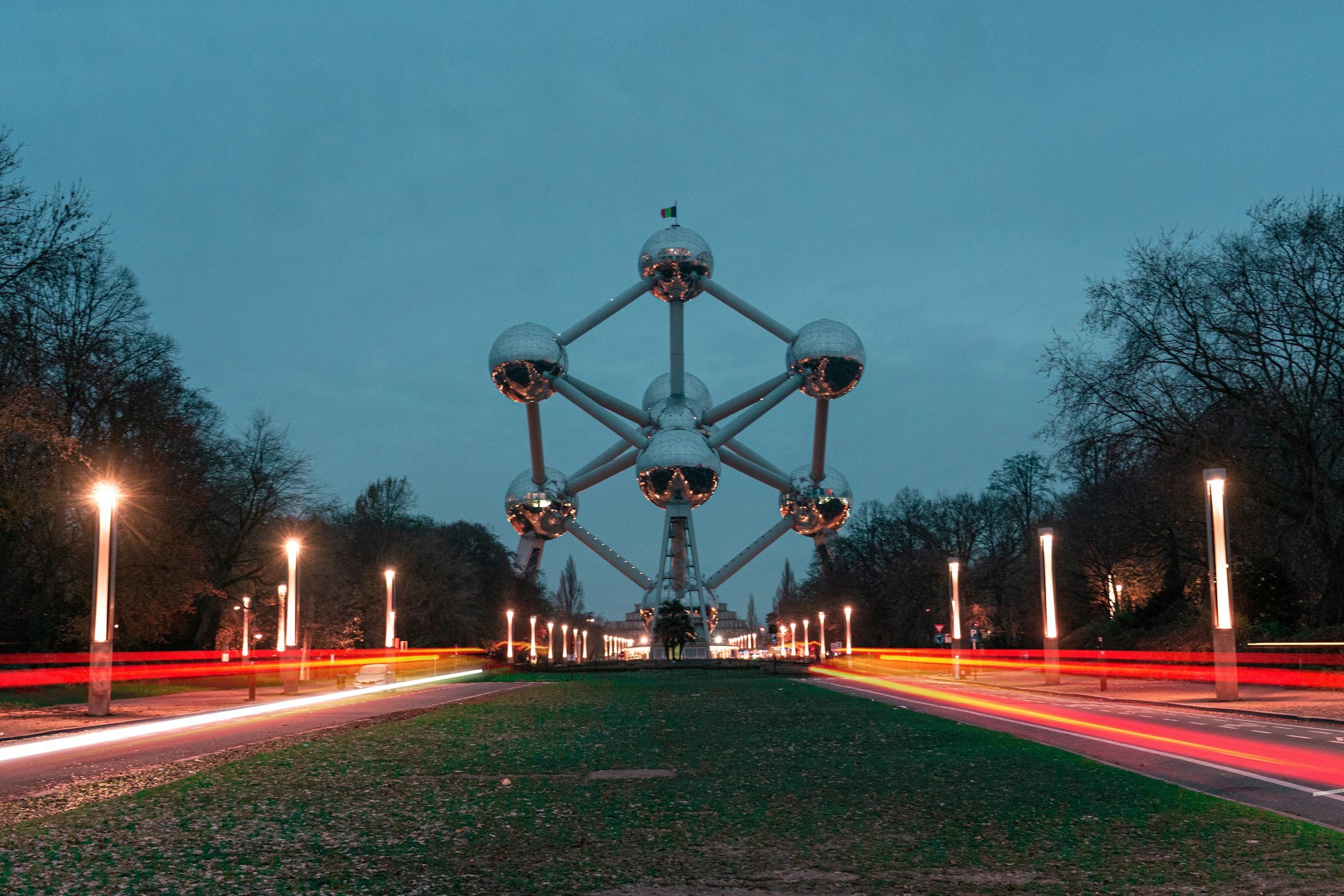
The Atomium is ridiculous. A model of an iron crystal magnified 165 billion times, built for the 1958 World’s Fair. Nine spheres connected by tubes. It looks like a science textbook illustration that escaped into three dimensions. You pay 16 euros to take an elevator up the central column, which is steep enough that your stomach notices. The view from the top sphere is fine. You see Brussels spread out, the mix of medieval spires and 1970s concrete blocks and those glass EU towers. The real reason to go is to stand underneath and admit that someone built this thing and it’s still standing.
What the neighborhoods actually do

Brussels
Marolles flea market runs every morning at Place du Jeu de Balle. Not tourist antiques but actual junk. Broken radios, old postcards, someone’s grandmother’s silverware. The square is surrounded by cafes where dealers drink coffee and negotiate. The neighborhood used to be working class and poor. Now it’s working class and poor with vintage clothing stores. Rent is pushing people out but hasn’t finished the job yet. You can still get a plate of mussels and frites for 14 euros at Chez Léon, though the original location near Grand Place is now a tourist trap. Go to the one on Rue des Bouchers if you must, but locals prefer the spots in Marolles where the menu isn’t translated.
Saint-Géry is where people go after work. The covered market building in the center has been converted into a bar and event space. The surrounding streets have restaurants that change every six months. You see groups speaking French, Dutch, English, all at the same table. This is where the EU staffers come when they want to pretend they’re not EU staffers. The bars stay open late but not late enough for anyone used to Mediterranean hours. By 1am most places are closing.
The comic book murals are spread across the city, fifty or sixty walls painted with Tintin and Lucky Luke and characters nobody outside Belgium recognizes. They’re supposed to celebrate Brussels as the capital of comics, which it is in the sense that several publishers are based here. The murals are fine. Some are genuinely good, like the Tintin on Rue de l’Étuve that shows him climbing a building. Most are just pictures on walls. You can follow a map and see them all, or you can stumble across three and call it done.
Where the two cities meet and don’t
The Royal Quarter runs from the Palace down through Mont des Arts to the old city center. This is where the Belgian government sits, separate from but adjacent to the EU machinery. The Palace is only open in summer and even then it’s mostly empty rooms with portraits. More interesting is the Galeries Royales Saint-Hubert, a shopping arcade from 1847 with a glass roof and stores that sell lace and chocolate at prices that assume you’re not paying attention. It’s beautiful in the way that commercial architecture used to try to be, before everyone gave up and built boxes.
You can walk from the medieval core to the EU district in twenty minutes. The route takes you past the Cathedral of St. Michael, which is Gothic and impressive and slightly shabby in the way that European cathedrals are when they’re not major pilgrimage sites. Then through streets of African restaurants around Gare du Midi, where the Brussels you see in tourism brochures stops entirely. Then into the glass and concrete of the European Quarter where the sidewalks are wider and cleaner and emptier after 6pm.
Brussels works because it doesn’t pretend to be one thing. The medieval square is for show. The Art Nouveau is for people who care about design. The EU quarter is for getting work done. They exist in the same city without trying to blend. You can spend a day moving between them and never feel like you’ve seen the whole picture, because there isn’t one. Just a collection of parts that happen to share a postal code.
If you liked this, you might like: Amsterdam, Istanbul, Tallinn.
Planning the trip? Compare hotel deals before you book.