1. The mosque that stays quiet
The Banya Bashi Mosque sits across from the Central Mineral Baths, steam rising from both buildings in winter. Built in 1566 when Sofia was Sredets under Ottoman rule, it still functions. Five times daily the call to prayer goes out, but you hear it only if you’re standing close. The city wrapped around it, built over it, tried to forget it. The mosque didn’t leave.

Sofia
Inside, the prayer hall is plain. No tourists taking photos of tilework. The men who come here are Bulgarian Turks, Roma Muslims, a handful of Arab students. Outside, the mineral springs that gave the mosque its name still run hot. People fill plastic bottles from public taps, the water sulfurous and supposedly therapeutic. The Romans knew about these springs. The Ottomans built a bathhouse. The Soviets turned it into a museum. Now it’s luxury apartments and a museum. The springs keep running.
Walk south down Ekzarh Yosif Street and you pass the synagogue, the largest Sephardic synagogue in the Balkans. It saved nearly all of Bulgaria’s Jews during the war, one of the few success stories in that landscape. The building holds maybe two hundred people now. Most left for Israel in the late 1940s. The architecture is Moorish revival, another empire’s aesthetic applied by a third empire’s subjects.
2. Largo and the complicated monument
The largo is what locals call the ensemble of Stalinist buildings forming Sofia’s administrative heart. Yellow neoclassical headquarters for old ministries, wide boulevards, a central square redesigned in the 1950s to erase the medieval city underneath. They found Roman ruins during construction. The solution was to build around them and add glass floors so you can peer down at old Serdica while walking to the metro.
The Monument to the Soviet Army stands in a park fifteen minutes east. A soldier and two workers raise a flag, surrounded by reliefs of Soviet troops liberating Bulgaria in 1944. Except liberation is the contested term. The country spent forty-five years as a Soviet satellite. Some people remember that as stability, jobs, housing. Others remember surveillance and purges. The monument gets vandalized regularly. Someone painted the soldiers as American superheroes once. The city cleaned it. Someone else did it again.
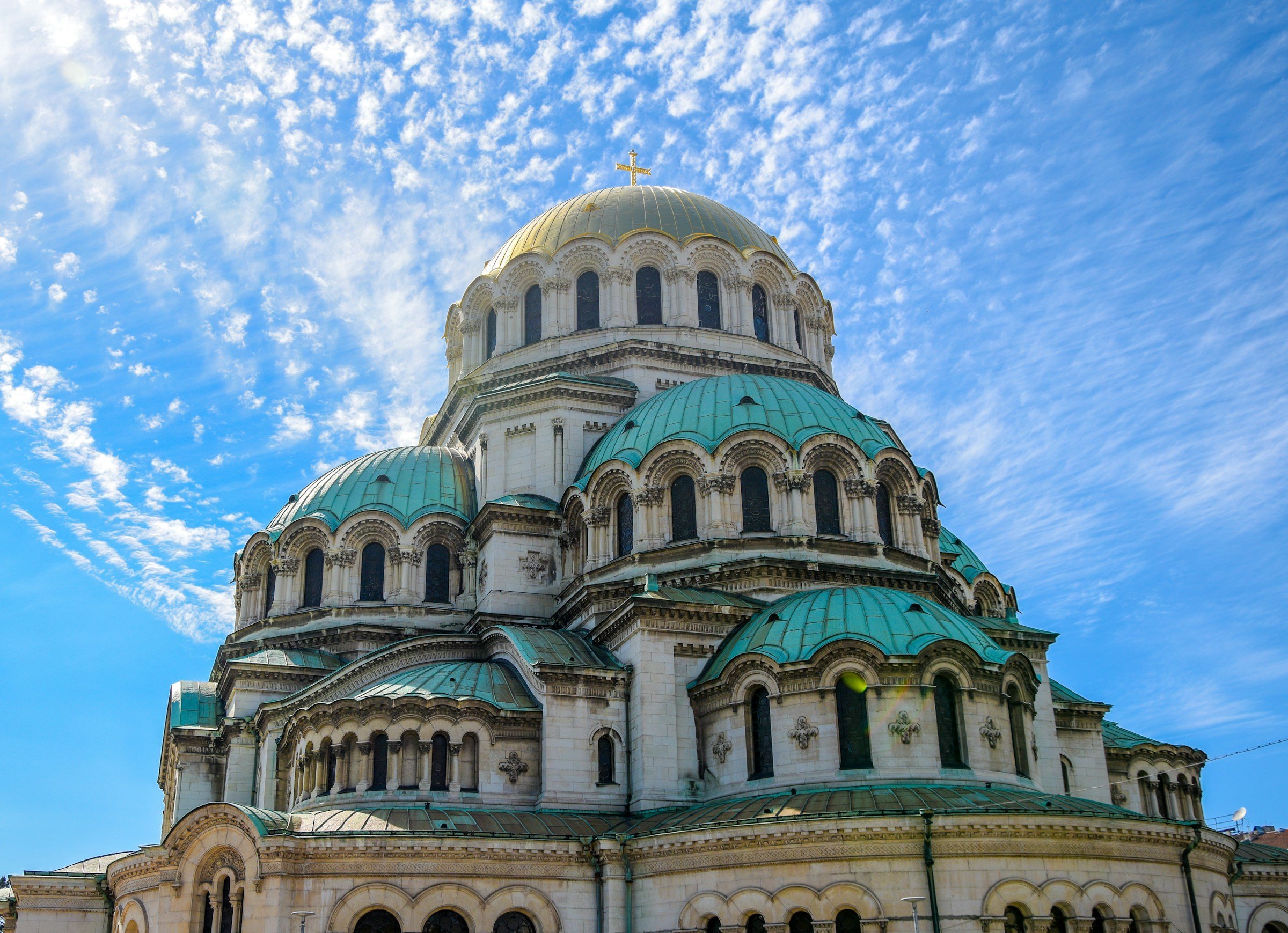
You won’t find a plaque explaining the monument’s history beyond the dates. That’s the pattern here. Architectural layers pile up without interpretation. The Alexander Nevsky Cathedral, built to honor Russian soldiers who died freeing Bulgaria from the Ottomans in 1878, sits two blocks from the largo. Gold domes, Byzantine revival, space for five thousand worshippers. It opened in 1912, a monument to one liberation before the next occupation arrived.
3. Theater and the language underneath

Sofia
The Ivan Vazov National Theatre faces the City Garden, a neoclassical building from 1907 with a peaked roof and columns. Performances are in Bulgarian, a language that uses Cyrillic script thanks to ninth-century missionaries from Byzantium. The alphabet is named for Saint Cyril, though his student Clement probably did more of the work. That alphabet became a tool of empires later. The Soviets imposed it on Central Asian languages. Modern Bulgaria uses it for national identity.
Signs in Sofia layer scripts. Tourist areas add Latin transliterations. The metro uses both. Street signs sometimes differ in spelling between the two. Bul. Tsar Osvoboditel or Blvd. Tsar Osvoboditel. The theater’s schedule is online in English but the commentary around performances stays Bulgarian. You can buy a ticket without speaking the language. Understanding why everyone stood and clapped at a particular line requires more work.
Behind the theater, Rakovski Street runs south toward the National Palace of Culture, a concrete Communist-era convention center from 1981. It hosted the state-sponsored celebrations and concerts. Now it’s where international DJs play. The building is brutal, functional, aging poorly. No one discusses tearing it down.
4. The market where empires shop
The Women’s Market spreads over several blocks near the Banya Bashi Mosque. Vegetable stalls, smuggled cigarettes, knockoff jeans, Ukrainian vendors selling honey next to Turkish spice merchants. The name comes from the 1950s when it was the official women’s cooperative market, but the trading has older roots. Ottoman-era bazaars ran here. Soviet distribution couldn’t kill informal trade. Now it’s half legal, half gray market, fully essential for anyone avoiding supermarket prices.
You find Bulgarian white cheese here, kashkaval aged in sheep’s milk, ajvar relish that’s better than the jarred grocery version. Also Chinese-made goods, Romanian wine, Turkish coffee sets. The vendors speak Bulgarian plus pieces of Turkish, Russian, English, Romani. Prices aren’t marked. You negotiate or pay double. A kilo of peppers costs 2-3 leva (1-1.50 USD) if you don’t look lost.
Two blocks west is the Central Market Hall, a restored 1911 building with a glass roof. It tried to go upscale. Some gourmet stalls survive, tourists buy craft beer, but half the stalls are empty. People still shop at the Women’s Market because it’s cheaper and you can argue over garlic. The hall represents an empire’s attempt at modern European commerce. The outdoor market represents what actually works.
5. Borisova Gradina and the statue problem
Borisova Gradina is the city’s largest park, a long stretch of trees and paths south of the center. The Communist regime put up monuments to Soviet-Bulgarian friendship. After 1989, some came down. Others stayed. The Monument to the Soviet Army is one. Smaller busts of Lenin and Dimitrov ended up in a sculpture park outside the city, where you can visit deposed leaders among the weeds.
The park also holds the Vasil Levski Stadium, named for a nineteenth-century revolutionary hanged by the Ottomans. He wanted a democratic republic, which neither the post-Ottoman monarchy nor the Communist government delivered. His monument is everywhere, dozens of statues. Safe nationalism. Everyone agrees he’s a hero because he died before he could govern.
Near the park’s north entrance stands the Monument to the Unknown Soldier, a modernist concrete structure with an eternal flame. It commemorates soldiers from both world wars, which means soldiers who fought for opposing sides. Bulgaria joined the Central Powers in 1915, the Axis in 1941. The monument doesn’t specify. The flame just burns.
Sofia keeps all its layers visible because removal costs money and raises arguments. Easier to let the mosque, the cathedral, the Soviet apartment blocks, and the Ottoman street plan coexist. You learn to read the city as palimpsest. Each empire left architecture. None left answers about what comes after empires end.
If you liked this, you might like: Vienna, Stockholm, Amsterdam.
Planning the trip? Compare hotel deals before you book.