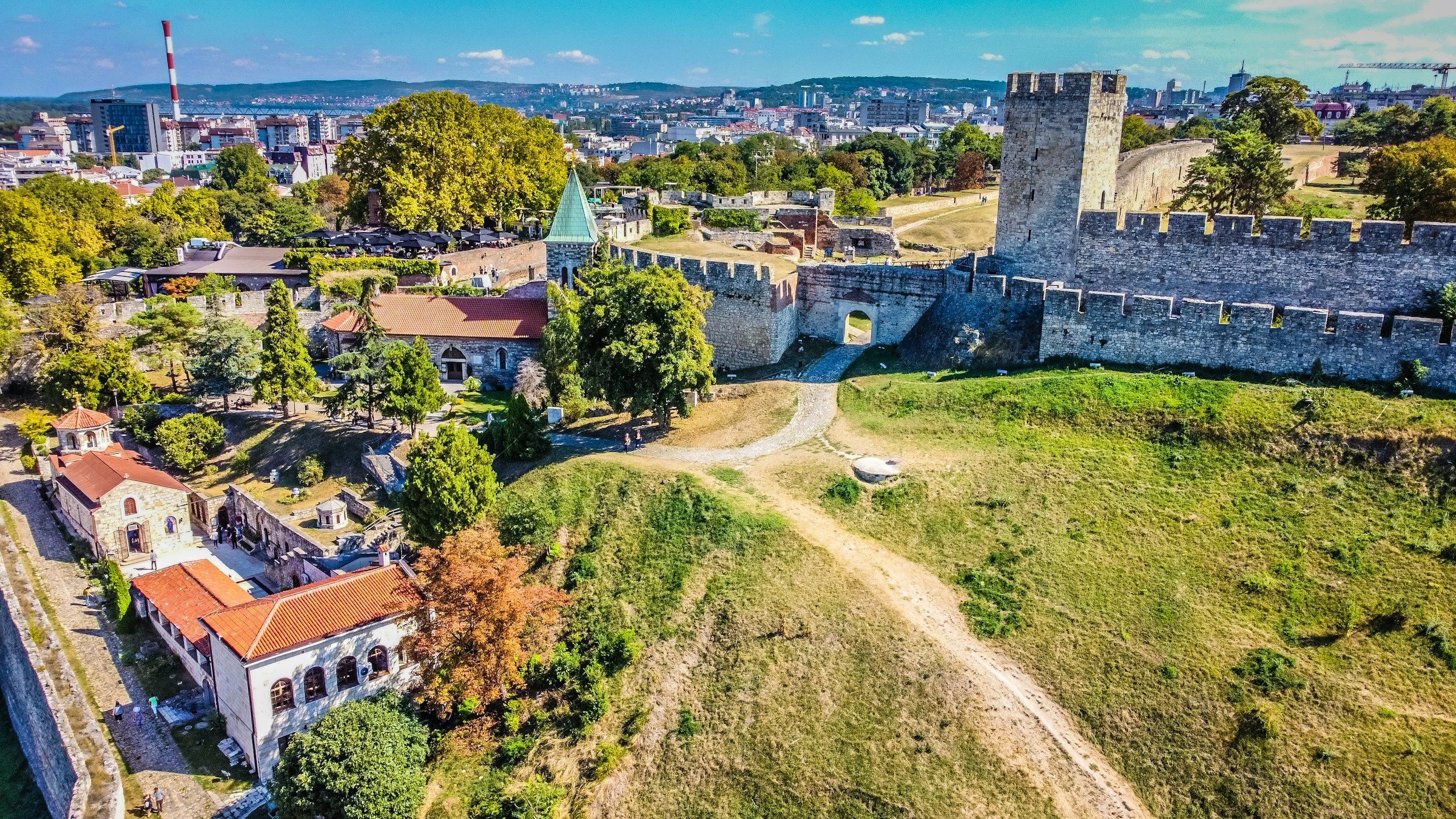
The fortress tells you everything before you say a word
Kalemegdan sits at the confluence of the Sava and Danube, which means every army that wanted to control the Balkans wanted this hill. Romans built here. Ottomans fortified it. Austrians blew parts up. Nazi occupiers executed prisoners against the walls. NATO bombs cratered the park in the late 1990s. You walk through layered stone and realize Belgrade has been destroyed and rebuilt forty times, and the current version is just the latest draft.

Belgrade
The fortress grounds sprawl. Couples sit on benches facing the river junction. Old men play chess under trees that grew after the last war. A Serbian Orthodox church sits inside the walls, rebuilt in the 1860s on the foundation of an earlier church the Ottomans demolished. Below the upper terraces, the lower town holds a military museum with tanks parked outside and Ottoman cannonballs stacked like fruit. Entry is 300 dinars (about $3). The museum closes on Mondays.
What nobody mentions: the park fills with teenagers after school, and they treat the ramparts like a skate spot. You hear wheels on stone more than you hear historical commentary.
Savamala used to be a railyard, now it is where the city argues with itself
The Sava riverfront was industrial wasteland for decades. Warehouses, freight tracks, buildings bombed in 1999 and left as hollowed concrete. Then developers started buying parcels. Then nightlife moved in. Then the city government demolished part of Savamala in a night raid to make room for a Dubai-backed megaproject called Belgrade Waterfront. Bulldozers came at 2am with masked men. Local businesses woke to rubble.
Now Savamala is split. One half is glass towers and a shopping mall that could be in Doha. The other half is graffiti-covered clubs, art collectives in gutted buildings, and Serbian grandmothers selling vegetables in a street market that has operated since before the war. You walk from a Zara to a ćevapi grill in three minutes. The contrast is not subtle.
KC Grad is a cultural center in a converted shipyard warehouse. It hosts concerts, exhibits, and film screenings. Bezistan is an open-air food and craft market under a Socialist-era pavilion. On weekends it fills with vendors selling ajvar, rakija, and smoked meats. The seafood is Danube-caught, sometimes that morning.
The riverfront promenade runs for two kilometers. It is clean and wide and feels like it was designed by a committee that had never been to Belgrade. The old Savamala streets behind it feel like the city that actually exists.
Skadarlija pretends to be Montmartre but the food is better
Skadarlija is a cobblestone street in Dorćol where restaurants put tables outside and musicians play accordion between courses. It wants to be bohemian. In the early 1900s writers and painters drank here. Now it is tourists and Serbian families celebrating anniversaries. The kitsch is intentional.
That said, the grilled meat is legitimate. Tri Šešira has been open since 1864. Dva Jelena since 1832. You sit at wooden tables under grapevines and order a kilogram of mixed grill: ćevapi, pljeskavica, chicken, pork. It comes with raw onion, kajmak (fermented cheese spread), and lepinja bread. A meal for two runs 3,500 dinars ($32) with beer. The portions assume you have been working a construction job.
The street musicians take requests. They expect tips. If you tip well they play longer. If you do not tip they move to the next table. This is a transaction, not a performance.
Zemun is technically Belgrade but it does not act like it

Belgrade
Cross the Sava and you hit Zemun, a former Austro-Hungarian border town that Belgrade absorbed in 1934. It kept its own architecture and its own attitude. The riverfront promenade, called Kej Oslobodjenja, lines up floating restaurants called splavovi. They serve Danube fish: catfish, carp, pike-perch. Šaran na žaru (grilled carp) is the standard order. Prices are lower than in central Belgrade. Expect 1,800 dinars ($16) for a fish plate with sides.
Gardoš Hill rises behind the promenade. Climb to Millennium Tower, an Austro-Hungarian lookout from 1896. The view spans the Danube, the confluence, and the entire city. The hill itself is residential. Houses painted yellow and rust. Narrow streets that dead-end at staircases. Cats everywhere.
Zemun Market operates in a covered hall near the waterfront. Vendors sell produce, dairy, cured meats, and homemade ajvar. It is where locals shop, which means prices reflect what people actually pay for food. A kilo of peppers runs 150 dinars ($1.40). The market opens early. By noon the best produce is gone.
The city’s scars are not hidden, they are used
NATO bombed Belgrade for 78 days in 1999. Some buildings were rebuilt. Others were left. The former Federal Ministry of Defence sits in ruins on Kneza Miloša Street, blackened concrete and empty window frames. No fence, no signage. People walk past it to the bus stop.
The Radio Television of Serbia building on Aberdareva Street is another crater. It was hit by missiles, killing sixteen employees. The rubble was cleared but the structure remains half-destroyed. Graffiti covers the lower floors. The neighborhood around it is dense and residential. Kids play soccer in the street next to it.
Belgrade does not commemorate these sites with plaques or museums. They exist as part of the landscape. You see them between a bakery and a pharmacy. The city rebuilt around them and kept going.
Kafanas are where you learn what Belgrade actually drinks
Kafanas are not cafes. They are something older. Wood panels, cigarette smoke (smoking is still allowed indoors), Yugo-era furniture. You order rakija (fruit brandy), usually šljivovica (plum). It comes in a small glass. You do not sip it.
Znak Pitanja, near the cathedral, has been open since 1823. The name means “Question Mark” because it could not use a proper name during Ottoman rule. The menu is ćevapi, beans, and grilled peppers. A plate with beer costs 800 dinars ($7). The clientele is local. Conversations are in Serbian. No English menu.
Dva Bela Goluba in Dorćol is smaller and even older. It smells like wood smoke and paprika. The walls are covered in black-and-white photos of Serbian writers and actors who drank there. The rakija is homemade. You drink it, order another, and realize three hours have passed.
Kafanas close when the owner decides to close. Sometimes that is midnight. Sometimes that is 4am. There is no schedule.
If you liked this, you might like: Prague, Lisbon, Athens.
Planning the trip? Compare hotel deals before you book.