You step out of Hamad International Airport into air so thick with heat it feels engineered, like the city turned the atmosphere up too high and forgot to dial it back. The roads stretching toward downtown are six lanes wide in each direction, empty enough at midday that you wonder if they built them for a population that hasn’t arrived yet. Everything gleams. The pavement looks poured last week. The lampposts have that showroom sheen. A half-built tower crane sits motionless against a sky bleached white by sun, and you realize the crane itself might be permanent, a feature rather than a phase.

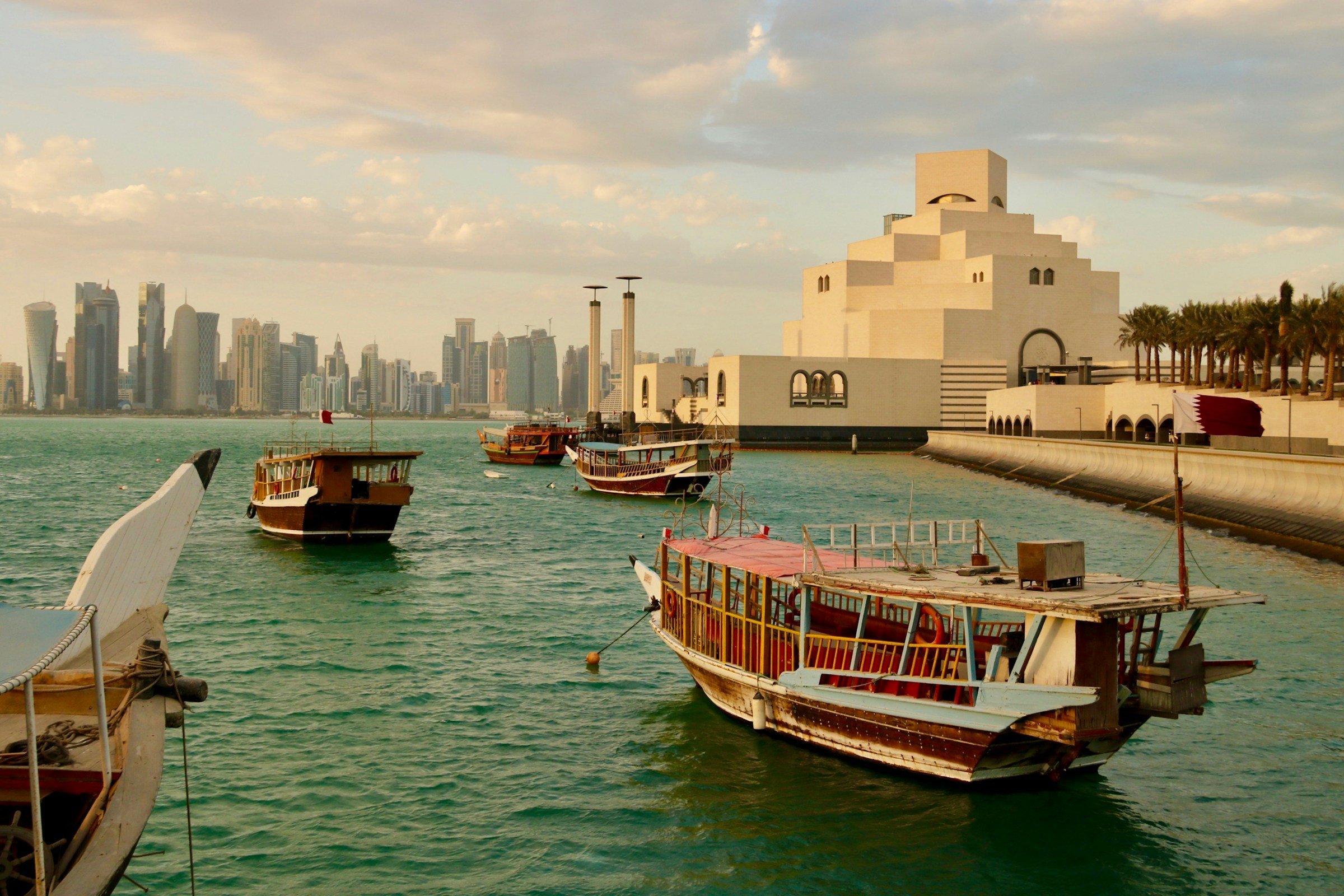
Doha runs on a logic where finishing things matters less than starting the next thing. The Corniche promenade curves along the bay with palms planted in mathematically perfect intervals, their root balls still wrapped in burlap you can see if you look close. Joggers pass museum buildings so new the concrete hasn’t fully cured. The Museum of Islamic Art sits on its own island, all geometric planes and limestone that photographs like a render. Inside, the galleries are cold enough to make you shiver after ten minutes outdoors. The collection is world-class. The building is stunning. But the gift shop feels like it opened yesterday and the cafe hasn’t figured out how to make decent coffee yet, which tells you something about priorities.
When the Construction Never Stops Being Construction
The metro opened a few years back, three lines of driverless trains connecting the airport to stadiums to malls. The stations descend five stories underground, all vaulted ceilings and marble floors, designed like monuments. You swipe a rechargeable card (10 QAR standard fare, about $2.75 USD) and ride in silence because nobody talks on the metro. The trains themselves are spotless. No graffiti. No gum on the seats. But also no wear, no patina, nothing to suggest anyone has lived with this system long enough to make it theirs. It feels like riding through an architect’s portfolio.
Souq Waqif, the old market near the Corniche, got rebuilt in 2006 to look older than it ever actually was. They used traditional materials and traditional methods to construct a version of history that might have existed if history had been more photogenic. You walk under wooden beams and past spice vendors selling saffron in small glass vials (200 QAR for five grams, about $55 USD, and yes, they’ll try to sell you Iranian saffron at Afghan prices). Restaurants line the alleys serving machboos, the local spiced rice dish with chicken or fish, heavy on the cardamom and loomi. It tastes good. It tastes correct. But you’re eating it under timber that was installed after you were born, which makes the whole experience feel like dinner theater without the show.
The falcons help. Souq Waqif has a falcon hospital where men in white thobes bring their hunting birds for beak trims and talon maintenance. The birds sit hooded on wooden perches, patient and lethal, worth more than most cars. Falconry isn’t a tourist attraction here. It’s older than oil, older than the city in its current form, and it doesn’t care whether you find it charming. That indifference is the most authentic thing in the market.
The Money Shows in Weird Places

Doha
Katara Cultural Village sits on reclaimed land north of the Corniche, a government-funded arts district with an amphitheater, galleries, and restaurants that struggle to fill tables outside of events. The beach is clean. The pigeon towers are unnecessary but beautiful. Everything costs double what it should. But on weekend evenings families show up, kids running near the fountains while parents sit on benches eating kunafa from a bakery that does get the proportions right (sweet cheese, shredded phyllo, orange blossom syrup, 25 QAR per serving, about $7 USD). For twenty minutes it almost feels inhabited.
Then you notice the buildings at the edges that haven’t opened yet, the storefronts with paper still taped over the windows, the construction fence around the plot that was supposed to be a new gallery. Katara has been “nearly finished” for a decade. It might stay that way.
The Pearl-Qatar, an artificial island shaped like a string of pearls, takes the same approach and pushes it further. Luxury apartments tower over marina berths where yachts sit unused. The ground-floor retail is Cartier, Valentino, stores that exist to prove they can exist here. Restaurants serve Italian food to expats who live in the towers and rarely leave them. You can walk the boardwalk for an hour and see more cars than people. Everything is for sale. Not much is for living.
Taxis won’t use meters unless you insist, and even then they’ll try to negotiate a flat rate (airport to Souq Waqif should run 30-40 QAR, about $8-11 USD, but they’ll quote 60). Uber and Careem work better. The bus system exists but requires research most visitors won’t bother with. Walking is punishing in summer, when temperatures hit 45°C and humidity turns the air into a wet blanket. You move from air-conditioned interior to air-conditioned car to air-conditioned interior, which is exactly how the city expects you to move.
What the Cranes Leave Behind
West Bay, the cluster of skyscrapers that defines Doha’s skyline, looks best from a distance. Up close you see the gaps between towers, the empty lots waiting for the next development, the streets that dead-end into construction barriers. The Torch Tower spirals 300 meters up, its facade lit in rotating colors after dark. It’s striking. It’s also alone, surrounded by buildings that haven’t matched its ambition yet. The skyline photographs like a completed vision but walks like a work in progress.
Some of this is intentional. Doha positions itself as a city in becoming, a place where the future is always six months out. But after a few days you start to wonder if the incompleteness is the point, if finishing would mean admitting the work is done and moving on to maintenance. Maintenance doesn’t get headlines. Maintenance doesn’t win bids for global events.
The food surprises you, though. Not the hotel restaurants or the mall food courts, but the small places in older neighborhoods like Al Sadd and Bin Mahmoud. Indian cafeterias serving dosa and biryani for 15 QAR (about $4 USD). Filipino joints with adobo and lumpia. Pakistani grills where mutton karahi comes out in a cast-iron pan still bubbling. The workers who built the city eat here, and the food is better than anything at Katara.
You leave Doha understanding it was never built for you to understand. It was built to impress, to host, to prove a point about what oil money can summon from desert and sea. Whether anyone lives here in a way that feels like living is a separate question, one the skyline doesn’t bother answering. The cranes keep turning. The towers keep rising. Somewhere behind the construction fences, the next version of Doha is already being poured.
If you liked this, you might like: Amman, Dubai.
Planning the trip? Compare hotel deals before you book.