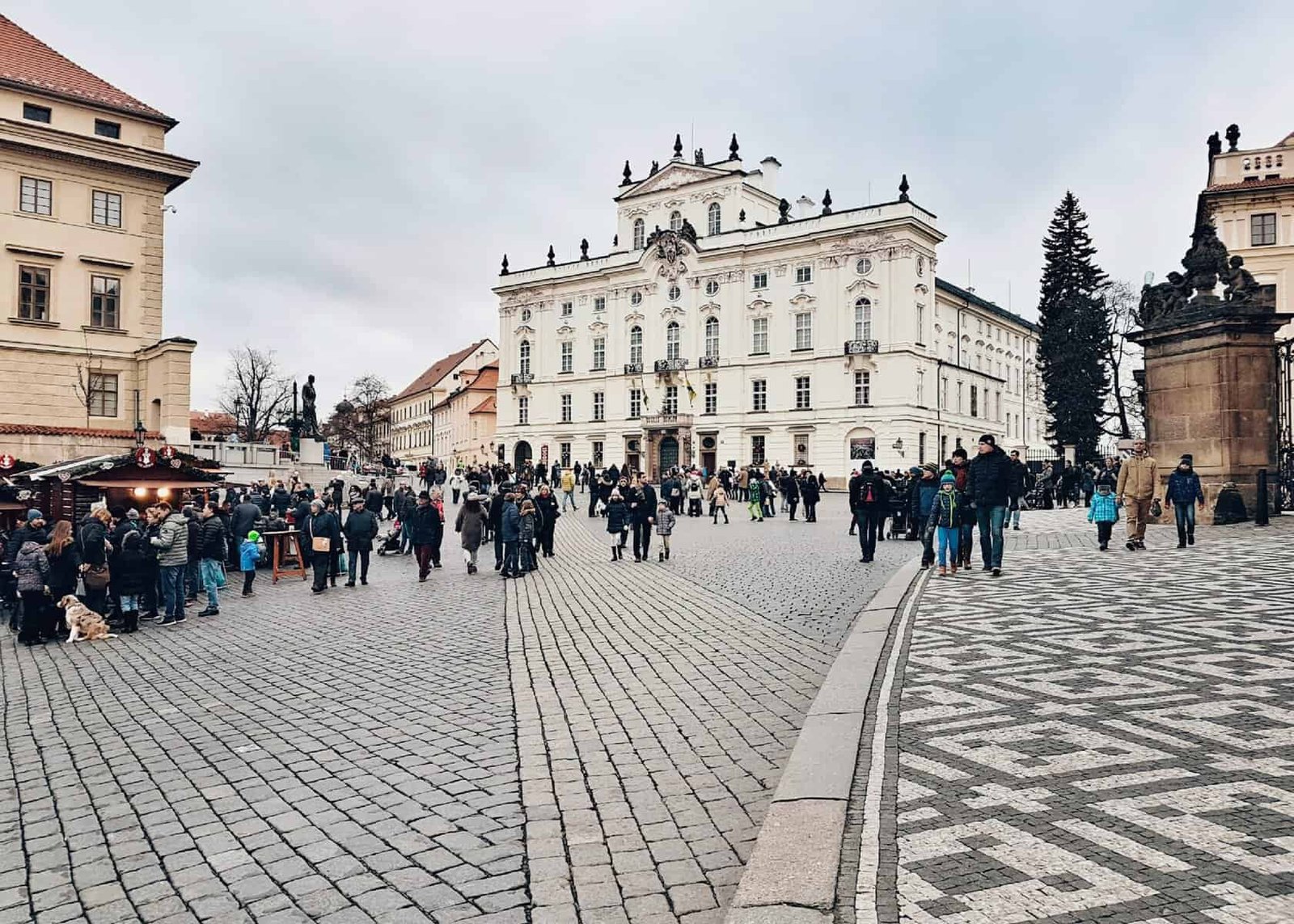
1. The Astronomical Clock at Quarter Past
You stand in Old Town Square watching tourists aim phones at the Astronomical Clock. Every hour a mechanical skeleton rings a bell and wooden apostles parade past two windows. The crowd applauds a fifteen-second show that has run since 1490, and you notice nobody mentions that the Nazis shot 27 Czech resistance leaders against the eastern wall of this same square in 1942. There is a small memorial, bronze crosses embedded in the pavement, but the tour groups step over them to photograph the clock.

The guidebooks call Prague a fairytale city. They mean the Gothic spires and the red rooftops and the castle on the hill. What they do not say is that fairytales usually involve someone being eaten. The architecture survived because occupiers kept it intact. The Habsburgs ruled for 400 years and built in Baroque. The Nazis declared Prague too beautiful to bomb. The Soviets filled Wenceslas Square with tanks in 1968 and the buildings remained photogenic throughout. You are admiring the survival of stones while walking through a place that spent most of the 20th century learning to keep its mouth shut.
The old Jewish Quarter is six blocks north. It is called Josefov and it is full of synagogues that are now museums. You pay 500 CZK ($22 USD) for a combined ticket. The Spanish Synagogue has Moorish arches and painted ceilings and walls covered in 77,297 names of Bohemian and Moravian Jews murdered in the Holocaust. The tour guide, a university student in a bright yellow vest, does not pause at the names. She talks about architectural features and moves the group toward the exit. In the gift shop you can buy a magnet with the Astronomical Clock on it.
2. Crossing the Bridge Before Breakfast
Charles Bridge at dawn is the only time the 14th-century stones are not covered in caricature artists and men selling Soviet military hats. You walk past 30 statues of saints, most of them added during the Counter-Reformation when the Habsburgs wanted Bohemia to remember it was Catholic again. The statue of St. John of Nepomuk has a bronze plaque worn smooth by a million hands. Touching it is supposed to bring good luck and guarantee your return to Prague.
The Vltava River below is brown. Swans gather near the banks where tour boats dump bread. On the far side of the bridge, steep steps climb to the castle district. Halfway up you pass a street musician playing “Scarborough Fair” on a wooden flute. He has a sign in English, German, and Mandarin asking for tips. The melody echoes off stone walls built when this was a fortress, not a postcard.
Prague Castle is the largest ancient castle complex in the world according to Guinness World Records, a fact printed on every brochure. Inside St. Vitus Cathedral, you pay 250 CZK ($11 USD) to see the tomb of Good King Wenceslas, who was actually a duke and was murdered by his brother in 935. The stained glass windows were installed in the 1930s during the brief 20-year window when Czechoslovakia existed as an independent country between world wars. Then 41 years of communism. Then democracy again in 1989. The windows survived everything and filter colored light onto tourists in running shoes.
3. The Restaurant With German Menus First

Prague
You sit down at a restaurant near the castle and the waiter brings you a menu in German before you say anything. When you ask for the Czech menu he looks annoyed and brings one that is clearly a photocopy of a photocopy. The prices are the same but the descriptions are shorter. Svíčková na smetaně is listed as “beef in cream sauce” with no mention of the cranberries or the bread dumplings that come with it.
The table next to you orders in English and receives menus with prices 30 percent higher. They do not know this. They order pork knee and Pilsner Urquell and take photos of everything. The beer is good because Czech beer is legitimately excellent, the one food item where the hype is not inflated. The pork knee is fine. It is pork and it is large and it costs 450 CZK ($20 USD) when the same thing costs 280 CZK ($12 USD) at a pub in Žižkov where no tour buses stop.
After lunch you walk down Nerudova Street, which is lined with Renaissance houses that have decorative signs instead of numbers. The Three Violins. The Golden Horseshoe. The Devil. Each house has a story that your guidebook explains in three sentences, all of them about architecture or famous residents, none of them about the fact that many of these buildings had their interiors gutted and rebuilt after 1989 when property laws changed and foreign investors arrived.
4. The Museum of Communism Above a Casino
The Museum of Communism is located above a casino and next to a McDonald’s, which feels like someone made a deliberate joke about capitalism. You pay 350 CZK ($15 USD) and walk through rooms displaying propaganda posters, ration cards, and a recreated interrogation room. There is footage of Soviet tanks in Wenceslas Square and photographs of Jan Palach, the student who set himself on fire in 1969 to protest the occupation.
The museum is private and for-profit. It opened in 2001, designed by an American. The woman selling tickets is eating a sandwich and half-watching a soap opera on a small television behind the counter. Most of the visitors are not Czech. The exhibition ends with a film about the Velvet Revolution and then you exit into a gift shop selling T-shirts that say “KGB: Keeping Guys Busy” and refrigerator magnets with hammer-and-sickle logos.
Around the corner, Wenceslas Square is full of exchange offices with terrible rates and strip clubs with aggressive touts. This is the same square where 250,000 people gathered during the demonstrations of 1989 jingling their keys to signal the end of the regime. The square is 750 meters long and wide enough for protests or parades or tank formations. At street level it is full of people eating fried cheese from paper cones and ignoring history at a competitive pace.
5. The Tram to Vyšehrad at Dusk
You take tram 18 south to Vyšehrad, the other castle, the one that almost no tour groups visit. The fort sits on a cliff above the river and the walls date back to the 10th century. Inside the gates there is a cemetery where Dvořák and Mucha are buried under Art Nouveau monuments. The graves are well-maintained. Fresh flowers appear regularly.
From the ramparts you can see the whole city, all the red roofs and all the spires and the river cutting through the middle. It looks like the postcard version. From this distance you cannot see the exchange offices or the overpriced restaurants or the groups being herded from castle to clock to bridge. You cannot see the layers of occupation that the architecture absorbed and outlasted. You can only see the stones, which are very old and very beautiful and which have no memory at all.
A few locals sit on benches eating sandwiches from home. One man throws a tennis ball for a dog. The sun is going down and the castle on the opposite hill lights up in stages, gold spotlights on Gothic towers. It is extremely pretty. That is not a lie. But pretty is what survived, and what survived is not the same as what was.
If you liked this, you might like: Bucharest, Sofia, Barcelona.
Planning the trip? Compare hotel deals before you book.