Syntagma to Monastiraki: Start Where the Riot Gas Lingers
You step off the metro at Syntagma and the Parliament guards are changing shifts in pleated skirts and pom-pom shoes while someone has spray-painted “ACAB” on the marble ten meters away. This is the tone. The Tomb of the Unknown Soldier sits beneath graffiti that nobody bothers to remove because removal would be its own kind of lie. Protestors gather here when the government does something unpopular, which is often, and the scorch marks on the pavement from old flares tell you this square has never been ceremonial in the way tourists expect.

Walk toward Ermou Street and you pass international chains selling sneakers, but take the parallel route along Mitropoleos instead. Vendors spread counterfeit handbags on bedsheets they can gather in ten seconds when police appear. An elderly woman sells dried oregano and thyme from her balcony garden, lowering a basket on a rope for your €2. The bags smell like hillsides and her hands, and this transaction happens fifty meters from a UNESCO site.
Monastiraki Square: Lamb Smoke and Column Fragments
The square opens up and Hadrian’s Library is right there, fenced and crumbling, while a souvlaki joint pumps lamb smoke into the same air that drifts over stones from 132 AD. You can eat for €3.50 standing up, grease dripping onto the pavement that was laid over Byzantine ruins that were laid over Classical ruins. The Athens Metro dug up so many artifacts during construction that they just built museums into the stations. Nobody pretends this is a clean archaeological site. It is a city that kept building on top of itself and now sells gyros in the gaps.
Across the square, the flea market sprawls into Ifestou Street. Old men sell Soviet-era camera lenses and cracked Byzantine icons alongside cheap Chinese electronics. A shopkeeper has propped his door open with a piece of marble column that might be 2,000 years old or might be a 1950s movie prop. He does not know and does not care. This is the honesty of a place that has too much history to reverence all of it.
Plaka: The Neighborhood That Ate Itself
Climb into Plaka and the lanes narrow under bougainvillea and air conditioning units bolted to neoclassical facades. This is the “old town” that was demolished and rebuilt for tourists in the 1960s, then landmarked to prevent further demolition, trapping it in a synthetic version of itself. Tavernas have menus in six languages and the waiter will warn you that moussaka takes thirty minutes because it is made to order, which is true, but also every moussaka in Plaka takes thirty minutes because they are all reheating the same batch.
Yet people live here. Laundry hangs from balconies above the tourist traffic. A grandmother leans out her window and yells at teenagers smoking on the steps of a Roman monument. The Anafiotika section, built by workers from the island of Anafi in the 1800s, clings to the north slope of the Acropolis in whitewashed defiance. Cats sleep on marble thresholds worn concave by centuries of feet. The neighborhood has been a stage set for so long that actual life looks like a performance, but the life is real.
The Acropolis from Below
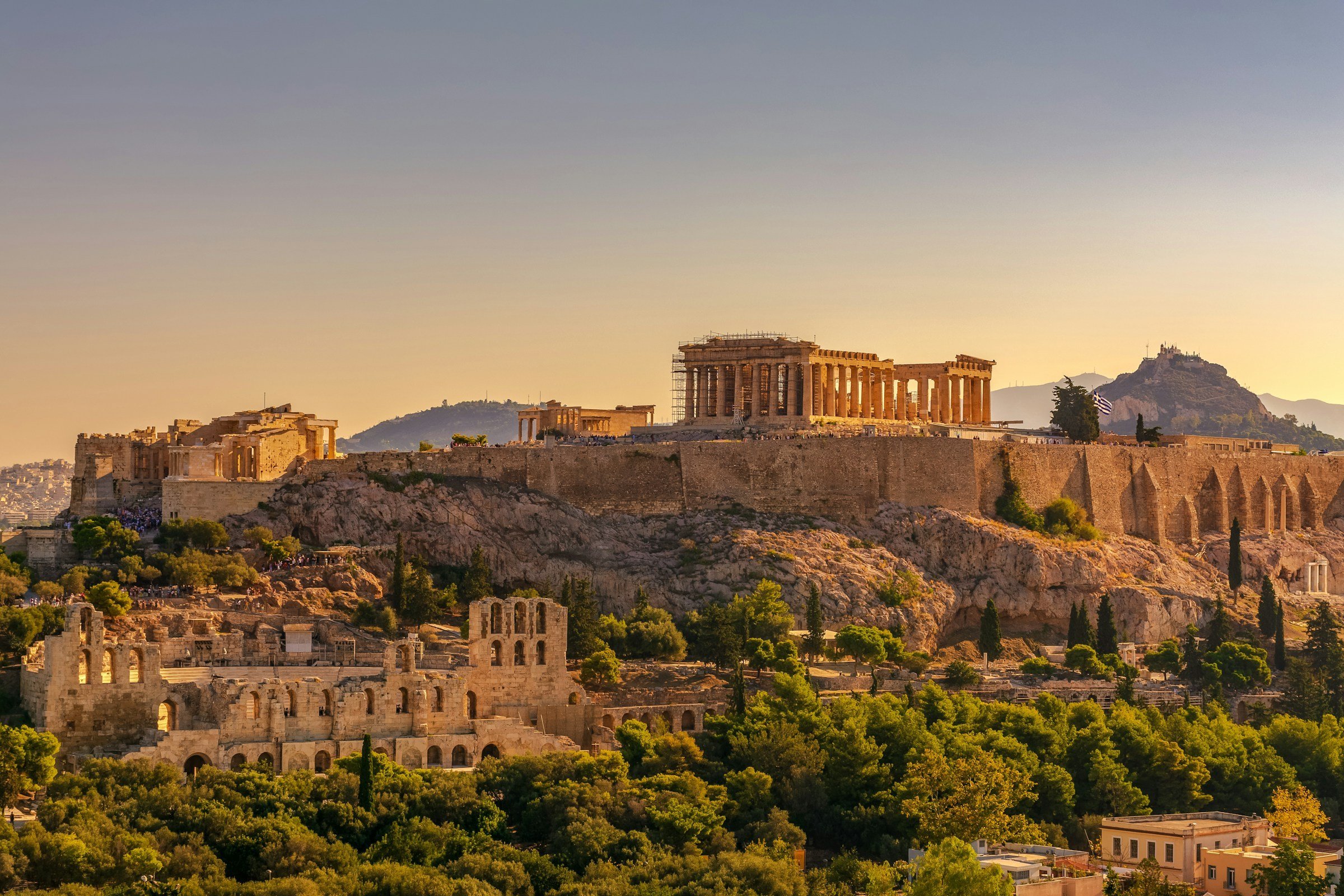
You can see the Parthenon from almost everywhere in Plaka, which means you can also see the scaffolding that has surrounded it for forty years. Restoration is permanent here. Cranes are part of the silhouette. The temple was a church, then a mosque, then an ammunition depot that a Venetian cannonball exploded in 1687. Now it is a construction site with a gift shop. The myth of ruins is that they are frozen, but these stones have been repurposed and patched and stripped for scrap and rebuilt wrong so many times that what you see is a decision about what antiquity should look like, not what it was.
Up to the Acropolis: The Climb That Costs €20

Athens
The entrance fee is €20 in summer (€10 November through March), and the ticket booth takes cards but the small museum inside is cash-only for reasons nobody explains. The path winds up through pines and the marble steps are polished slick by millions of shoes. By the time you reach the Propylaea, the gateway, you are sweating and the views over the city open up to show an endless grid of concrete apartment blocks interrupted by the green of the National Garden and Lycabettus Hill.
The Parthenon is smaller than you expected and more damaged. Sections of the frieze are in London, more are in Paris, and what remains is scaffolded or roped off. Tourists pose for photos while ignoring the signs asking them not to. The temple sits on bedrock that has been a sanctuary since the Bronze Age, and the bedrock is covered in graffiti from the 1700s when aristocrats carved their names into it because defacing monuments is not a modern invention.
The thing nobody tells you is that the Erechtheion, the temple with the caryatid columns, is more interesting. Five of the six maiden figures are copies. The originals are in the Acropolis Museum except for one that Lord Elgin took. But the building is strange and asymmetric because it had to accommodate sacred olive trees and a mark in the rock that was supposedly Poseidon’s trident. Function warped the design, and you can see the argument between religion and architecture frozen in stone.
Down Through Anafiotika: Cycladic Alleys Glued to a Cliff
Descend the north side and you drop into Anafiotika’s maze of white houses built illegally on public land. The law said if you could raise a roof and four walls in one night, the city could not tear it down. So workers from Anafi did exactly that in the 1860s, and now their descendants rent the houses to tourists on Airbnb for €90 a night. Cats own the staircases. Jasmine grows over doorways. The view from the dead-end alleys is straight down to the Ancient Agora, where Socrates argued himself into a death sentence.
The Agora: A Field of Broken Columns Where People Picnic
The Agora costs another €10 unless you bought the combo ticket at the Acropolis. It is a field of ruins with paths mowed through the weeds. The Temple of Hephaestus stands intact at the western edge, the best-preserved Classical temple in Greece, which means tourists ignore it because it looks too finished to be romantic. The Stoa of Attalos was reconstructed in the 1950s with American money and now houses a museum of pottery shards and lead voting tokens.
People spread blankets on the grass between column drums and eat sandwiches. There is no reverence in the air. Children play tag around the Altar of the Twelve Gods. This was the center of Athenian public life, and now it is a park with labeled rocks. The disconnect is the point. Mythology does not survive contact with laundry and lunch.
If you liked this, you might like: Lisbon, Istanbul, Rome.
Planning the trip? compare hotel deals from Stavanger, Oslo, Bergen, and Trondheim.