The Grid That Almost Was
Ildefons Cerdà drew his plan for Barcelona’s Eixample in 1859 with a ruler and an engineer’s faith in right angles. He imagined chamfered corners where streets met at 45-degree cuts, creating octagonal intersections that would let air and light flood a city choking on medieval density. Stand at Passeig de Gràcia and Carrer d’Aragó today and you can see his vision realized: every block measures 133 meters, every corner beveled, every building facade aligned to a surveyor’s dream. The grid runs northwest from Plaça de Catalunya for sixty blocks, interrupted only by the Sagrada Família’s impossible spires and Antoni Gaudí’s stone fever dreams.

Barcelona
The tension starts three blocks up Passeig de Gràcia. Casa Batlló’s facade ripples like water disturbed by a thrown stone, its balconies shaped as carnival masks, its roof scaled in ceramic tile that catches different colors depending on whether you approach from the Gothic Quarter or from Diagonal. Next door, Casa Amatller follows the grid’s rules with a neat Gothic Revival profile and sharp gables. The contrast is not subtle. One building respects Cerdà’s orthogonal mandate. The other treats it as a joke.
You pay €35 (about $38) to enter Casa Batlló, which is high but warranted by what you find inside: a central light well tiled in gradated blues that grow darker as they rise, compensating for the reduced daylight on lower floors. Gaudí calculated this. He also carved the wooden doorframes to fit a hand’s grip, angled the windows to frame specific views of the street, and designed ventilation ducts that pull air through the building without mechanical systems. Every curve serves a function, but the functions hide behind surfaces that look like melted wax or petrified kelp forests.
Where the Straight Lines Crack

Barcelona
Walk four blocks north to Casa Milà, known as La Pedrera for its quarry-like facade, and the grid surrenders entirely. The building occupies a full corner plot at Passeig de Gràcia and Carrer de Provença, but its walls bow outward in undulating stone waves. No two windows align vertically. The wrought-iron balconies twist like seaweed. The rooftop, open to visitors for €25 ($27), is a sculpture park of chimneys shaped as medieval knights, their helmets formed from broken champagne bottles pressed into white cement. From up here you see the Eixample spreading in every direction, its blocks stacked like dominoes, and you understand what Gaudí was arguing against.
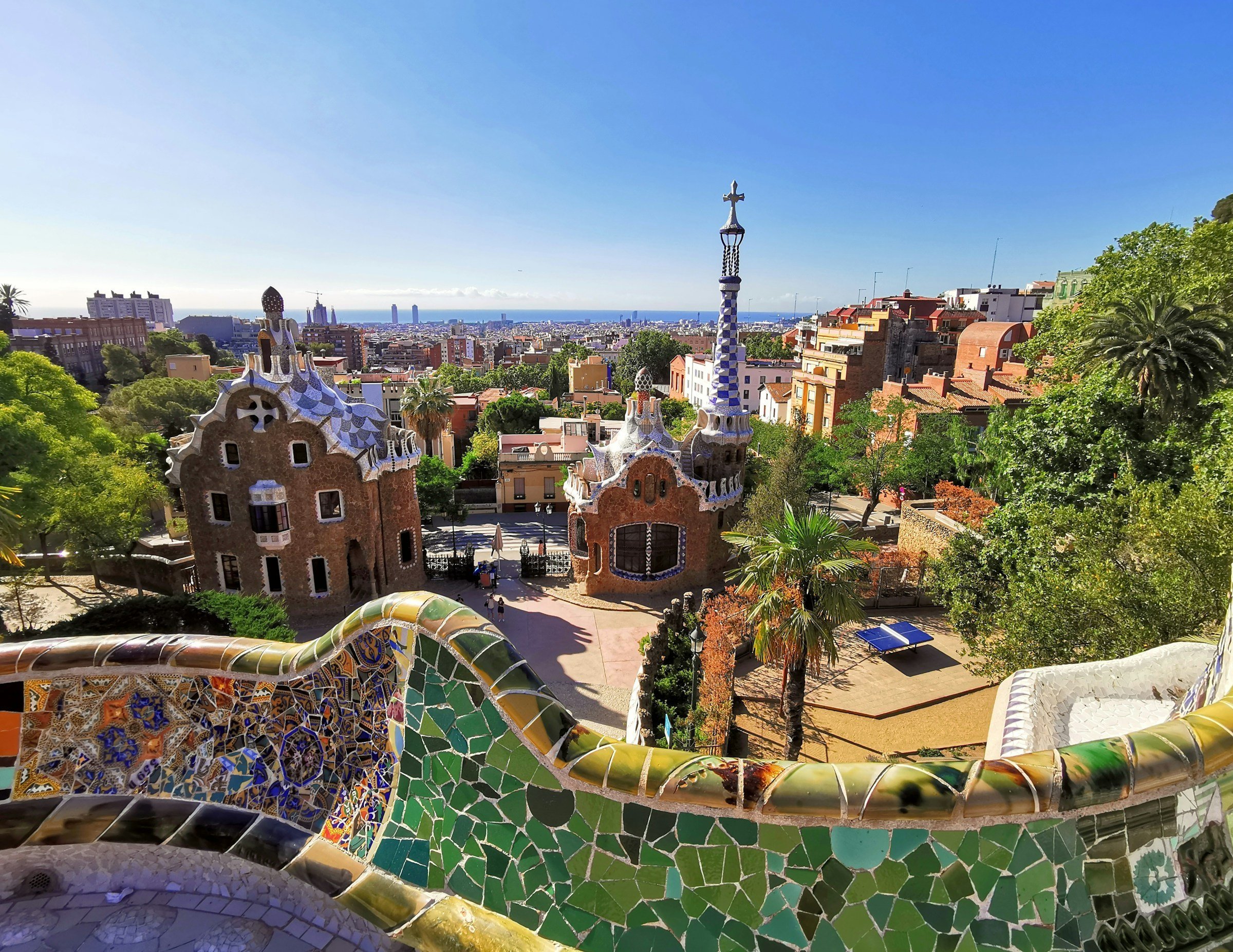
The argument plays out in miniature at Parc Güell, six kilometers north in the Gràcia neighborhood. Eusebi Güell commissioned Gaudí to design an English-style garden city on a hillside, lots platted for wealthy families who would commute downtown. Only two houses sold. The rest of the development became a public park in 1926, and what remains is Gaudí’s vision of organic architecture imposed on a site that slopes at brutal angles. The main terrace is held up by columns that lean and branch like stone trees. The ceramic-tiled benches curve to fit a human back, their surfaces encrusted with broken china and glass in patterns that suggest waves or snake scales or neither, depending on the light. Entry to the monumental core costs €10 ($11). The surrounding park is free and locals use it for jogging, which Gaudí would have hated.
The Sagrada Família, unfinished and surrounded by construction cranes since 1882, is where the tension between order and eccentricity becomes theological. Gaudí spent his last years sleeping in the worksite chapel, calculating the angles for columns that branch into hyperboloid vaults, designing facades that depict the Nativity in stone so detailed you can identify individual plant species. The Nativity facade faces northeast, toward the rising sun. The Passion facade faces southwest, stark and angular, its figures carved by Josep Maria Subirachs in a style that rejected Gaudí’s naturalism for Cubist brutality. The interior, when you pay €26 ($28) to enter, is a forest of tilted columns that support a ceiling pierced by skylights. The light comes through in shafts of blue and green and amber. The geometry is hyperboloid, catenary, helical. Nothing is perpendicular. Gaudí called it a structure that mimics trees, but trees don’t fracture sunlight into these particular colors.
The City That Accommodates Both
The Eixample’s grid tolerates this. Casa Vicens, Gaudí’s first major commission, sits in Gràcia at Carrer de les Carolines 20. The house is Mudéjar revival with Islamic tile work covering the facade in green and white checkerboards, its tower crowned with ceramic sunflowers, its garden enclosed by a palm-frond fence cast in iron. It disrupts nothing. The street continues its straight path. The neighboring buildings remain rectangular. Gaudí’s excess is contained within property lines.
This is the actual tension. Not between order and chaos but between a city that planned itself into geometric submission and the architects who worked within that submission while refusing its aesthetic. The grid did not break when Gaudí built. It absorbed. Walk down Carrer de Roger de Llúria and you pass Rationalist apartment blocks, Art Nouveau pharmacies with stained-glass skylights, Brutalist office towers, and modernista fantasies where every lintel is carved into a woman’s face. They all align at the property line. They all respect the 133-meter block. The facades are where the arguments happen.
You see this most clearly from Bunkers del Carmel, the anti-aircraft battery site on Turó de la Rovira hill. The view costs nothing and requires a 20-minute uphill walk from Alfons X metro station. From the concrete platform you see the Eixample spreading below like a chessboard tilted toward the sea. The grid is obvious. So are the interruptions. Sagrada Família punches through the pattern. The hospital of Sant Pau, another Domènech i Montaner project, occupies nine full blocks but rotates 45 degrees off the grid to align with solar angles instead of streets. Torre Glòries, the blue glass suppository on Avinguda Diagonal, tilts backward as it rises.
The city accommodates this because the grid was never about aesthetics. Cerdà wanted sewers, ventilation, sunlight, and firebreaks. He got those. What happened within the blocks was someone else’s problem. Gaudí and his contemporaries took that freedom and built arguments in stone and ceramic and iron, every curved line a rebuttal to the right angle, every organic form a rejection of the ruler. The Eixample absorbed it all. The grid held. The tension remains visible from any rooftop, written into the skyline: order below, eccentricity erupting through it, neither one winning.
If you liked this, you might like: Moscow, Ljubljana, Paris.
Planning the trip? Compare hotel deals before you book.