1. The Villa Swallowed by the Block
You walk north from Piața Romană and notice it halfway down Strada Vasile Lascăr. A three-story villa from 1912, cream stucco with green shutters and a turret that once announced wealth. The iron gate still works. Someone has planted roses along the fence. But on three sides, gray concrete apartment blocks rise eight stories higher, built so close you could pass a coffee cup between balconies. The villa sits in permanent shadow after 2pm.

This is Bucharest’s standard arrangement. The communist planners didn’t demolish the bourgeois past so much as surround it, making every Belle Époque survivor look like a historical footnote trapped in an architectural argument it already lost.
The villa houses a law office now. The blocks around it hold 400 families. You do the math on who won.
2. Boulevard Unirii, Or How to Erase a Neighborhood
Ceaușescu wanted his own Champs-Élysées, something wider and longer and more socialist. He got Boulevard Unirii, which runs 3.5 kilometers straight from the People’s Palace to Piața Alba Iulia. It is the second-widest boulevard in Europe. To build it, demolition crews flattened Uranus Hill, a neighborhood of 40,000 people living in low-rise homes and synagogues and churches that had stood since the 1700s.
You walk it today and the scale feels like a mistake. Eight lanes of traffic, fountains nobody maintains, apartment blocks set back 50 meters from the road. The proportions are off because humans were not the reference point. The reference point was a parade route for a dictator who died before most of the buildings were finished.
Peer down the side streets. Occasionally you catch a monastery dome or a 19th-century mansion that survived because it sat one block outside the demolition zone. These remnants make the boulevard’s emptiness harder to ignore, not easier. You keep thinking about what used to fill all this space.
3. The People’s Palace and the Houses That Watch It

Bucharest
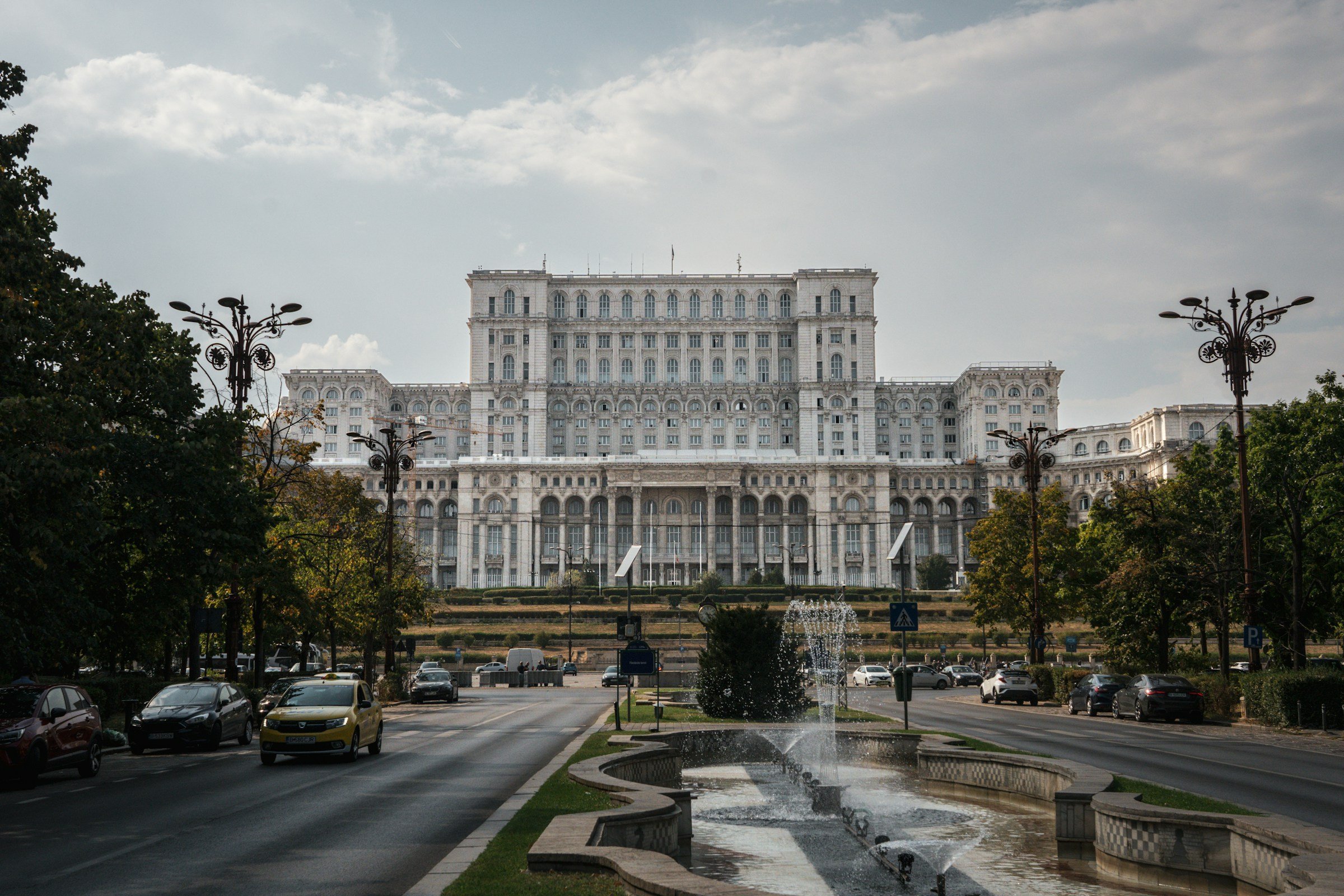
The Palace of Parliament is the heaviest building on earth, 330 meters long, 240 meters wide, with 1,100 rooms and four million cubic meters of volume. It consumes 9,000 tons of crystal and 480 chandeliers. Ceaușescu demolished Dealul Arsenalului, another historical district, to construct this monument to centralized planning. A fifth of it still sits empty.
But walk west on Bulevardul Libertății and stop at the intersection with Strada Izvor. Look left. You see a row of villas from the 1920s, each one painted a different pastel, with wrought-iron balconies and carved wooden eaves. They are five minutes on foot from the palace. The communist government left them standing, probably because housing party officials in these older buildings was more comfortable than cramming them into new concrete blocks.
The juxtaposition is violent. A single palace that could hold an entire government faces a street of private homes that once represented individual taste, individual capital, individual decisions about paint color and garden size. Neither side acknowledges the other. You stand between them and feel the city’s central tension in your chest.
4. Lipscani, Where the Layers Refuse to Settle
The old merchant district survived partly by accident, partly because even Ceaușescu’s planners understood you cannot move a city’s commercial center without collapsing the economy. So Lipscani kept its narrow streets, its 18th-century inns, its churches wedged between shops.
Then the modern landlords arrived. Now a Sephora occupies a ground floor built in 1848. A craft beer bar operates inside vaulted ceilings that once stored grain for the Wallachian princes. You walk past Hanul lui Manuc, a three-story courtyard inn from 1808, and next door a glass-front coworking space reflects the old wooden balconies in its tinted windows.
Two blocks north, past Strada Șelari, the communist contributions appear. A blocky department store from 1976. An office building with precast concrete panels. They do not blend. They assert. The effect is a neighborhood that cannot decide which century it belongs to, so it inhabits all of them badly.
Tourists love Lipscani because it feels authentically old. But the old parts exist in constant argument with the socialist interruptions and the capitalist renovations. You cannot see one layer without the others shouting over it.
5. The North, Where Money Tried to Smooth the Contrast
Zona Primăverii and Aviatorilor, up near Piața Victoriei, represent Bucharest’s wealthiest prewar addresses. Diplomats and industrialists built mansions with gardens that ran a quarter-acre deep. Many survived the communist period by conversion: the Yugoslav embassy in one, a state cultural institute in another, housing for approved artists in a third.
Since 2000, developers have filled the gaps. Glass towers for office space. Apartment buildings with underground parking and entry codes. These new structures try for a compromise scale, usually six to eight stories, with limestone cladding and balconies meant to echo the older proportions.
It does not work. You walk Strada Aviator Popisteanu and a 1935 villa with ionic columns sits next to a 2015 glass office block trying very hard to look understated. The old building has 20 windows. The new one has 200. The old one steps back from the street. The new one comes right to the property line. The architectural languages are incompatible, and money cannot buy them a shared grammar.
What you learn in the north is that even wealth cannot resolve Bucharest’s spatial argument. The city carries too many pasts in too little room. Every block is a layered fight between aristocratic restraint, socialist monumentality, and capitalist maximization. None of them won. All of them stay.
If you liked this, you might like: Sofia, Belgrade, Barcelona.
Planning the trip? Compare hotel deals before you book.