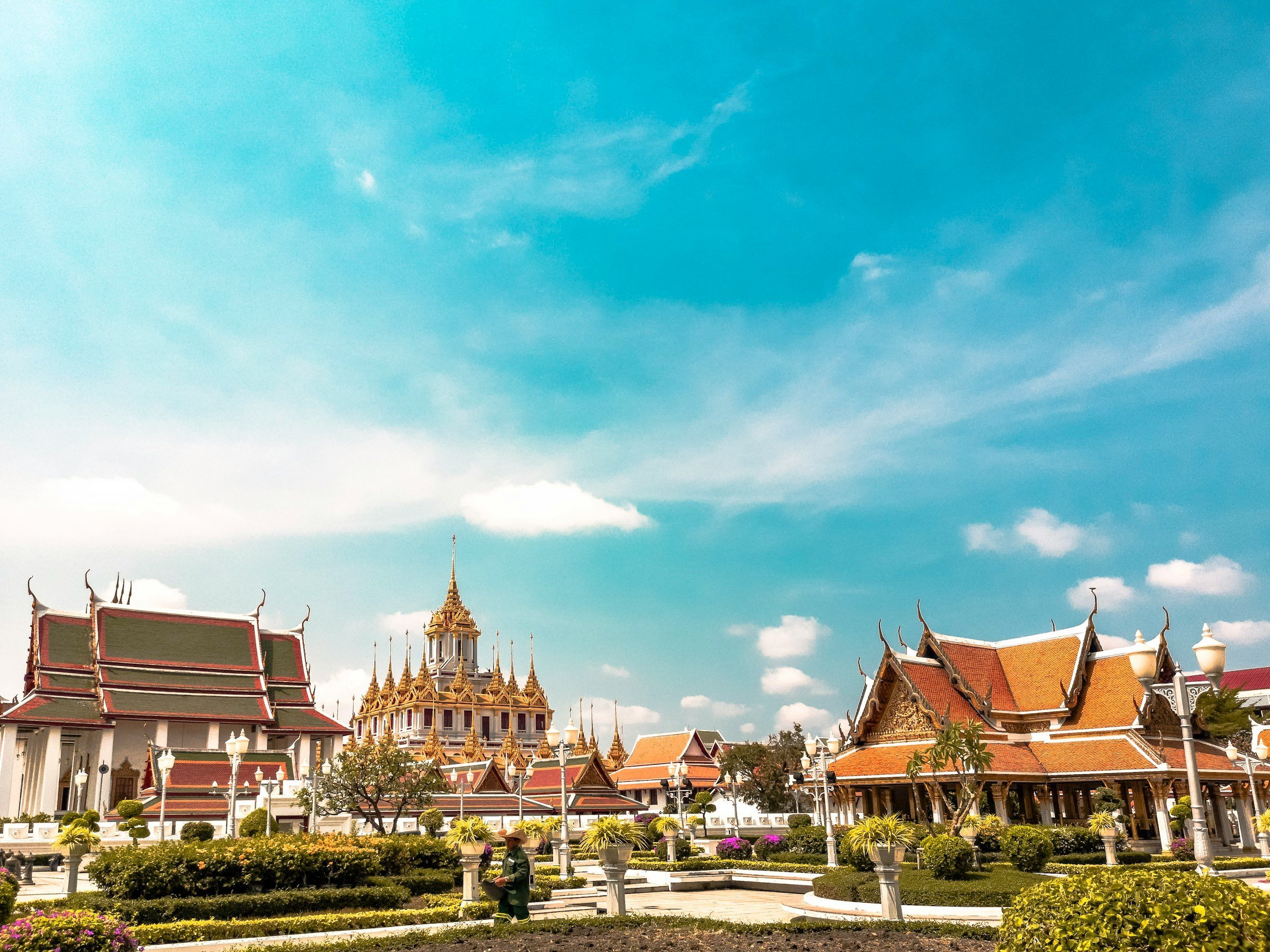
The Compound Walls That Stop the City
You walk through Bangkok’s Sukhumvit district past high-rise condos, street vendors frying pork over charcoal drums, motorbikes weaving three-wide between cars, tuk-tuks idling in diesel clouds. The noise level sits at a constant roar. Then you pass through a gate in a whitewashed wall, cross twenty meters of swept courtyard, and the volume drops by half. Not gradually. Immediately. The temple grounds operate under different acoustic rules than the streets around them.

Bangkok
Wat Arun sits on the Thonburi side of the Chao Phraya River. The central prang rises 70 meters, covered in broken Chinese porcelain that was used as ship ballast two centuries ago. From the BTS Skytrain on the opposite bank you see office towers, luxury hotels, shopping centers pressing against the riverfront. Wat Arun occupies the same shoreline but exists in a different layer. Tourists climb the prang’s steep stairs. Thai families sit in the sala pavilions. Monks in saffron robes walk the inner paths. Outside the walls, the expressway traffic sounds like surf. Inside, you hear footsteps on stone and the rustle of bo tree leaves.
The separation is architectural but also temporal. Bangkok moves at the speed of its traffic, which is to say it doesn’t move much but vibrates in place with constant acceleration and braking. The temples move at the speed of daily chanting schedules, the replacement cycle of incense sticks, the growth rate of rain trees in the courtyards. A monk I spoke with at Wat Pho said the temple grounds have been continuously occupied since the 16th century. The massage school there has trained practitioners for decades using the same pressure-point diagrams carved into stone pavilion walls. Tourists come through, take photos of the 46-meter Reclining Buddha, and leave. The institutional continuity stays.
The Morning Alms Routes That Cut Diagonals

Bangkok
Monks walk alms routes through Bangkok at dawn. Not tourist show routes but actual neighborhood circuits where residents wait outside shophouses and apartment buildings with prepared food. The routes cut diagonal lines through the city grid that ignore traffic patterns. A monk on alms round walks down the center of a soi that normally chokes with delivery trucks. Cars wait. Motorbikes idle. The city briefly reorients around a different organizing principle.
I followed one alms route in the Ari neighborhood that started at a small temple near the BTS station and wound through residential streets where most buildings are four stories, concrete, balconies full of potted plants and laundry lines. The monks walked single file, barefoot, carrying steel bowls. People knelt on the sidewalk or on plastic mats laid across cracked pavement. They placed rice, fruit, packaged snacks into the bowls. Some whispered prayers. The monks didn’t stop walking. The whole exchange happened in silence except for the sound of food settling into bowls and the ambient hum of the city waking up, muted but not gone.
What surprised me was the route’s indifference to the neighborhood’s commercial logic. It passed expensive coffee shops that wouldn’t open for hours, skipped the main road where street food vendors were already setting up, followed narrow lanes where there was nothing to buy. The route served a distribution network that predated the current economy. Residents along these lanes have participated in alms-giving for long enough that the practice survives gentrification, rising rents, the arrival of expat residents who don’t know the schedule. The temporal layer persists.
Wat Phra Kaew and the Geometry Problem
Wat Phra Kaew occupies one corner of the Grand Palace complex. The grounds cover 94 hectares in the heart of old Bangkok, bounded by walls and canals. Inside, the architecture follows traditional cosmological layouts, buildings oriented to cardinal directions, specific structures positioned according to religious hierarchy. Outside the walls, the street grid bends around the palace perimeter like water flowing around a large rock. Ratchadamnoen Avenue runs straight until it hits the palace, then curves. Sanam Chai Road does the same from the south.
The palace doesn’t adapt to the city’s expansion. The city routes itself around the palace. This creates navigation problems. Trying to walk a straight line through this part of Bangkok means constant detours. Taxis and tuk-tuks know the workarounds. But the effect from ground level is a sense that certain geometries take priority over others. The sacred geography came first. The road network accommodates it.
Inside Wat Phra Kaew you see tour groups moving in streams behind guides holding numbered flags. They photograph the Emerald Buddha, a 66-centimeter jadeite figure that sits high in the main chapel, robes changed three times per calendar cycle by the King. Security is tight. No photos inside the chapel. Shoes off before entering. The rules are stricter than at most Bangkok temples and enforced by staff who have no interest in tourist convenience. The price is 500 baht (15 USD), steep for Thailand. But the temple doesn’t price for volume. It prices to maintain barriers. You’re allowed in, but on terms that predate your arrival by centuries.
The Gaps Where Different Time Systems Overlap
Bangkok runs on multiple overlapping time systems. The civic calendar follows the Gregorian year. Many temples use the Thai solar calendar, which is 543 years ahead. Astrological calculations for auspicious dates draw from the Thai lunar calendar. Market vendors price by the minute, adjusting mango prices based on ripeness and heat. The BTS Skytrain runs on six-minute headways during peak periods. None of these systems conflict because they operate in different domains.
The temples create gaps in the urban rhythm. You can walk from the chaos of Khao San Road, where backpackers drink from buckets and touts offer every tour and scam, into Wat Chana Songkhram in two minutes. The temple grounds are small, maybe 100 meters on each side. But they establish a different temporal zone. Monks live there. Families come for ceremonies. Old women sell garlands at the entrance, a ten-baht offering (30 cents USD) to place at the Buddha image inside. The transaction is slow and ritualized. You don’t rush someone making merit.
What the temples preserve is not the past but a parallel present. Wat Benchamabophit, the Marble Temple, stands near government offices and uses Carrara marble imported from Italy in its construction. It’s as much a product of early 20th-century modernization as any surrounding ministry building. But once you’re inside the courtyard with the marble bot and the rows of Buddha images in the galleries, the fact that you’re minutes from a busy intersection stops registering. The temple marks a boundary where different speeds apply. Bangkok’s sprawl continues on all sides. The temples remain stationary, which in a city this restless makes them strange anchors. Not tourist sites, exactly, but operational remnants of an organizing logic the rest of the city grew around and never replaced.
If you liked this, you might like: Hong Kong, Beijing, Kuala Lumpur.