If you’ve only been to Cairo, the silence will confuse you
Cairo taught you that Arab capitals announce themselves with horns and the constant negotiation of four lanes becoming seven. Amman doesn’t do that. You stand at a major intersection in Abdali at what should be rush hour and hear conversations from the opposite sidewalk. The traffic exists but it doesn’t scream. Drivers use their horns to communicate specific information, not as a reflex whenever their foot touches the brake.

Amman
This isn’t serenity. It’s the particular quiet of a city that grew too fast to develop the infrastructure for chaos. Amman had 30,000 people in 1948. Palestinian displacement after the Nakba brought hundreds of thousands. The 1967 war brought more. The Gulf War sent Palestinians from Kuwait. The Iraq War sent Iraqis. The Syrian civil war brought over a million Syrians. Each wave arrived faster than the last, and the city kept building upward on hills that already made expansion difficult.
The result is a capital that feels like it’s still figuring out how to be a capital. Downtown, near the Roman amphitheater, you find density and the layered grit of old souqs. But drive ten minutes to Abdoun or Sweifieh and you’re in neighborhoods of new villas and shopping malls that could be in Houston. The city never had time to develop a unified aesthetic or a single governing logic.
If you’ve only done Mediterranean beach towns, the dryness becomes tactile
You feel the desert in your sinuses before you see it. Amman sits at 750 meters above sea level, close enough to the Dead Sea rift that the air carries a particular mineral dryness. Your lips crack. The skin on your knuckles tightens. You start buying small bottles of water not because you’re thirsty but because you need to prove to yourself that hydration is still possible.
The hills are white limestone and beige concrete. Trees exist but as punctuation, not background. This isn’t the Levantine green of Damascus orchards or the aggressive irrigation of Israeli kibbutzim. It’s the aesthetic of a place where water is expensive and shade is architecture, not foliage.
In summer, temperatures hit 32-35°C but the dryness makes it feel survivable until you’ve been walking for twenty minutes and realize you haven’t sweated once. That’s when dehydration finds you. In winter, it can drop to 4°C at night and the wind off the desert cuts through the misconception that deserts are always hot.
If you’ve only known refugee crises from headlines, the scale here is spatial

Amman
Nearly a third of Jordan’s population is Palestinian, many still living in camps that have been permanent for 70 years. Jabal al-Hussein, Wihdat, and Baqa’a started as tents and are now dense urban neighborhoods with concrete homes, shops, medical clinics, and a street life that outlasted the international community’s attention span. These aren’t temporary shelters. They’re suburbs with a different founding document.
The Syrians who arrived after 2011 followed the same pattern. Zaatari camp in the north gets the documentary crews, but most Syrian refugees in Jordan live in Amman itself, in East Amman neighborhoods like Hashmi al-Shamali where rents are cheap and Arabic is Syrian-accented. You hear it in grocery stores, in the phrasing of questions at shawarma stands, in the way children play in streets that remind their parents of Homs or Daraa.
This isn’t visible as crisis infrastructure. There are no blue tarps or rows of identical shelters. It shows up as pressure on a city that was already crowded. Rents spiked. Schools added second shifts. The public hospital wait times doubled. You see it in the way traffic has gotten worse not because of new roads but because of more people needing to use the roads that exist.
If you’ve only eaten Levantine food in the diaspora, the repetition reveals the constraints
You expect variety and instead get precision within a small range. Mansaf is the national dish, lamb cooked in fermented dried yogurt and served over rice with jameed, a hard yogurt ball that gets reconstituted into sauce. It’s served at weddings, funerals, celebrations, and moments when a family needs to prove hospitality. You will eat it multiple times if you stay longer than a week.
Falafel and hummus are breakfast. Shawarma is lunch or late dinner after shops close. Knafeh, the cheese pastry soaked in sugar syrup, is what you eat at Habibah downtown when a conversation has gone well or when you need to apologize for something. The cuisine is excellent within these boundaries, but the boundaries are real. Jordan imports most of its food. Fresh produce is expensive. The cooking adapts.
A meal at a decent restaurant in Abdali or Sweifieh costs 15-25 JOD ($21-35 USD). A street falafel sandwich is 0.75 JOD ($1 USD). The gap tells you everything about who this city serves and who makes it run.
If you’ve only trusted Roman ruins in places where tourists expect them, these get ignored
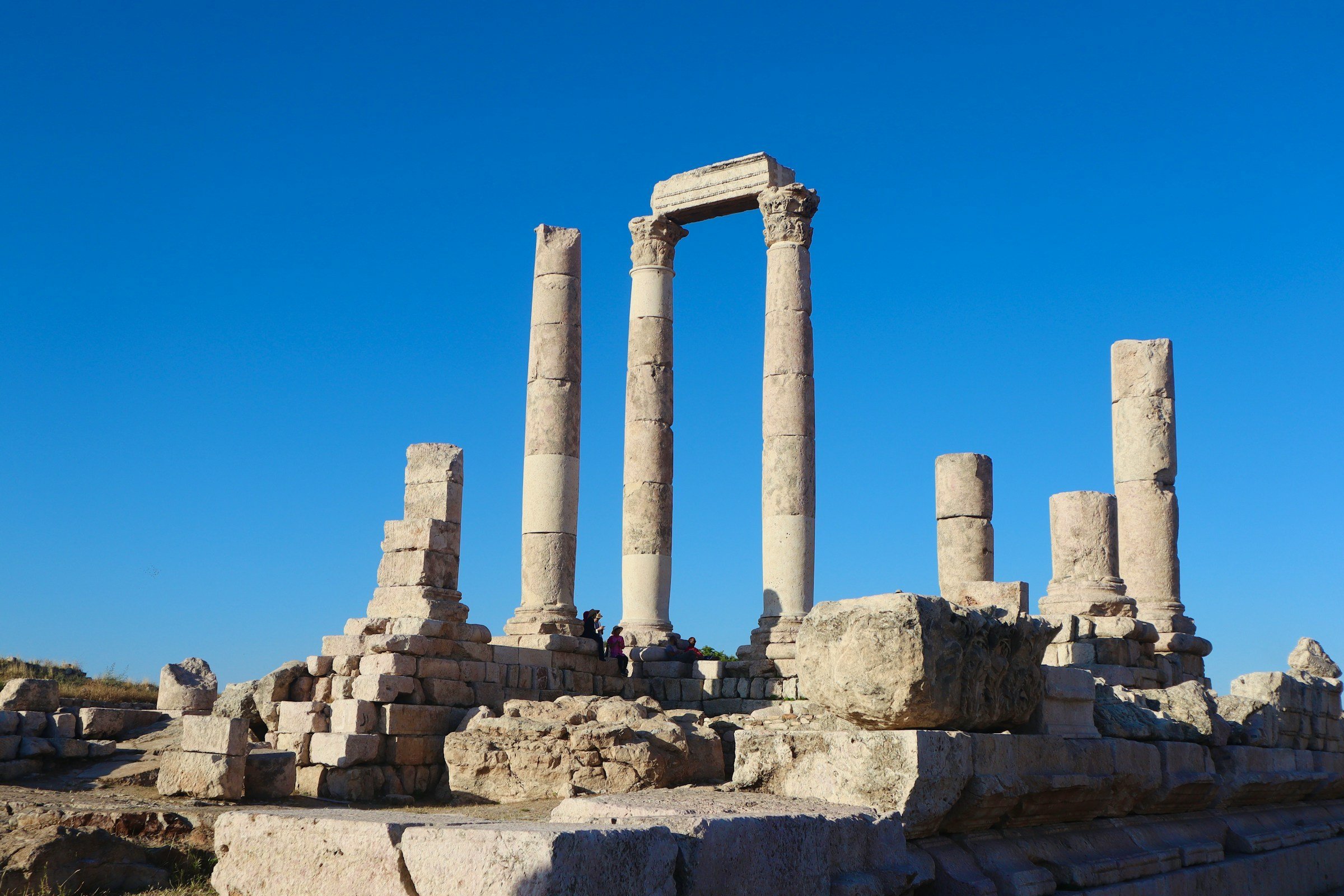
The amphitheater downtown seats 6,000 and still hosts concerts. The Roman nymphaeum is half-restored and sits next to a traffic circle where service taxis gather. On Jabal al-Qal’a, the Citadel hill, you find the Temple of Hercules and Umayyad Palace ruins with views across the entire city. Entry costs 3 JOD ($4.25 USD) and most days you share the site with school groups and maybe a dozen other visitors.
This isn’t Petra. Nobody flew here just to see these stones. They’re what you visit because you’re staying in Amman for work or family and need something to do on a Friday. The lack of crowds means you can sit on 2,000-year-old steps and watch the city without someone selling you a camel ride or a miniature carved treasury.
The ruins don’t define Amman the way the Acropolis defines Athens. They’re one layer among many, visible but not central, preserved because they’re there but not because the city’s identity depends on them.
If you liked this, you might like: Doha, Dubai.
Planning the trip? Compare hotel deals before you book.