Ban Jelačić Square at First Light
You start where the trams converge. Ban Jelačić Square opens wide under neoclassical facades painted ochre and cream, their symmetry a Habsburg inheritance. The equestrian statue at the center faces south, sword raised. Locals use it as a meeting point without discussing what the sword commemorates. Around the perimeter, café chairs scrape against cobblestones as waiters wipe down tables. A flower vendor arranges stems in galvanized buckets. The buildings watch with shuttered windows, their cornices and pediments perfectly aligned.

The square feels formal even when pigeons scatter across it. You notice the cleanliness first, then the geometry. This is a city that kept its grid when other capitals dissolved into organic sprawl.
Tkalčićeva Street and the Scars
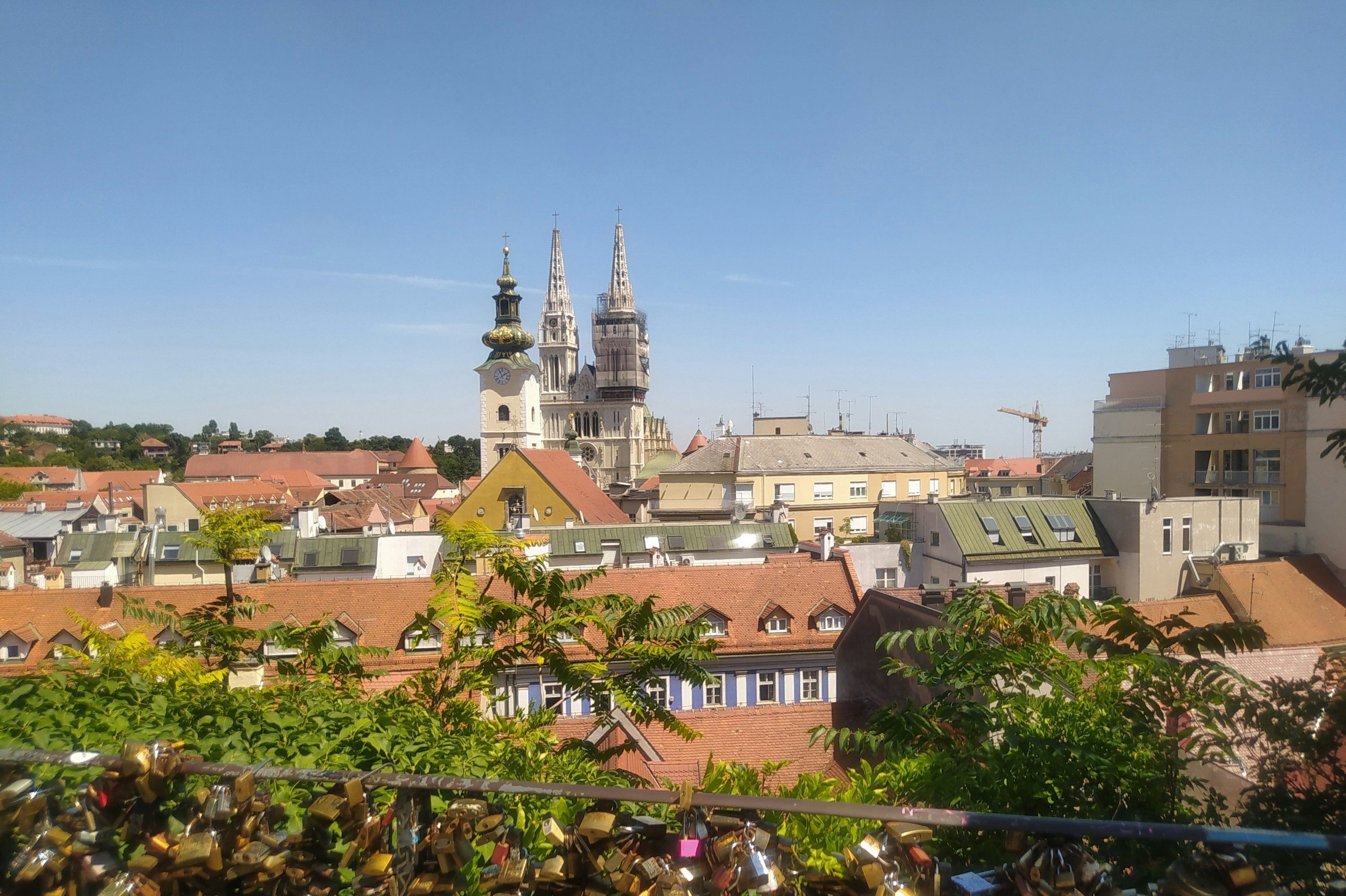
Walk north past the cathedral. Its neo-Gothic spires punch the sky, rebuilt after an 1880 earthquake left the originals in rubble. Scaffolding clings to one tower. It has clung there for years. The 2020 earthquake, magnitude 5.5, cracked more than it toppled, but restoration moves at the pace of municipal budgets and heritage committees.
Tkalčićeva Street runs parallel to the cathedral, a pedestrian corridor lined with bars and bakeries. The buildings here are three stories, painted rose and mustard and pale green. Upper windows show cracks sealed with fresh plaster. Some facades wear mesh netting to catch loose debris. You are drinking coffee (12 kuna, about 1.60 USD) outside a place with chalkboard menus when you see it: a building propped by steel beams, its ground floor operating a gelato shop as if the engineering above is a minor aesthetic choice.
Nobody stares at the beams. This is what persistence looks like.
Dolac Market and What Gets Sold
Climb the stairs behind the cathedral to Dolac, the open-air market. Red umbrellas shade vendors selling cabbage, potatoes, and soft cheese wrapped in cloth. The women wear headscarves and aprons. They quote prices in kuna, occasionally in euros if they read you as a foreigner who will not haggle. Cheese costs 40 kuna per kilogram (5.30 USD). Strawberries appear in spring, small and dark red, nothing like the supermarket giants.
Below the umbrellas, a covered hall sells meat and fish. The floor is concrete, hosed down each afternoon. Whole chickens hang from hooks. A butcher slices pork with a cleaver, the thwack echoing between tile walls. The fish vendor offers Adriatic sea bass, their eyes still clear.
This is not picturesque in the way travel blogs mean. It is functional. People buy food here because it is fresh and cheaper than grocery chains. You can buy it too, but only if you have a kitchen and a plan.
Stone Gate and Candles That Do Not Go Out
Walk west into Gornji Grad, the upper town. The Stone Gate, a medieval remnant, houses a shrine. Inside the tunnel, candles burn in rows before an icon of Mary. The painting survived a fire in 1731 that consumed the wooden gate around it. Locals stop to cross themselves and light another candle (5 kuna, about 0.65 USD). The walls are soot-blackened from centuries of wax smoke. The air smells like beeswax and damp stone.
You do not need to be religious to feel the weight here. This is the oldest part of Zagreb, where streets narrow and the Habsburg order loosens into medieval angles.
St. Mark’s Church and the Roof Everybody Photographs
St. Mark’s Square sits at the top of Gornji Grad. The church roof is tiled in a checkerboard of red, white, and blue, depicting the coats of arms of Zagreb and Croatia. Tour groups photograph it from every angle. The church itself is small, Romanesque, rebuilt after earthquakes. It is not open to tourists. The parliament building and government offices ring the square, their facades sober and cream-colored, guards standing outside in ceremonial uniforms.
The square is pretty. It is also a reminder that this city was an administrative center for empires. The elegance is not accidental. It was imported, imposed, and then maintained long after the empire collapsed.
Strossmayer Promenade and the Funicular

Zagreb
Walk south along Strossmayer Promenade. Chestnut trees shade the path. Benches face west toward the lower town, offering a view of red rooftops and the twin spires of the cathedral. Street musicians set up in the afternoons. A saxophonist plays jazz standards. A painter sells watercolors of the city, the colors brighter than the real thing.
At the southern end, the funicular descends to Ilica Street. It is the shortest funicular in the world, 66 meters. The ride takes 55 seconds and costs 5 kuna (0.65 USD). Locals ride it because walking the hill in winter ice is miserable. Tourists ride it because the signs say “shortest funicular in the world” and that feels worth documenting.
Ilica Street and the Department Store Nobody Mentions
Ilica is the main shopping street, running west from Jelačić Square. Trams clatter down the center. Storefronts sell shoes, pastries, and mobile phones. Zara occupies a corner. A shopping center called Importanne hides in a brutalist block, its interior dim and dated, the escalators groaning.
Halfway down Ilica, a building still shows bullet holes. Small pockmarks stipple the plaster around a second-floor window. The war ended in 1995. The city repaired most damage, replastered most walls. But here and there, someone decided not to erase it. You walk past without a historical placard to explain. The holes are smaller than you expected.
Frankopanska Street and Where the Grid Loosens
Turn south off Ilica into the streets behind the train station. The buildings here are apartment blocks from the 1920s and 30s, Art Nouveau details softened by decades of grime. Balconies sag slightly. Laundry hangs on lines. A bakery sells burek (15 kuna, about 2 USD), cheese or meat, the phyllo still warm. You eat it standing at a counter while a woman mops the floor behind you.
This part of Zagreb does not appear in guidebooks. It is not derelict, but it is not renovated either. The elegance thins here. You see what persists when tourism dollars concentrate elsewhere.
The Train Station and What Faces It
Zagreb’s main station is a yellow building with arched windows. Inside, the departure boards flicker. A few vendors sell sandwiches and newspapers. Trains leave for Ljubljana, Vienna, Budapest. The platforms smell like diesel and old concrete.
Across the street, a park stretches toward Jelačić Square. Fountain. Benches. Teenagers smoking near a pavilion. The trees are planted in rows. Even the green spaces follow a grid. You can see the whole city from here: the upper town on its hill, the cathedral spires, the Austro-Hungarian blocks lined up like soldiers.
It is not beautiful in a postcard way. But it is honest. This is a city that absorbed empire, war, earthquakes, and the long bureaucratic grind of reconstruction. The elegance persists not because Zagreb is frozen in time, but because someone keeps repainting the ochre facades and replacing cracked roof tiles. The scars stay because forgetting is expensive too.
If you liked this, you might like: Athens, Dublin, Madrid.
Planning the trip? Compare hotel deals before you book.