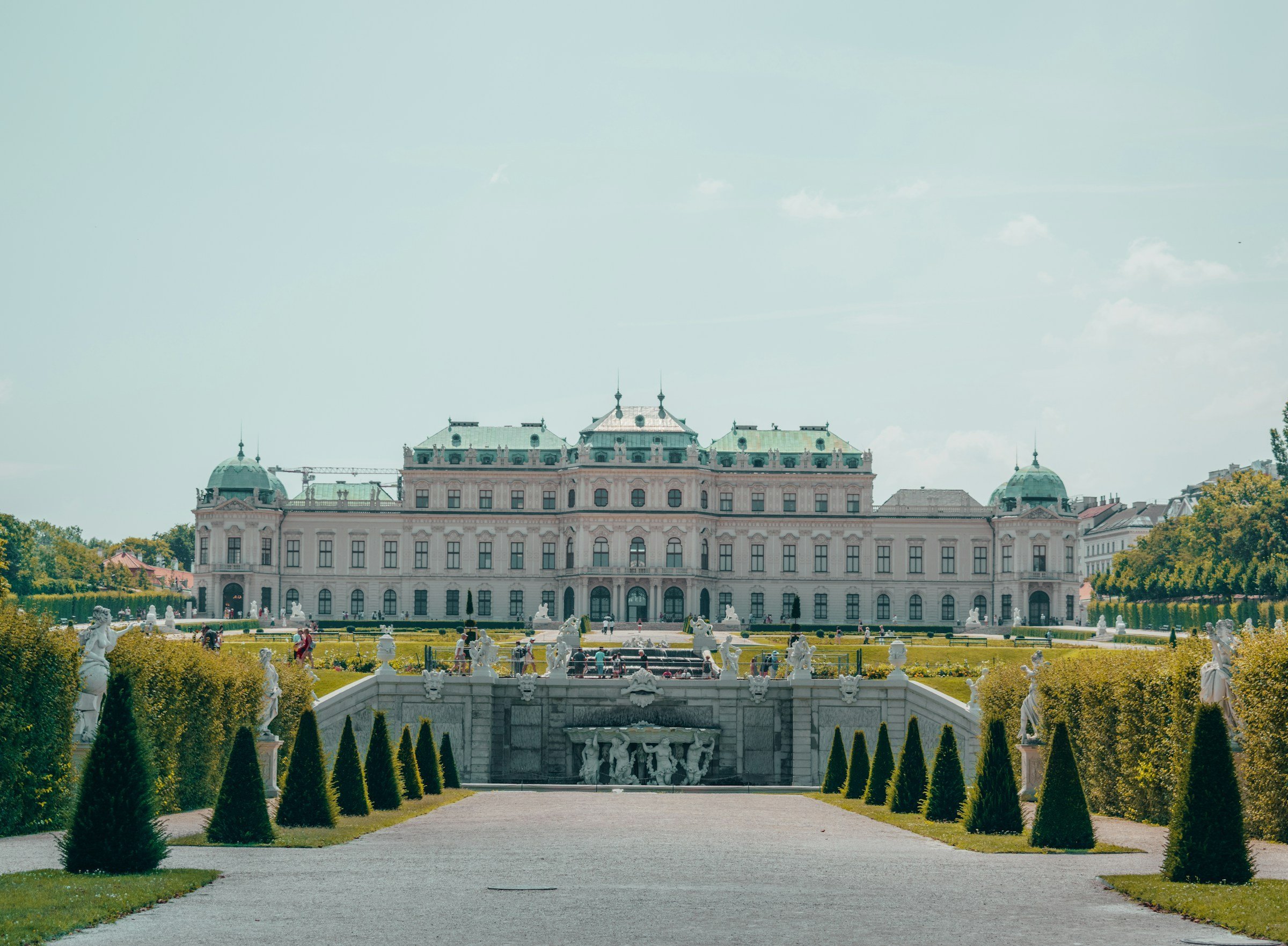
You walk down Ringstrasse and the buildings refuse to apologize. The Hofburg sprawls across blocks like it still runs an empire. The Kunsthistorisches Museum faces its twin across a park, both crowned with copper domes that have oxidized to the color of old money. The Parliament building pretends Greece, the Rathaus pretends Flanders, the Opera House pretends everything. They were all built in a fifty-year window when Vienna was capital of half of Europe, and now they’re monuments to a country smaller than Indiana.

Vienna
The gap between then and now gives the city its particular mood. Not sadness exactly. More like a man wearing a perfectly tailored suit to a job interview for a position he knows he won’t get. The Habsburgs ran the show for six hundred years. Then 1918 happened and the empire dissolved into eight countries, and Vienna woke up as the head of a body that no longer existed. The grand cafes stayed open. The palaces became museums. The orchestra kept playing. What else were they going to do?
The Palace District and Its Ghosts
Schönbrunn Palace sits on the edge of the city with 1,441 rooms, forty of which you can tour. Maria Theresa picked the yellow paint. Her son Joseph II opened the gardens to commoners in 1779, which was radical at the time and is now just real estate you can walk through for free. The fountain of Neptune faces the palace. Behind it, the Gloriette colonnade sits on a hill with views back toward the city center. On weekday mornings before the tour groups arrive, you can stand at the Gloriette and see the whole improbable symmetry: geometric gardens, the palace facade stretching wider than necessary, and beyond it the modern city that has grown up around these bones.
The admission is €20 for the Imperial Tour (about $22), €28 for the Grand Tour with more rooms ($31). The difference matters if you care about seeing where the empress kept her breakfast china. Most people don’t need the extra rooms. What registers is the scale. Room after room of gilt and ceiling frescoes and porcelain stoves taller than a person, built for a family whose children were traded to foreign courts like chess pieces. Franz Joseph was born here, died here, spent nearly seventy years as emperor, and watched his empire start crumbling before his death in 1916. His bedroom at Schönbrunn is plain, almost monastic. The bed is narrow. That contrast tells you more than the state rooms.
Back in the Innere Stadt, the Hofburg Palace sprawls across the first district with no clear perimeter. The complex added buildings across five centuries. The Imperial Apartments are open for tours, and the Sisi Museum documents Empress Elisabeth, who hated court life and got stabbed by an anarchist in Geneva in 1898. The Spanish Riding School operates out of a hall inside the Hofburg, where Lipizzaner horses perform baroque dressage routines perfected in the 1700s. Tickets run €17 to €38 ($19 to $42) depending on seating. Performances happen weekend mornings. The horses are beautiful and the whole thing feels like a expensive anachronism that Vienna keeps funding because what else preserves the brand?
Coffee and the Art of Sitting Still
The cafe culture isn’t charming in the postcard way. It’s stubborn. Cafe Central opened in 1876 in a neo-Gothic arcade and has vaulted ceilings like a cathedral. Trotsky used to play chess here before the revolution. Freud had a regular table. Now it’s full of tourists photographing their Sachertorte, but the waiters still wear tuxedos and the coffee comes on a silver tray with a glass of water, and you can sit for three hours on one melange (€6.50, about $7) without anyone suggesting you leave.
Cafe Sperl in the sixth district has nicotine-yellow walls and marble tables and regulars who read Kronen Zeitung over breakfast pastries. Cafe Hawelka near Stephansplatz serves Buchteln (sweet rolls) after 10pm, baked by the owner’s family for decades. The coffee is strong and slightly burnt. You don’t go for the coffee. You go because these places have been open since before the empire fell and they’re still serving the same pastries with the same silver tongs, and there’s something defiant about that.
The Viennese cafe tradition includes newspapers on wooden holders, cakes under glass domes, and the assumption that time doesn’t apply once you sit down. It’s not efficient. The service is formal to the point of coldness. But the city kept these spaces alive through two world wars and Soviet occupation and now through chain coffee franchises opening on every corner. A melange costs twice what an espresso costs at the Italian place down the street. People pay it anyway.
The Dislocation of Everyday Spaces

Vienna
Naschmarkt runs for a kilometer between the fourth and sixth districts, a permanent market where you can buy Turkish spices, Croatian wine, Styrian pumpkin seed oil, and Japanese knives. It’s been a market since the 1700s. On weekday mornings, the Vietnamese vendors sell vegetables at one end while Austrian pensioners argue over the price of peppers in the middle and the organic cheese stall at the far end charges €24 per kilo ($26) for mountain cheese aged in caves. The contrast is Vienna in miniature: layers of empire and immigration and modern wealth existing in adjacent stalls.
Karmelitermarkt in the second district is smaller, less touristed, and has a Saturday market where farmers from Lower Austria sell root vegetables and apple juice. The neighborhood around it used to be Jewish before 1938. Then it wasn’t. Then it slowly became Turkish and Serbian and is now gentrifying into yoga studios and natural wine bars. The layers don’t erase each other. They sit on top of each other like sediment.
The U-Bahn is clean and punctual and decorated with 1970s orange tile that nobody has bothered to update. A weekly pass costs €17.10 (about $19). The trains announce stops in German. The maps make sense. It works because Vienna never stopped funding public infrastructure even when the empire collapsed and the country went broke. The stations near Ringstrasse have marble and chandeliers. The stations in the outer districts have concrete and fluorescent lights. Both get you where you’re going on time.
What Persists Without Permission
The State Opera House runs performances nearly every night from September to June. Standing room tickets cost €10 to €20 ($11 to $22) and you queue an hour before curtain for spots along the rail at the back of the hall. The acoustics are perfect. The productions range from conservative to experimental. You stand for three hours watching Verdi or Strauss in a house built for an empire that intended to last forever. It didn’t, but the opera season still runs.
Stephansplatz in the first district centers on St. Stephen’s Cathedral with its zigzag roof tiles and Gothic tower. The catacombs underneath hold bones from plague victims and the internal organs of Habsburgs, stored in copper urns because apparently the family couldn’t be buried in one piece. The tower climb is 343 steps and costs €6 ($7). From the top you see the first district’s tile roofs and then the modern city spreading outward, socialist housing blocks from the 1920s mixing with postwar construction.
Vienna didn’t rebuild itself as a forward-looking capital after 1918. It couldn’t afford to. Instead it maintained what was already there and added around the edges. The result is a city where a tram from 1950 rolls past a palace from 1690 and both are part of the ordinary commute. The elegance is real. So is the melancholy. They’re the same thing.
If you liked this, you might like: Istanbul, Moscow, Berlin.
Planning the trip? Compare hotel deals before you book.