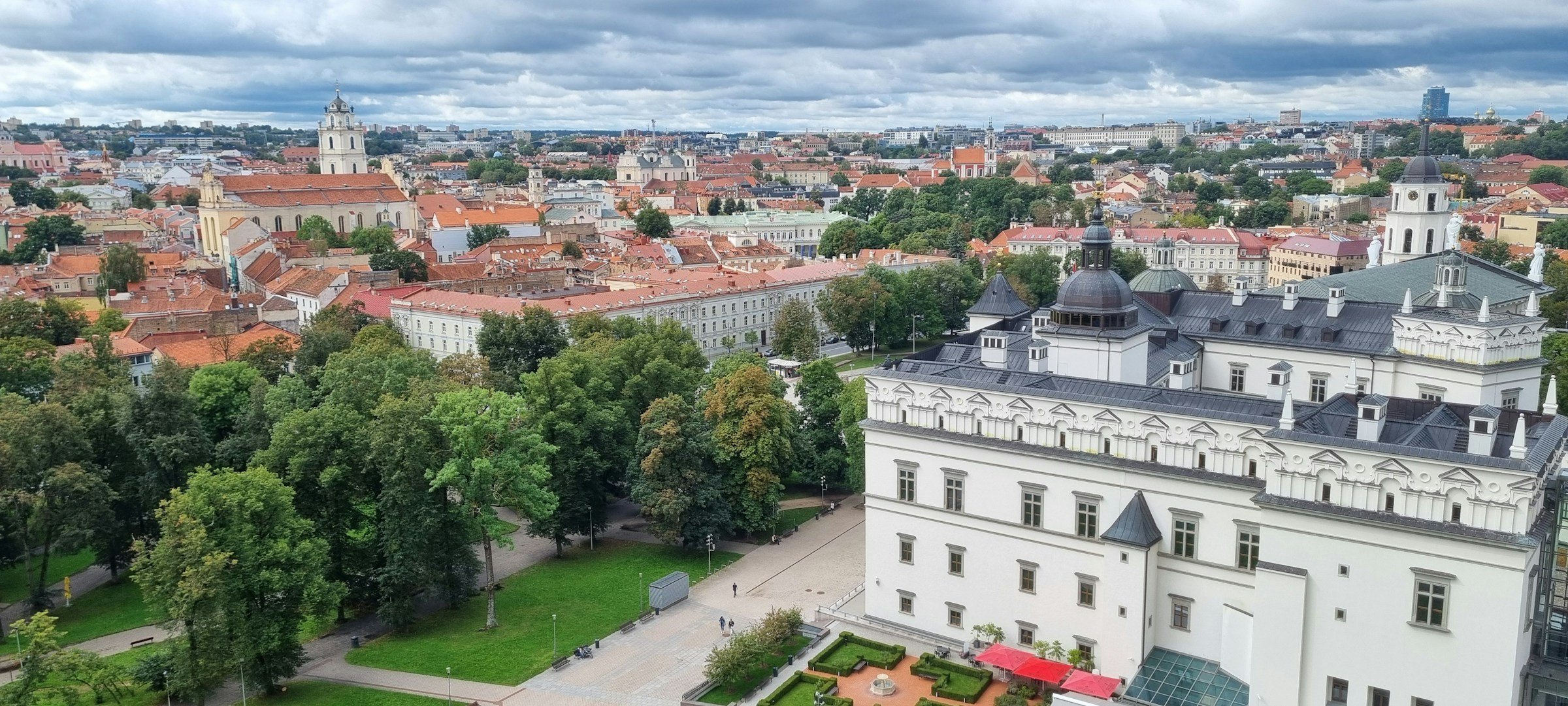
You walk from Pilies Street to Gedimino Avenue and cross three centuries in fifteen minutes. The distance isn’t far. The shift is absolute. One block you’re dodging tour groups outside pale yellow churches, Renaissance courtyards hiding behind arched gates. Next block the sidewalk widens, the buildings flatten into Soviet gray, and you realize the whole city is a clock you can read by looking at walls.

Vilnius Old Town packs its baroque density into less than a square mile. St. Anne’s Church stacks Gothic brick in patterns so intricate Napoleon supposedly wanted to carry it back to Paris in his palm. Across a narrow street the Bernardine Church spreads wider, heavier, built to anchor rather than soar. You turn a corner and find another courtyard, another archway, another cafe table wedged between buildings that lean close enough their eaves nearly touch. The density isn’t claustrophobic. It’s compressive. Every alley leads somewhere, every church courtyard opens onto a square you didn’t know existed. The whole district feels engineered to pack maximum ornament into minimum space, as if the builders knew they had one chance to concentrate everything that mattered before the money or the wars ran out.
Where the grid takes over
Cross the Neris River or walk west past Cathedral Square and the architecture stops negotiating. Soviet planners didn’t work in alleys. They worked in blocks. Lazdynai district spreads in rows of nine-story apartment buildings, identical balconies stacked like egg cartons, green space between them that never quite became parks. The buildings aren’t ugly. They’re relentlessly practical. Concrete panels, small windows, external staircases added later when elevators kept breaking. You can see the logic: house thousands of people efficiently, minimize construction cost, repeat across every city in the empire.
What surprises you is how fast the transition happens. One street you’re navigating cobblestones and watching for ankle-breakers between the stones. Two streets over you’re on asphalt, the buildings pulled back from the road, the scale suddenly American suburban except the density is higher and nobody has a yard. The shift isn’t gradual. Vilnius doesn’t blend its eras. It stacks them.
Reading the layers outward

Vilnius
The Užupis neighborhood tries to split the difference. Technically part of Old Town, it feels like a sketch of what could have happened if the baroque builders had more space and less money. Buildings here lean crooked, plaster crumbling to show brick underneath. Artists claimed the district in the 1990s when rent was cheap and infrastructure was broken. They declared independence, wrote a constitution that guarantees the right to be lazy and the right to love. The cafes now charge eight euros for a sandwich. The graffiti looks curated. You can see the gentrification happening in real time, uneven and self-aware, art studios next to apartments with laundry hanging in windows that won’t close properly.
Further out, past the Television Tower where Soviet troops killed civilians in 1991, the newer construction starts. Glass office buildings that could be in Tallinn or Warsaw or anywhere developers got EU money. Shopping centers with underground parking. The architecture here doesn’t refer to history because it’s trying to erase history, or at least stop thinking about it for a few hours while you buy Swedish furniture.
But Old Town keeps pulling you back. The concentration of churches alone works like gravity. Vilna Gaon Jewish State Museum occupies a building that’s too small for its subject. Jewish Vilnius was called the Jerusalem of the North before the Nazis killed almost everyone. The museum holds photographs, documents, a few artifacts rescued from synagogues that no longer exist. Outside, a marker shows where the ghetto walls stood. The baroque buildings nearby don’t acknowledge this. They just keep being beautiful, which feels worse than if they were ugly.
What the timeline means when you’re standing in it
You eat cepelinai at Forto Dvaras, potato dumplings the size of your fist, and the restaurant plays at medieval theme while serving food that’s purely peasant fuel, the kind of calories you needed to survive a Lithuanian winter when survival wasn’t guaranteed. The waiter brings mushroom sauce in a clay pot. Three tables over a family speaks Russian. Next table over, American tourists photograph their plates.
Walk to MO Muziejus for contemporary art and the building itself is a restored 16th-century palace, white rooms with vaulted ceilings now holding video installations about memory and borders. The juxtaposition isn’t subtle. It’s the whole point. Nothing in Vilnius pretends the past is separate from now. The city got invaded, occupied, rebuilt, re-invaded, reoccupied, and finally left alone long enough to figure out what it wanted to be. What it wanted to be, apparently, was all of it at once.
The most honest view is from Gediminas Tower. You climb the hill, brick fortification at the top, and the whole city spreads below. Old Town’s red roofs cluster tight. Soviet blocks form straight lines to the horizon. Glass towers catch light near the river. You can see where one era ends and another begins, but they don’t stay separate. A baroque church sits in the middle of a Soviet square. New construction fills gaps between 19th-century buildings. The timeline isn’t linear. It’s layered, and you’re standing in all the layers simultaneously.
Currency runs in euros now, which makes the bills feel temporary, like Vilnius hasn’t decided if it wants to fully join the economic architecture of Western Europe or keep one foot in the ruble zone that shaped everything east of here for so long. A beer costs €3.50. A museum ticket costs €6. A taxi from the airport costs €15 if the driver runs the meter, €25 if he doesn’t and you don’t argue.
You leave Old Town heading toward your hotel near the train station and pass through the architectural timeline in reverse. Glass to concrete to baroque to cobblestones. The whole city works this way. A decade written in a district, a century compressed into ten blocks. You don’t need a guidebook to know where you are in history. The buildings tell you. They’ve been telling anyone who looks since the walls went up.
If you liked this, you might like: Madrid, Zagreb.
Planning the trip? Compare hotel deals before you book.