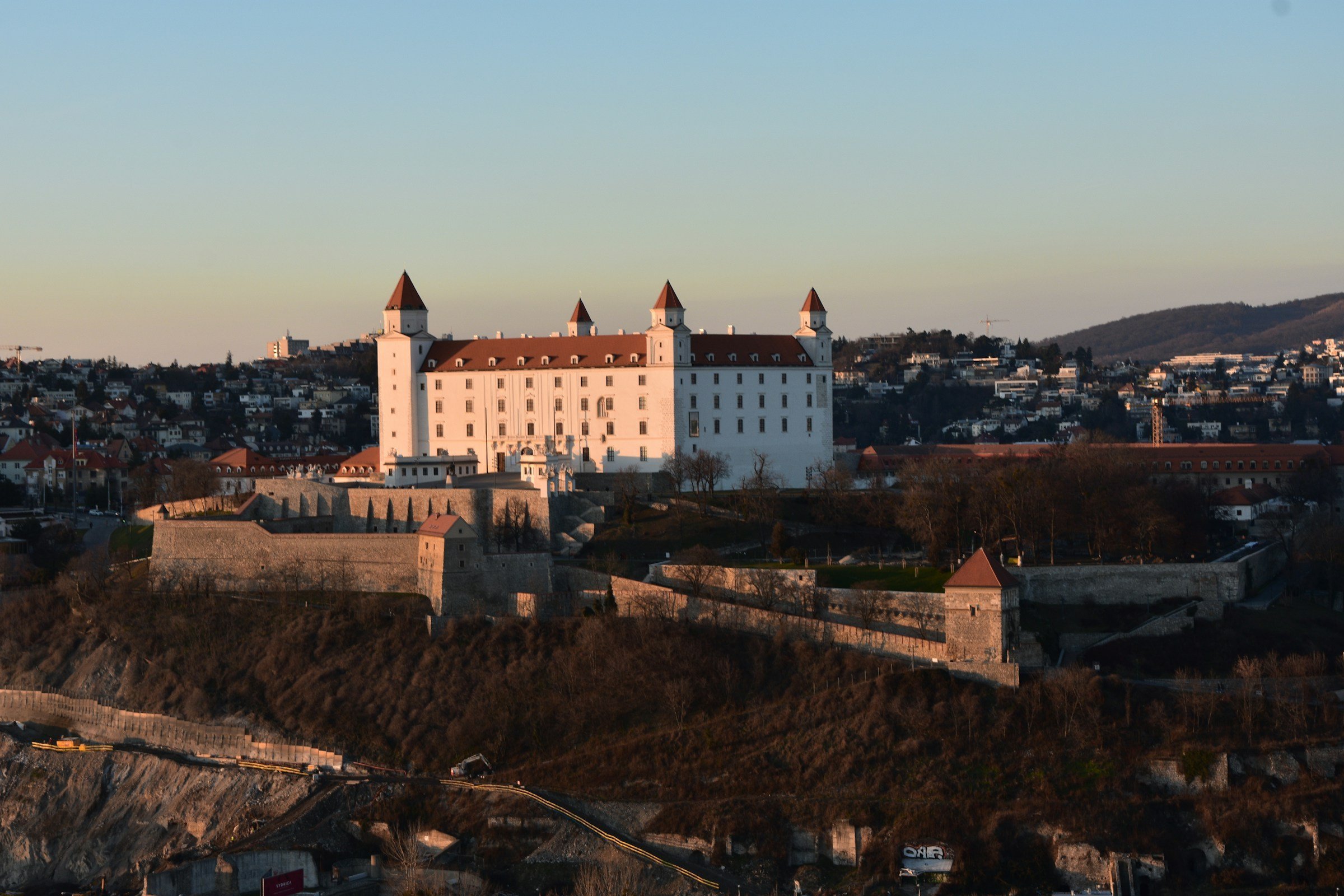
Why does Bratislava Castle look like a piece of Soviet furniture?
People ask this within ten minutes of arriving. The castle sits on a hill visible from almost anywhere in the Old Town, a white rectangular block with four corner towers. It looks like someone flipped a table upside down. The comparison everyone makes is to an IKEA piece that came with missing instructions.

Bratislava
The structure dates to the 9th century, rebuilt multiple times, burned down in 1811, and left as a ruin until the 1950s when the communist government decided restoration meant stripping away baroque detail and painting everything institutional white. They wanted clean lines. They got a building that photographs like a bureaucrat’s fantasy of what a castle should be.
Inside, the castle houses the Slovak National Museum and offers views across the Danube into Austria. The courtyard gets wedding photos on weekends. The exterior remains that peculiar white block, and locals either defend it as brutalist heritage or wish someone would add back the decorative elements that got erased. No middle ground exists on this.
What is the UFO Bridge actually called?
Most SNP Bridge. Named for the Slovak National Uprising of 1944. Nobody calls it that. Everyone says UFO Bridge because of the observation deck shaped like a flying saucer perched on a single pylon 85 meters above the Danube. The elevator costs 10 EUR (around $11 USD) to reach the viewing platform and restaurant.
The bridge opened in 1972 and required demolishing most of the Jewish quarter to build the access roads. This fact gets mentioned in every guidebook and ignored by every Instagram post. The view from the top shows the castle, the Old Town spires, and the Petržalka housing estates stretching south. Those estates house one-third of Bratislava’s population in identical panel apartment blocks.
The restaurant up there serves overpriced Slovak food and expects you to spend 20 EUR ($22 USD) minimum if you skip the observation deck ticket. Go for a drink at sunset. The view matters more than the menu.
Do people actually eat in the UFO restaurant?
Tourists do. Locals went once for a birthday or anniversary and decided the novelty didn’t justify the prices. The bryndzové halušky costs three times what you pay at a normal pub for potato dumplings with sheep cheese. The space feels like a corporate event venue that happens to rotate slowly above a river.
Is the Old Town actually medieval or just themed?

Bratislava
The layout is medieval. The buildings are reconstructions. Bratislava took damage in World War II, then spent four decades under a government that valued concrete housing blocks over heritage preservation. Restoration happened mostly after 1989, sometimes faithful to original plans, sometimes guessing.
Michael’s Gate and tower from the 14th century survived intact. St. Martin’s Cathedral, where Hungarian kings got crowned for 300 years, kept its gothic bones. The narrow streets between Hlavné Námestie and the castle walls follow medieval paths. But walk those streets and you notice how many buildings have clean modern interiors behind historical facades.
Hlavné Námestie gets criticized for looking like a film set. The pastel buildings around the square got restored in the 1990s with EU money. They photograph well. They also house Starbucks, souvenir shops selling matryoshka dolls despite being in Slovakia, and restaurants with menus in five languages.
Three blocks away on Obchodná Street, you find a different Bratislava. Soviet-era department stores, concrete plazas, tram lines. That contrast happens fast. Medieval core, communist perimeter. No gradual transition.