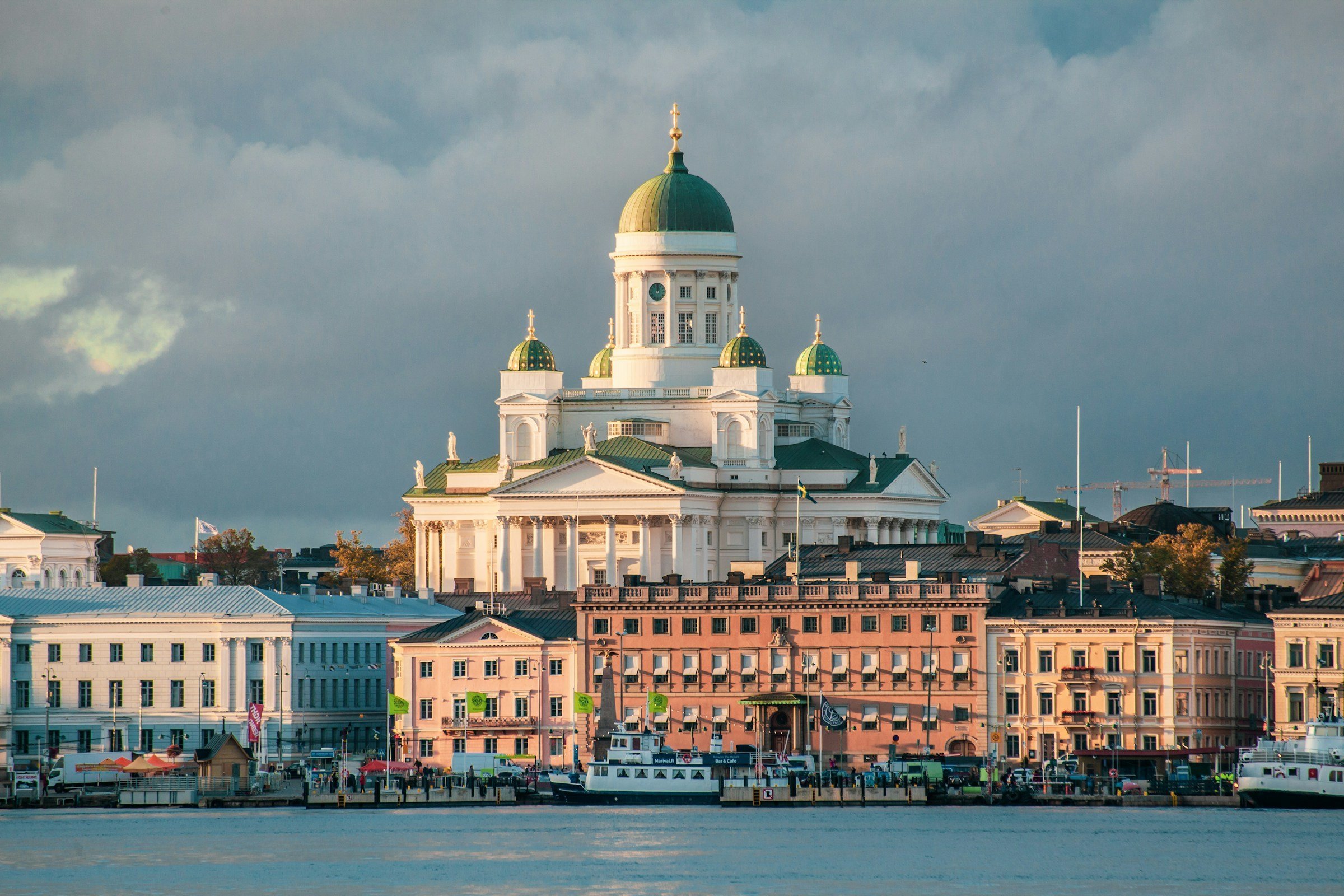
The light problem nobody mentions until you live here
You arrive in Helsinki and someone mentions the sun. Not weather small talk. An actual warning about the light, or the absence of it, or the overabundance of it depending on when you show up. By your third month you understand this is the organizing principle of the entire city. The architecture, the drinking culture, the way people fill their apartments with candles even in summer, the reason public saunas are not quaint traditions but survival infrastructure. Helsinki is a city engineered around managing what the sun does to human psychology when it stays away for months or refuses to leave for months.

Helsinki
During the darkest stretch, the sun climbs above the horizon around 9:15 and drops again before 15:30. Except “climbs” is generous. It drags itself to a sad angle, casts long shadows that never resolve into proper daylight, then gives up. You walk to a museum at noon and the light has the quality of dusk. People move through this with a kind of practiced efficiency, but the coffee consumption tells the real story. Finns drink more coffee per capita than anywhere else on the planet, and the darkness explains a lot of it. Without caffeine you end up staring at a dark window at 14:00 wondering if you imagined the sun ever existing.
The city’s design admits this openly. Look at Oodi, the central library that opened a few years back. Floor-to-ceiling windows on three sides. The entire building is a light trap, a place to sit with a book while absorbing every available photon. Cafes face south and charge extra for window seats without saying that’s what they’re doing. The Allas Sea Pool, a complex of heated pools and saunas on the waterfront, makes no sense until you realize it’s a strategic deployment of warmth and social density against the void of midwinter. You sit in 27-degree water while snow collects on your hair and you understand that luxury here is not marble countertops but access to light and heat when the environment provides neither.
Summer runs on revenge
Then the planet tilts and the whole arrangement inverts. The sun comes up before 04:00 and sets after 22:00, and for a few weeks in the middle it barely sets at all. The first night you try to sleep through this you realize every blind in Helsinki is industrial-grade blackout material. You see teenagers drinking beer in Kaivopuisto park at 23:00 in full daylight and it breaks something in your brain about what evening means. The city’s summer personality is pure retaliation against the winter that just ended and the winter that’s already waiting six months out.
Terraces that sat empty and shuttered in the dark months suddenly have two-hour waits. Helsinkians drink wine at outdoor tables in 16-degree weather because being outside while the light lasts matters more than the temperature. The ferries to Suomenlinna run packed with people who just want to be on water while the sky stays bright. You see this especially on the islands. Pihlajasaari fills with people who have stripped down to swimsuits in water that’s maybe 17 degrees, and no swimmer there pretends this is comfortable. They’re just refusing to waste a single hour of sun.
The restaurant scene shifts entirely. Places like Juuri and Grön that built reputations on new Nordic cooking pivot their menus to ingredients that only exist for eight weeks. Chanterelles, new potatoes, Baltic herring that tastes different in summer, berries that grow in forests an hour north. You pay €38 for a tasting menu that’s essentially a countdown timer on the growing season. The prix fixe at Demo changes every three weeks because that’s how fast things come in and out of season when your summer is that compressed.
The architecture of coping

Helsinki
Walk through Kallio or Punavuori and you notice the windows. Huge windows, sometimes entire walls of glass in buildings that should be freezing. Triple-glazed, argon-filled, with frame technology that costs more than the furniture inside, but the priority is clear. Light matters more than privacy. More than heating efficiency, even, though Finns will argue their windows are efficient too. Every building design is a negotiation with the light problem. Even the brutalist housing blocks from the 1960s have oversized windows because some architect understood that people lose their minds without daylight.
The sauna obsession makes more sense here too. There are public saunas all over the city, not tourist attractions but neighborhood facilities. Löyly on the waterfront, Kulttuurisauna near Hakaniemi, Kotiharju in Kallio. You pay €15, sit in cedar-lined heat with strangers, jump in the Baltic, repeat. Think of it as a forced reset of your nervous system, which starts to feel necessary when the sun won’t cooperate with your circadian rhythm. I watched a woman at Kulttuurisauna sit through three rounds of steam, walk outside into 22:00 daylight in summer, and say to her friend, “I can finally sleep now.” For her the sauna was a way of recalibrating her body to accept that bright evening light doesn’t mean stay awake.
Even the central train station, designed by Eliel Saarinen, has those massive arched windows in the waiting hall. Train stations are usually caves. This one insists on natural light even though it’s underground for half its length. The metro stations have skylights where they shouldn’t structurally need them. The Kamppi bus terminal, which should be a fluorescent nightmare, has a glass atrium. The city keeps trying to import the sky indoors because it can’t trust the sky to be useful on its own schedule.
What survives the swings
You meet people who moved here from elsewhere and they all tell versions of the same story. The first winter nearly broke them, the first summer felt like a manic episode, and somewhere in the third year they stopped fighting it and started planning their entire year around the light. You stock up on vitamin D supplements in autumn. You book trips south during the darkest months not for vacation but for survival. You learn to drink your coffee by the window at Cafe Regatta when the darkness stretches longest and guard those hours like they’re medication, because they are.
The drinking culture makes more sense through this lens too. Finland has a reputation for heavy alcohol consumption and it tracks directly with the seasonal brutality. The bars in Kallio stay packed through the dark months not because Finns are social butterflies but because sitting alone in a dark apartment at 16:00 when the sun just set is intolerable. You drink because the alternative is confronting what endless darkness does to your mood without a buffer. The city’s entire social infrastructure is built to keep people from isolating during the months when isolation feels like the only reasonable response to the environment.
Food prices reflect this too. Fresh vegetables in winter cost double what they cost in summer because they’re shipped from Spain or the Netherlands. A tomato during the cold months is €4/kg, a luxury item, while the same tomato when the sun stays high is €1.50. You learn to eat root vegetables and preserved fish in winter because that’s what the economics and the latitude allow. The summer markets like Hakaniemi sell strawberries for three weeks and everyone acts like it’s a religious event because next week they’ll be gone and you’ll be back to apples from Poland.
Helsinki works if you accept that you’re living in a city designed around compensating for what the planet’s tilt does at this latitude. The light dictates everything. The architecture, the food, the social patterns, the public infrastructure. You’re not visiting a city with some charming quirks about daylight. You’re entering a 200-year experiment in how humans adapt urban life to environmental conditions that shouldn’t really support a city this far north. It works, but only because every single element of how the place functions acknowledges the light problem and builds around it.
If you liked this, you might like: Brussels, Bratislava, Moscow.
Planning the trip? Compare hotel deals before you book.