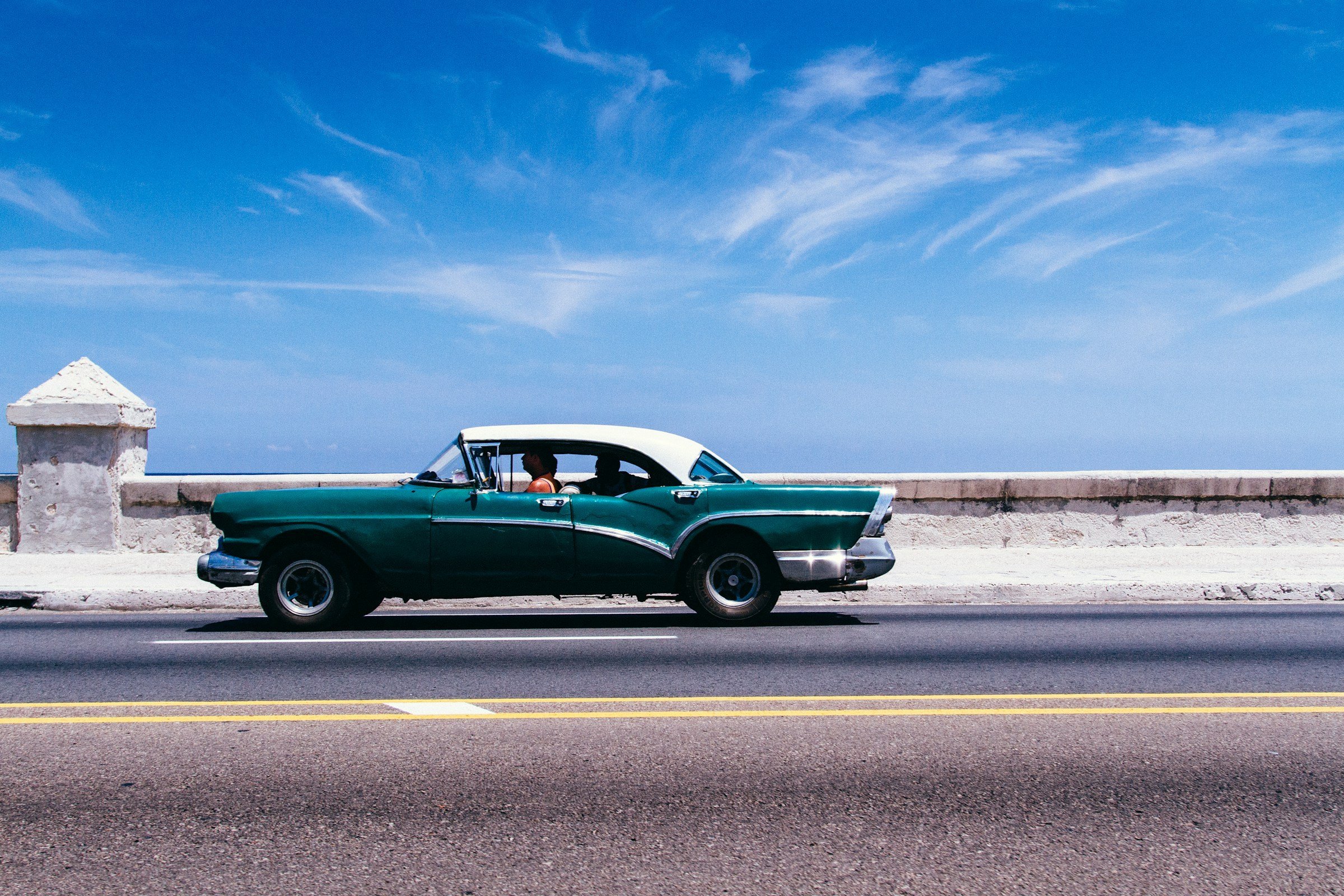
You walk past a 1957 Chevrolet Bel Air, still running, still ferrying passengers, and realize Havana achieved something no American city could: it stopped. While Detroit demolished Packard plants and Dallas buried its streetcar tracks, Havana kept what it had because replacement was impossible. The revolution that seized banks and factories also locked the built environment in place. What looks like preservation was actually immobility.
Havana
The cars everyone photographs are the obvious proof, but they are also the least interesting part. Every Pontiac still coughing along Malecón has a Lada engine or Chinese parts or something welded from Soviet tractor stock. They are maintained, not preserved. What matters more are the buildings, the street grid, the scale of commercial blocks that American cities ripped out for parking lots and highway ramps. Havana never got the money to do that kind of damage.
Stand at the corner of Calle O and Calle 23 in Vedado and you are looking at what every American downtown looked like in 1958. Mid-rise apartments with balconies, ground-floor shops with hand-painted signs, sidewalks wide enough for people to stop and talk without blocking foot traffic. The Habana Libre hotel looms above, a Hilton before it became a Hilton, its modernist bulk exactly what downtown Minneapolis or Atlanta built before they built three more and demolished the neighborhood that surrounded the first one. Havana built one and stopped.
The Grid Nobody Bulldozed
Vedado’s street plan is a perfect grid extending west from the Malecón seawall. The streets have numbers or single letters. The blocks are compact. There are no superblocks, no cul-de-sacs, no streets that force you onto an arterial road after three turns. This is the walkable urbanism that American planners now spend millions trying to recreate in suburbs, and it exists in Havana because the government was too broke to replace it.
You can walk from the Hotel Nacional to the University of Havana in twenty minutes, passing through residential blocks where laundry hangs between buildings and kids play baseball with sticks and bottle caps. The buildings are crumbling, paint peeling in sheets, balconies propped with wooden beams. Some look ready to collapse. But the street pattern holds, and the mixed-use density holds, and you never lose the sense of being in a city designed for people who walk.
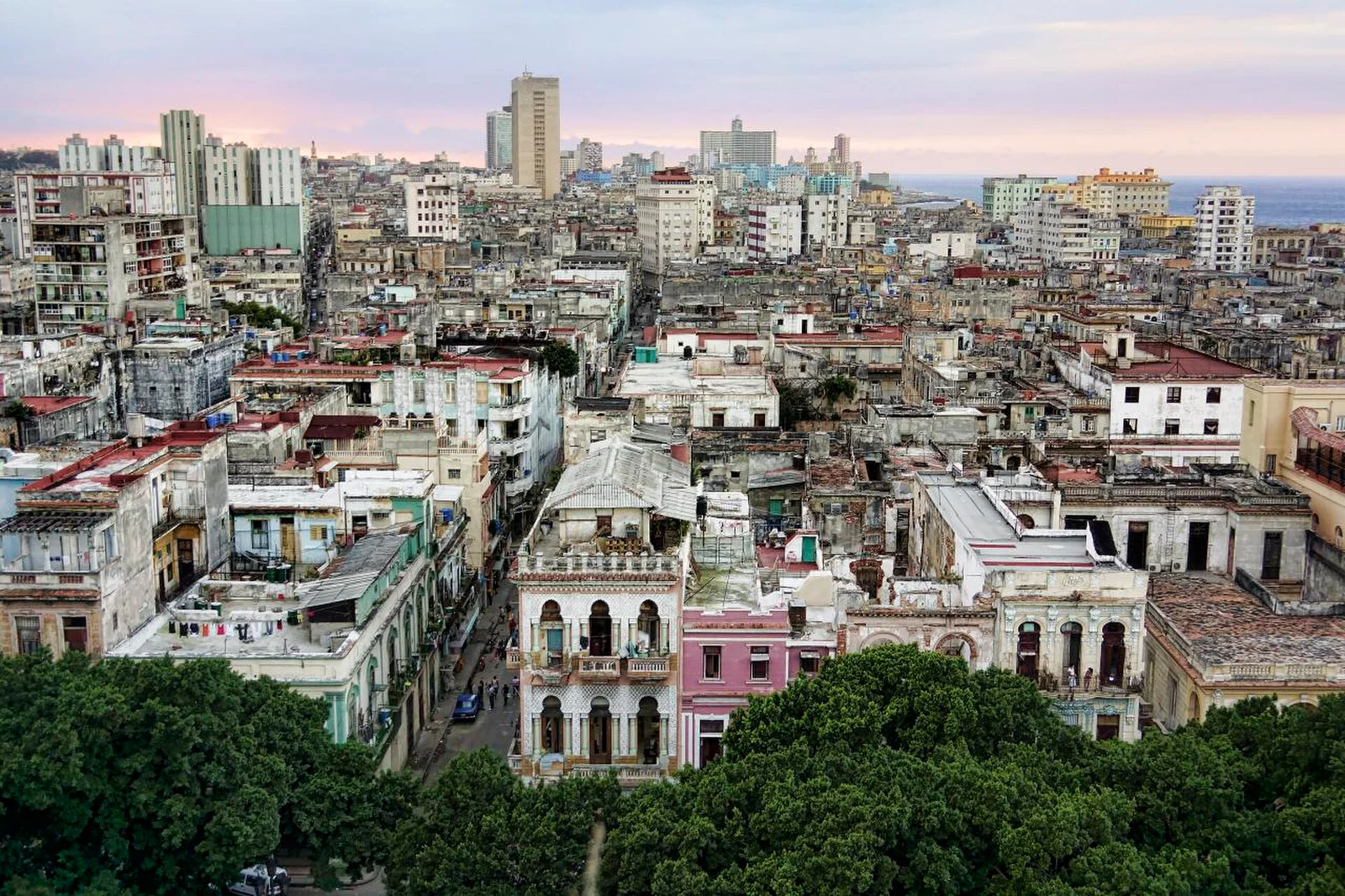
Old Havana has the colonial core, the plazas and churches and fortresses that every guidebook covers. What tourists miss is that the nineteenth-century expansion east and west of that core also survived. Centro Habana, the neighborhood between Old Havana and Vedado, is a grid of five-story buildings with commercial ground floors and residential units above. It is denser than Vedado, poorer, hotter. Entire families live in single rooms with fourteen-foot ceilings. But the street life is intact. Vendors sell peanuts in paper cones. Men play dominoes on card tables. There is a bodega every three blocks, not a supermarket in a parking lot fifteen minutes away by car.
This is what American cities demolished in the name of urban renewal. They called it blight and brought in the bulldozers. Havana called it the same thing and did nothing because doing nothing was the only option. The result is a city where the fabric of pre-war urbanism is still legible, still functioning, still shaping how people move through space.
Decay as Preservation Strategy

Havana
The paint is not charming when you live under a roof that leaks. The romance of ruins is a tourist luxury. But decay does preserve a certain truth: these buildings were made to last, and they have, barely. Walls are two feet thick. Ceilings are high because air conditioning was not assumed. Windows are large, shuttered, designed for cross-ventilation. You can see how people lived before cheap energy made architecture disposable.
American cities tore down their pre-war housing stock because maintaining it was expensive and building cheap替代. Havana could not afford replacement, so maintenance became an improvised art. You see rebar jutting from balconies where repairs started and stopped. You see apartments retrofitted with satellite dishes and Chinese air-conditioning units, colonial bones wrapped in socialist neglect and post-Soviet jury-rigging. It is a palimpsest that no city with money would tolerate.
The upside is authenticity, if that word means anything. There is no Disney version of Havana, no scrubbed waterfront development with condos and Starbucks. The Malecón seawall is where people fish, where couples sit at night, where waves crash over the roadway during storms and soak everyone walking past. It has been the same stretch of concrete since 1952. The government talks about restoring it. The government has been talking about restoring it for decades. Meanwhile, it remains what it is.
What the Embargo Locked In
You cannot separate Havana’s frozen condition from the American trade embargo, which cut off access to materials, investment, and the logic of consumer capitalism that rebuilt every other city in the hemisphere. Havana missed the 1970s. It missed the 1980s. It missed globalization, gentrification, Walmart, the mortgage boom, the entire economic engine that turned Mexico City and São Paulo into modern metropolises with functioning infrastructure and functional inequality.
Instead, Havana got ration books and Soviet concrete apartment blocks in the outer neighborhoods. It got a dual-currency system where tourists pay in CUC and Cubans earn in CUP (twenty-five to one). It got a government that controlled all real estate and prevented the market from clearing out old neighborhoods for luxury development. Inequality exists, but spatial inequality is muted. There are no gated communities. The richest and poorest Cubans live within blocks of each other because housing is allocated, not sold.
The result is a city where a fifty-year economic freeze preserved the spatial logic of mid-century urbanism while also trapping residents in buildings that need repair and systems that barely function. The buses are crowded beyond capacity. Tap water is not safe to drink. Blackouts happen. The peso buys almost nothing. But the street grid is walkable, the density is human-scale, and the city has not been carved up by highways or hollowed out by sprawl.
What Comes After Frozen
Things are changing, slowly. Private restaurants (paladares) operate in living rooms. Private taxis compete with state cabs. Airbnb operates in a legal gray zone. The government loosened restrictions on private enterprise, then tightened them, then loosened them again depending on economic crisis and political mood. The future is unclear, but the direction seems obvious. Cuba needs money. Money will arrive with conditions. Those conditions will include development.
You can already see the first edge of it. Old Havana has been partially restored with foreign investment, and those blocks now look like Cartagena or Antigua, colonial theme parks aimed at cruise ship passengers. The rest of the city waits. If capital floods in, the crumbling buildings will be replaced or renovated. The street grid might survive if planners are smart. The density might survive if the government resists pressure to demolish and sprawl. But the frozen quality, the sense that you are walking through a city that missed seventy years of capitalism, will not survive. It cannot. Havana will thaw, and when it does, it will look like everywhere else.
Until then, you walk past the Chevrolets and the hand-painted signs and the bodega with three items on the shelves, and you see what American cities used to be before they chose speed and cars and disposability. Havana did not choose preservation. It was simply too poor to afford demolition. But the result is the same: a city where the past is not nostalgia but infrastructure, still standing, still used, still shaping daily life in ways most people no longer remember were possible.
If you liked this, you might like: Mexico City, Miami.
Planning the trip? Compare hotel deals before you book.