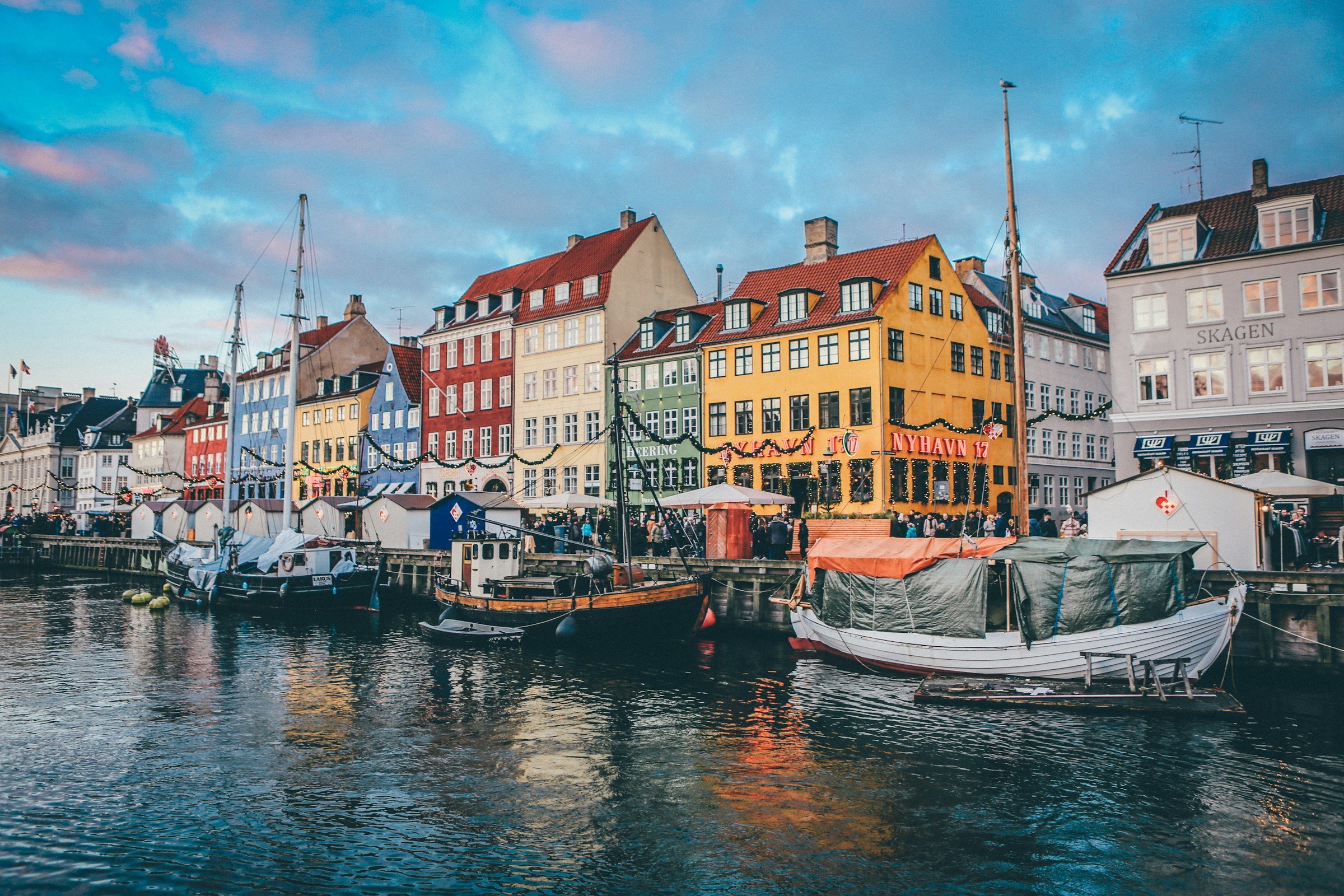
Why does everything look so accessible when there are literal palaces everywhere?
You walk past Amalienborg and realize the queen’s residence has no fence. Four identical rococo buildings face a cobblestone courtyard where tourists stand ten feet from windows where royalty eats breakfast. A single guard in a bearskin hat does ceremonial loops. No barriers, no keep-out signs, no reinforced perimeter.

The design philosophy is that power should look approachable. Christiansborg Palace, where parliament meets, lets you walk through the same doors as legislators. The prime minister bikes to work without a motorcade. You see ministers buying rye bread at Irma wearing the same Rains jackets as everyone else.
This creates a strange visual tension. The buildings assert monarchy and state authority with columns and copper domes, but the ground plane refuses to enforce separation. Rosenborg Castle sits in a public park where people sunbathe on the lawn in summer. The moat has ducks. You can walk up to the walls.
Danish design earned its reputation by making chairs and lamps that rejected ornamentation, but the ideology runs deeper. It is about stripping symbols of exclusivity even when the buildings themselves remain grand. The result is a city that wants you to believe power belongs to everyone, even as it maintains every visual marker of a thousand-year aristocracy.
Where does this obsession show up in ordinary buildings?
Social housing looks better than luxury apartments in most cities. Superkilen Park in Nørrebro has basketball courts and a Moroccan fountain and Thai boxing ring on land that used to be industrial nothing. The architects made public space as a political argument, not decoration.
Tietgenkollegiet student housing is a cylinder with 360 private rooms around a shared courtyard. Nobody gets a better view. Dormitory hierarchy is designed out. VM Houses in Ørestad has balconies angled so every unit gets sun and a view of the water, even though that created a jagged facade that cost more to build.
The Copenhagen Metro runs driverless trains with floor-to-ceiling windows because riders deserve to see where they are going. Platforms have glass walls and natural light even underground. This is expensive. They did it anyway because the transit system is a public good and should feel like one.
Louisiana Museum of Modern Art, 40 minutes north by train, has sculpture gardens that slope toward the sea. The art matters less than the premise that a museum should give you a view. Galleries have windows. You are allowed to ignore the Giacometti and watch the waves.
How do you spot the contradictions?

Copenhagen
The bicycle infrastructure is world-class until you want to bike after midnight when you have been drinking. Then the city’s car-free ideology meets its refusal to build late-night transit. The last metro runs around 12:30 on weeknights. Cabs cost 250 DKK ($36) to go three kilometers because the taxi system protects a cartel.
Noma closed after years of redefining Nordic cuisine while paying stages nothing. The restaurant became a symbol of the tension between Denmark’s egalitarian self-image and its tolerance for unpaid labor in the name of craft. Apprenticeships are fine. Thirty-year-olds working 14-hour days for free is a different thing.
The Freetown Christiania experiment in communal living has been running since 1971. It is also Copenhagen’s most visible hard-drug market. Police rarely enter. The city tolerates this because evicting a thousand people would contradict the story about inclusion, but nobody calls it success. You smell weed on Pusher Street and see paranoid tourists taking photos they were told not to take.
Strøget, the central shopping street, is pedestrian-only and filled with the same international chains you find in any European capital. The democratic design ideology does not extend to preventing H&M and Zara from occupying prime real estate. The street feels less Danish than the neighborhoods six blocks away.
What is the most honest example of the whole philosophy?
The Black Diamond library extension at the Royal Library is clad in black granite and glass. It tilts over the harbor. The reading rooms inside are open to anyone. You do not need a library card to sit at the long tables under the atrium. Students and retirees use the same chairs.
There is a bookshop and a cafe, but the core offering is free and unstaffed. Computers, desks, quiet. The assumption is that you will not steal books or damage furniture because the social contract is strong enough to make enforcement unnecessary. This mostly works.
I watched someone leave a laptop on a table for 45 minutes while getting lunch. It was still there when he came back. The architecture is dramatic, but the program is pure access. The building argues that a public institution can be beautiful and grand without being exclusionary.
Does the obsession make the city feel sterile?
Yes, in Nordhavn and parts of Ørestad where new construction follows sustainability checklists but forgets to include anything weird. The buildings are correct. Bike lanes, green roofs, triple-pane windows. Also boring in a way that older neighborhoods are not.
Vesterbro has basement bars that feel like someone’s living room. Jægersborggade in Nørrebro has coffee roasters and natural wine shops in old pharmacies and hardware stores. These streets predate the design ideology and survived because nobody tore them down to build rational housing blocks.
The Meatpacking District got converted into restaurants and galleries but kept the industrial grit. You eat wood-fired pizza in a former slaughterhouse with hooks still in the ceiling. The design ideology allows this because it reads as authentic working-class history, even though the neighborhood now serves 160 DKK ($23) brunch to people in Ganni.
The best parts of Copenhagen are where the egalitarian ideology crashes into older layers and makes compromises. A rococo palace with no fence. A housing block with murals. A library in a tilted black box where anyone can walk in and stay all day.
If you liked this, you might like: Vienna, Vilnius, Oslo.
Planning the trip? compare hotel deals from Stavanger, Oslo, Bergen, and Trondheim.