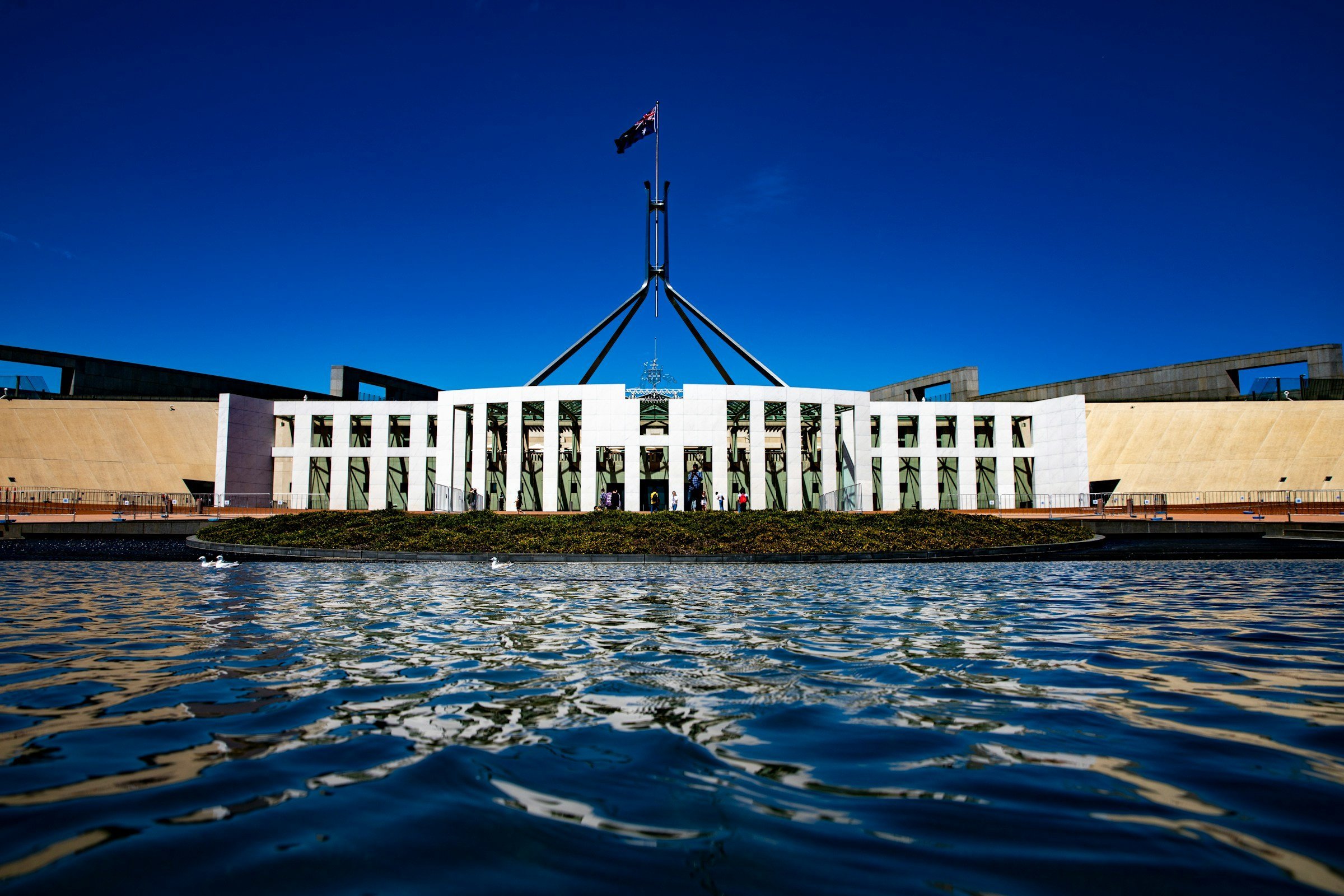
Why does everyone say Canberra doesn’t feel like a real city?
Because it isn’t one. Not in the way Sydney or Melbourne grew from convict camps and gold rush tent cities into something organic and messy. Canberra was drawn on paper by an American architect who won a design competition, then built in waves as federal money allowed. The street grid makes sense until you try to drive it. Roundabouts connect to roundabouts that feed into more roundabouts, and the suburbs have names like “Yarralumla” and “Deakin” that sound important but mean nothing to anyone who didn’t grow up here.

Canberra
You notice the emptiness first. Parliament House sits on a hill in the center, and around it: grass. Kilometers of it. The National Gallery, the War Memorial, the various museums, all spaced apart like someone was worried they might touch. Between my hotel in Civic and the lake, I walked past four separate empty parks before breakfast. The population is 460,000, but it feels like 80,000 because everyone commutes in from the suburbs and leaves by six.
Public servants make up a third of the workforce. The rest of the economy serves public servants. You see it in the restaurants around New Acton: places that do a $28 lunch special because someone else is paying. The coffee is excellent because Canberrans have standards and nothing else to do.
Is there anything to actually do besides tour Parliament?
The war memorial is worth three hours if you can handle that much nationalism at once. It’s free, massive, and genuinely moving if you ignore the gift shop. They’ve catalogued every Australian military death since 1885. You can search a database for your great-grandfather’s service record. The building itself is art deco on the outside, dimly lit galleries on the inside, with a central hall where they project poppies onto the tomb of the unknown soldier at closing time.
The National Gallery has a room of Aboriginal bark paintings that most people walk past to get to the Pollocks. Stay in that room. The paintings are from Arnhem Land in the 1970s, detailed creation stories on eucalyptus bark, and they’re displayed low enough that you can see the brush marks.
Questacon is a science museum aimed at kids but adults end up spending two hours there anyway. You can generate a mini earthquake, stand inside a tornado simulator, or learn why water spirals down a drain. It’s $32 AUD (21 USD) and rarely less than half full.
Lake Burley Griffin is human-made, dug out in the 1960s to match the original city plan. It’s pleasant enough for a walk. People kayak on it. There’s a fountain in the middle that shoots water 152 meters high on calm days, which feels like exactly the kind of detail a government capital would care about.
Where do people actually eat and drink?
Braddon, the neighborhood just north of Civic, has the highest concentration of restaurants that aren’t hotel dining rooms. Lonsdale Street runs four blocks and you can eat Laotian, Italian, Korean, or Greek without much walking. Morks is Thai with a wine list, busy most nights, and the crying tiger beef is salty enough to kill a cardiac patient. Bookings required on weekends.
Monster Kitchen and Bar in the Ovolo Hotel does brunch for people who think $24 smashed avocado (16 USD) is a reasonable price. It is not, but the room has floor-to-ceiling windows and the coffee comes in ceramic cups that weigh half a kilo.
BentSpoke Brewing in Braddon makes the best beer in Canberra, which is not a high bar but they clear it. The Crankshaft IPA is 6.2% and tastes like grapefruit rind. Locals drink here after work because there are only three other places in walking distance.
Kingston has older pubs. The Dock is a wine bar with share plates that change weekly. Mezzalira does Italian in a former industrial space, all exposed brick and hanging Edison bulbs, and the cacio e pepe is correct. You’ll pay $85 AUD (56 USD) per person with a glass of wine.
For cheap: Dickson has a cluster of Asian restaurants where public servants eat pho on lunch breaks. Bamboo Garden does hand-pulled noodles for $15 AUD (10 USD). The draw is the noodles, not the decor.
Do I actually need more than two days here?

Canberra
No. You can see Parliament, the war memorial, the gallery, and walk the lake in a day and a half if you start early. The second day drags unless you’re really into archives or brutalist government buildings.
People add Canberra to an east coast itinerary because it’s the capital and they think they should. Then they arrive and realize it’s three hours from Sydney and three hours from the coast and there’s no beach. If you’re doing Sydney to Melbourne by car, it’s a logical overnight stop. Otherwise you’re making a detour for bureaucracy.
The Australian National Botanic Gardens are worth an hour if you’ve never seen eucalyptus forests. They have 600 species of eucalypt, which sounds impressive until you’re staring at the 47th type of gum tree. The rainforest gully has better variety.
How do you actually get around without a car?
You rent a car. Canberra’s bus system exists but runs every 30 minutes outside peak hours and stops at seven most nights. The light rail connects Civic to Gungahlin in the north, which is of little use to visitors. Taxis are expensive because distances are long. An Uber from Civic to the airport is $35-45 AUD (23-30 USD) for 15 minutes of driving.
The city is flat and has bike paths, but they’re designed for weekend recreation, not transport. You can rent a bike and ride around the lake in two hours. You cannot bike to dinner in Kingston without adding 20 minutes to your trip.
Everything is further than it looks on a map. The war memorial appears close to Parliament until you’re walking it in summer heat and it’s been 25 minutes. Canberra was designed for cars in an era when petrol was cheap and emissions were not on the agenda.
What’s the one thing nobody tells you before visiting?
How cold it gets. Canberra sits at 600 meters elevation, inland, and winter nights drop to freezing. I stayed once when the hotel room heater ran all night. Locals wear puffer jackets to the pub. The city empties out in winter because public servants take leave and everyone else follows.
Summer is the opposite problem. It hits 35-40°C (95-104°F) with no ocean breeze, and the eucalyptus forests around the city make bushfire smoke a regular occurrence. The sky turns orange. You taste ash.
Spring is tolerable. The tulips in Floriade bloom and the city pretends it’s Amsterdam for a month. Autumn has clear skies and daytime temperatures around 20°C (68°F). Those are your windows.
If you liked this, you might like: Wellington.
Planning the trip? Compare hotel deals before you book.