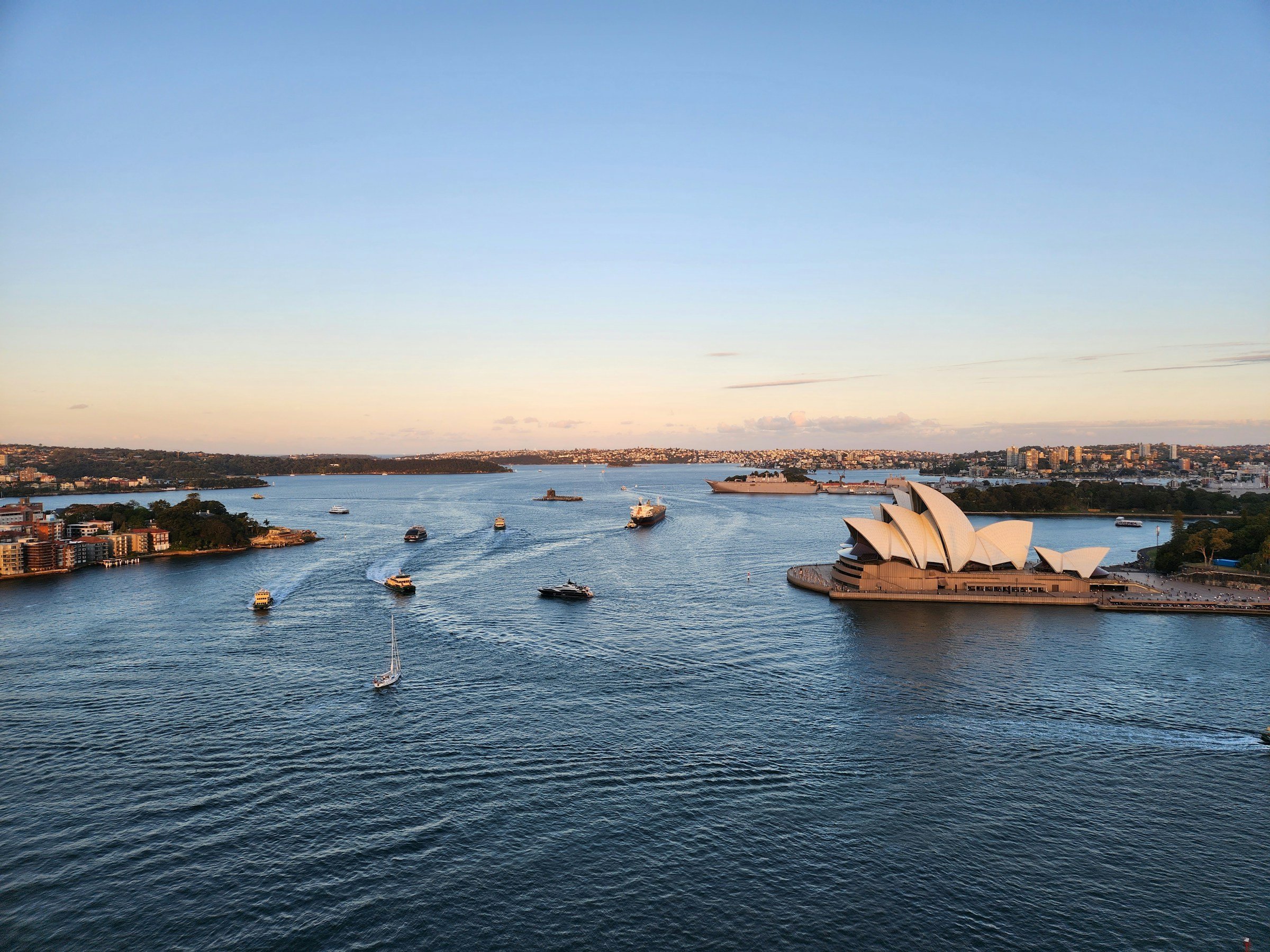
If you picture Sydney as a harbor with buildings around it, reverse that
Most cities have a center that spreads outward. Sydney works backward. The harbor is the center, and the actual urban mass sprawls inland from there in every direction for thirty kilometers. The Opera House and the Harbour Bridge sit at the geographic edge, not the middle. If you spend three days walking around Circular Quay and The Rocks, you have seen the postcard and missed the city.

Sydney
The CBD clusters on a narrow strip between the water and Central Station. Walk fifteen minutes west from Wynyard and you hit Darlinghurst, then Surry Hills, then neighborhoods most tourists never hear about. The density thins fast. Parramatta, twenty-three kilometers inland, feels like a separate city. It has its own river, its own train hub, its own downtown of glass towers. People commute from there into the harbor zone for work, then commute back out. The tourist circuit never touches it.
Ferries radiate from Circular Quay to harbor suburbs. Manly takes thirty minutes. Watsons Bay sits at the mouth where the Pacific starts. Balmain and Birchgrove cling to the western fingers of the harbor. These places exist because of water access, not because they are near anything else. Residents treat the ferry like a subway line. For visitors, it feels like a scenic cruise. Both are true.
The eastern beaches are not harbors and do not pretend to be
Bondi sits on the ocean, not the harbor. So do Coogee, Bronte, Tamarama, and Maroubra. They face southeast into the Tasman Sea. The water is colder and rougher than harbor water. The sand is coarser. The waves matter to surfers and to the swimmers who ignore the flags and get pulled out by rips.
Bondi gets the crowds because of the name. It also gets backpackers sleeping on the grass, tour buses unloading at the pavilion, and restaurants that know they do not need to try hard. The coastal walk south from Bondi to Coogee takes ninety minutes and stays interesting. Bronte has a better beach, fewer people, and a saltwater pool carved into the rock shelf. Coogee has families and actual residents. Tamarama is a slot canyon between cliffs where the surf pounds straight in.
These beaches do not connect to the harbor. You cannot walk from Circular Quay to Bondi along the water. The land mass between them is residential Sydney: Paddington, Woollahra, Edgecliff, Double Bay. The bus from the city takes forty minutes in traffic. The ocean and the harbor are two separate systems.
The CBD shuts down after office hours, which is not normal for a city center
George Street and Pitt Street are full of workers at lunch and empty by 7pm. The malls close. The food courts close. Martin Place has almost no foot traffic at night. This is strange for a downtown that bills itself as the heart of a major city. The actual nightlife happens in neighborhoods: Newtown for students and dive bars, Darlinghurst for restaurants that stay open late, Surry Hills for coffee that costs seven dollars and comes with oat milk.
The Star casino stays open because casinos always stay open. King Street Wharf has a strip of waterfront restaurants that cater to expense accounts. But walk three blocks inland from there and the streets are office buildings with locked lobbies. The CBD is a place people leave, not a place they go after dark.
Contrast this with Melbourne, where the CBD is thick with bars and restaurants until midnight. Sydney’s layout never forced density. The city spread horizontally because it could. Neighborhoods developed their own commercial strips instead of feeding into a single downtown core.
Inner west neighborhoods function as separate villages with their own pull

Sydney
Newtown has King Street running straight through it for two kilometers. Record shops, Thai restaurants, vintage clothing, bookstores that survived the internet. The street has been the same for twenty years, which means it is now retro. Students from Sydney University walk over. People take the train from other neighborhoods because Newtown still feels like Newtown.
Marrickville, two stops further out, is warehouse conversions and Vietnamese bakeries. The Addison Road Markets run every Sunday. Breweries opened in old factory buildings. This used to be the cheap option. Now it costs what Newtown cost ten years ago.
Glebe sits between the university and the harbor, close enough to both that it should be expensive everywhere. Half of it is public housing. The Saturday markets at Glebe Public School draw people from across the city. The bread stall sells out by 10am. The book stall has wooden crates of paperbacks for two dollars each.
These neighborhoods do not need the harbor. They do not depend on tourist traffic. They are not extensions of the CBD. They are their own anchors.
The northern beaches exist in a different mental zone entirely
Cross the Harbour Bridge or take the tunnel and you enter the northern suburbs. Mosman, Neutral Bay, Cremorne. Money lives here. The houses have water views. The streets are quiet. This is not where you go to walk around.
Keep going north and you hit Manly, which is both a ferry destination and the gateway to the northern beaches. Freshwater, Curl Curl, Dee Why, Collaroy. These are surf beaches with residential sprawl behind them. They do not connect to the eastern beaches. They do not connect to the inner west. They are a separate strip facing a different stretch of ocean.
People who live on the northern beaches talk about going “into the city” the way people in outer suburbs talk about it. The trip is long enough to require planning. The bus from Mona Vale to Wynyard takes seventy minutes. The northern beaches are Sydney in the technical sense but not in the daily sense.
The actual size of this city does not register until you try to cross it
Sydney sprawls across 12,000 square kilometers. The train network runs from Richmond in the northwest to Waterfall in the south, a span of ninety kilometers. Penrith sits at the foot of the Blue Mountains, an hour and fifteen minutes from Central Station. That is still Sydney.
You do not feel this sprawl when you stay near the harbor. The tourist zone is compact. But try to visit someone in Campbelltown or take a day trip to the Royal National Park and you realize the city is huge and mostly horizontal. It spread along the coast and inland across flat terrain with nothing to stop it.
This is why traffic is bad and why the train matters. The distances are too far to drive casually. Forty kilometers is a normal commute. People live in one zone and work in another and the two zones barely overlap.
If you liked this, you might like: Canberra, Wellington.
Planning the trip? Compare hotel deals before you book.