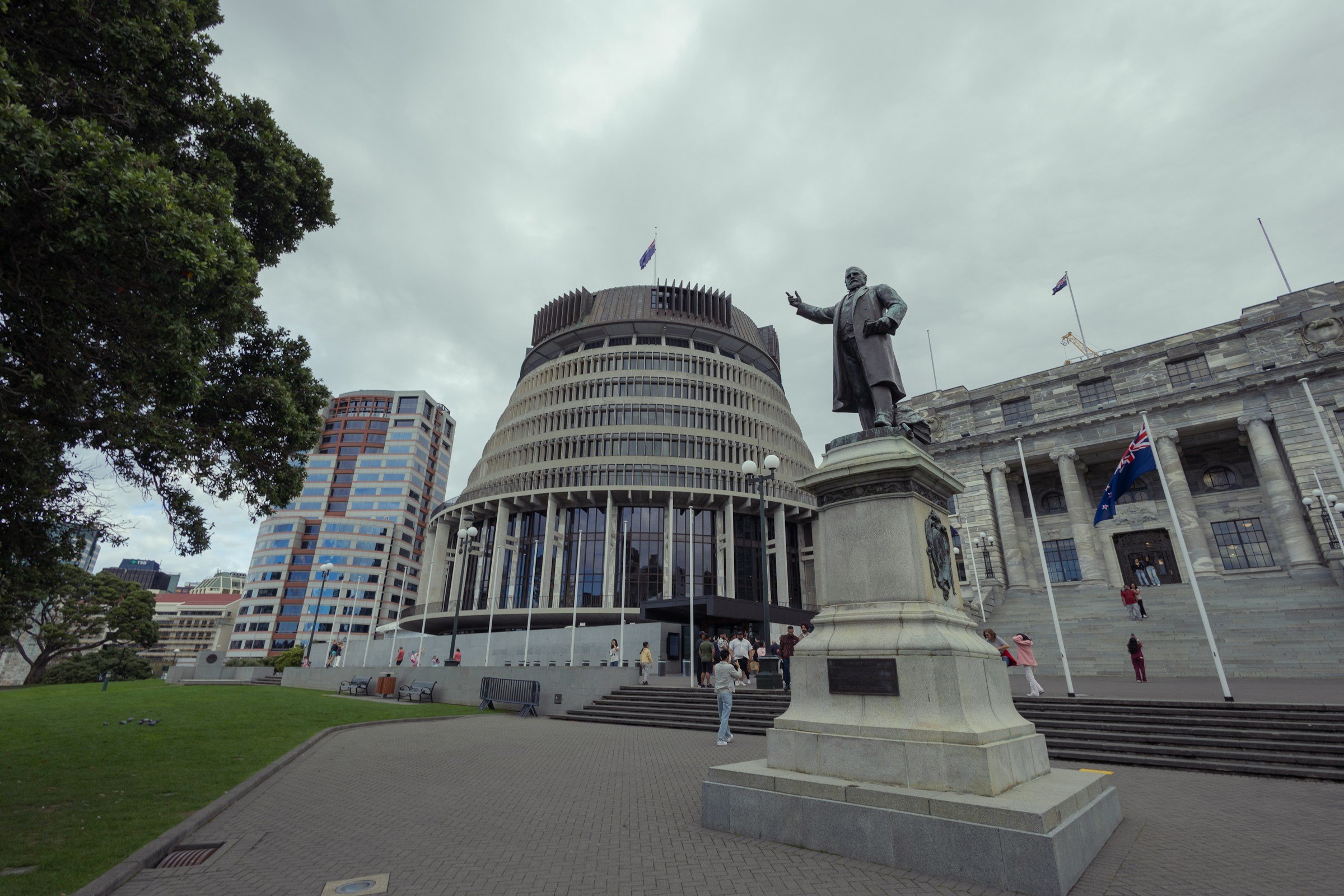
You step off the ferry at Queens Wharf and the wind hits you sideways. Wellington announces itself this way, a gust that can pivot a person mid-stride. The harbor stretches behind you, calm enough for sailboats, but the air above it moves like something chased. This is a city built on slopes too steep for normal planning, where the grid gives up halfway through and streets turn into staircases. Everything feels like it might blow away or slide into the sea.

Wellington
Lambton Quay and the Cable Car
You walk up Lambton Quay, the main drag that runs parallel to the waterfront. Office towers press against hills that rise at angles you associate with ski slopes. The storefronts are standard, international chains mixed with local cafes, but look up and you see houses perched on ridges that seem improbable. How did anyone get lumber up there? How does mail arrive?
The cable car station sits at the base of one of these climbs. You pay NZD $9.50 (USD $5.70) for a round trip and board a red carriage that tilts backward as it ascends. The ride takes four minutes. Through the window you watch the city compress below you, the harbor widening, the hills multiplying in every direction. At the top is the Botanic Garden, 64 acres of maintained green that feels like a temporary truce with the wind. Native ferns and imported roses share space. Paths switchback down toward the city, but most people take the cable car back. The descent on foot is steep enough that your knees complain.
Kelburn and the University Strip
From the Botanic Garden you can walk into Kelburn, where Victoria University sprawls across hillsides in a series of 1960s concrete blocks and newer glass buildings. Students move between lecture halls on paths that zigzag to manage the grade. The wind up here is worse, funneled between buildings, strong enough that the university installed railings on some walkways. On bad days you see people bent nearly double, pushing forward.
The campus bleeds into residential streets where wooden houses cling to slopes with foundation work that looks like guesswork. Some homes have garages at street level and living rooms three stories down. Others have decks cantilevered out over nothing, held up by posts that seem too thin. After the 2016 Kaikoura earthquake, engineers red-tagged dozens of homes in this neighborhood. The terrain here is not cooperative.
Cuba Street and the Flat Center
You descend back toward the waterfront, this time aiming for Cuba Street, one of the few areas where the ground stays level for more than a block. The street is pedestrian-only in sections, lined with thrift stores, record shops, cafes that roast their own beans. Wellington’s cafe culture is aggressive. Flat whites cost NZD $5 (USD $3), and baristas will argue about extraction times.
The Cuba Street vibe is defiantly scruffy. Bucket fountains, an actual kinetic sculpture of buckets that tip and clang, sits in the middle of the street. Vintage clothing stores sell wool coats you will need because the temperature drops ten degrees when the wind shifts. You notice that almost no one carries an umbrella. They are useless here, inside out within seconds.
For lunch you try a pie from one of the bakeries. Steak and cheese, lamb and rosemary, butter chicken. These are not American pies. The pastry is thick, the filling dense, and you eat it while walking because sitting outside is a gamble. A gust can take your napkin to the harbor.
Te Papa and the Waterfront

Wellington
You walk east toward Te Papa, the national museum that sits directly on the harbor. Entry is free. Inside are Maori meeting houses, treaty exhibits, natural history displays about earthquakes and volcanoes. New Zealand sits on a tectonic boundary, and Wellington is overdue for the next big one. The museum has seismic isolators under the building, visible through cutaway displays. You can see the rubber pads and steel that let the structure float during a quake.
Outside Te Papa the waterfront promenade continues past Waitangi Park and toward Oriental Bay, the city’s attempt at a beach neighborhood. The bay has sand, imported, and a curve of cafes and apartments that would feel Mediterranean if not for the wind. Even in summer you see people in windbreakers. The water is cold, the Cook Strait current flowing through, and swimming here is for locals who have built up tolerance.
Mount Victoria and the Eastern Hills
From Oriental Bay you can climb Mount Victoria, another slope that redefines steep. The road switchbacks up through residential streets where every house has a view and a structural engineer on speed dial. At the summit lookout, 196 meters above sea level, you get the full picture. Wellington is a city squeezed into the margins, hemmed by hills on three sides and water on the fourth. The airport runway juts into the harbor, built on reclaimed land because there was nowhere else flat enough. Planes approach at angles that make passengers grip armrests.
The wind at the summit is relentless. Explanatory plaques bolted to concrete show fault lines, prevailing wind patterns, historical photos of landslides. The 2013 Seddon earthquakes damaged hundreds of buildings downtown, many still under repair years later. Insurance here is expensive when you can get it.
Brooklyn and the Southern Fringe
You descend the southern side of Mount Victoria into Brooklyn, a suburb that clings to yet another ridge. The Brooklyn Wind Turbine, a single massive blade visible from across the city, spins almost constantly. It generates enough power for 60 homes, a reminder that at least the wind is useful for something.
The streets here are narrow, one lane in sections, with pull-over spots where cars negotiate who reverses. Houses are weatherboard and corrugated iron, paint jobs that need constant upkeep because the salt air and wind strip everything bare. You notice retaining walls everywhere, some professional concrete work, some improvised timber and prayer.
From Brooklyn you can see the airport clearly, planes dropping toward that stub of runway, the harbor beyond, the hills rising on the far side in the Hutt Valley. The city looks fragile from this angle, temporary, a settlement that exists because someone decided to try despite the terrain and the wind and the fault lines. It should not work, but it does, barely, provisionally, one gust away from reconsidering.
If you liked this, you might like: Sydney, Canberra.
Planning the trip? Compare hotel deals before you book.