Why does it feel like I’m leaving the city when I’m only twenty minutes from Copacabana?
You follow the switchbacks up Morro dos Prazeres and the apartment towers disappear behind vegetation that closes in from both sides. The road narrows. Motorcycles pass with centimeters to spare. You can still hear traffic from the main avenue below, but it’s muffled now, arriving in waves when the breeze shifts. The air is cooler. By the time you reach the top, you’re in a neighborhood of narrow alleys and painted concrete homes stacked on a gradient so steep that front doors open onto rooftops of the houses below.
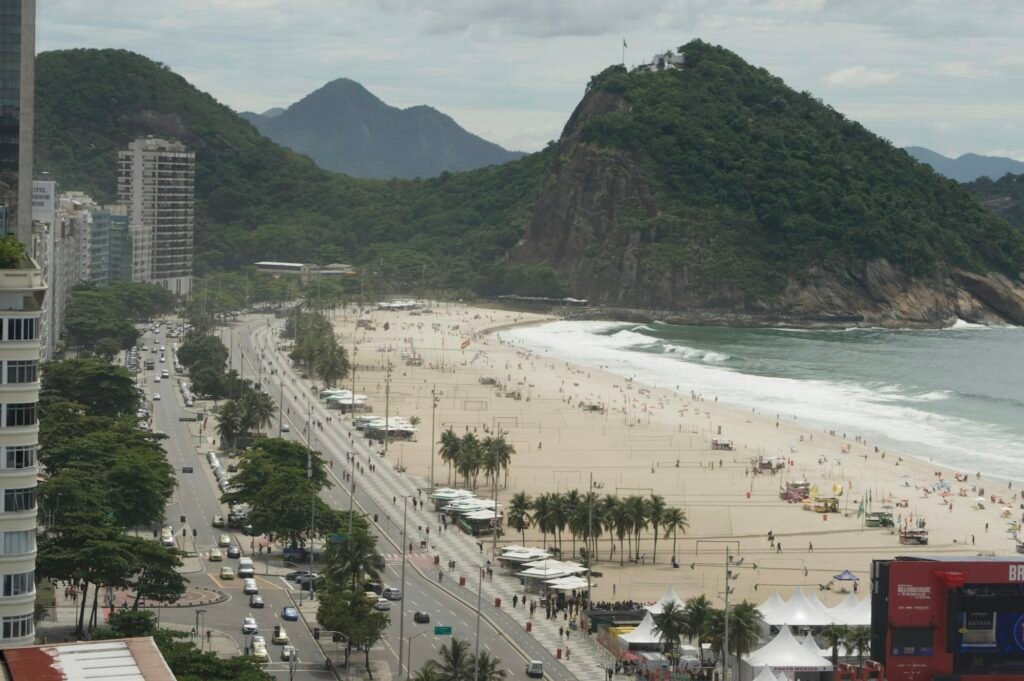
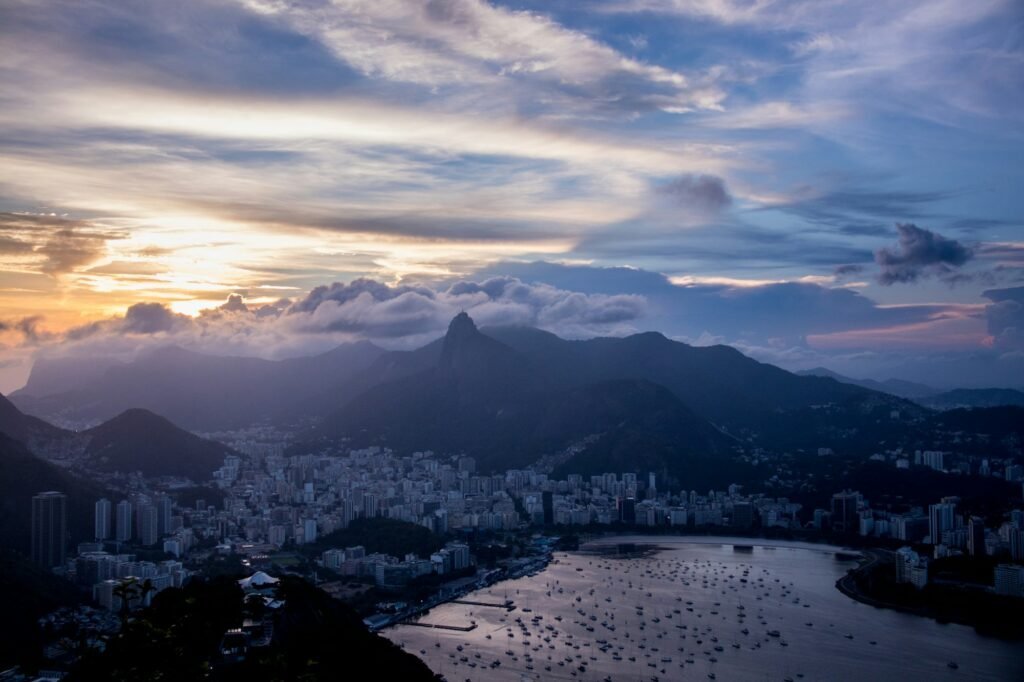
Rio’s mountains don’t sit at the edge of the city. They erupt inside it. Corcovado, Dois Irmãos, Pedra da Gávea, and dozens of smaller peaks create isolated pockets where the urban grid simply stops. Roads can’t follow the gradient. Bus routes terminate. The favelas that climb these slopes exist in a different gravitational reality than the beachfront neighborhoods ten minutes away by car. Same city, different altitude, completely separate infrastructure.
The disconnect isn’t metaphorical. In Rocinha, the largest favela, you can stand on a rooftop and see the Sheraton below you in São Conrado. The hotel has valet parking and a pool. The favela has staircases that climb eight stories without a break. Both exist on the same mountainside. Neither acknowledges the other except in the abstract.
Can I actually walk between neighborhoods or do the mountains make that impossible?
You can walk from Copacabana to Ipanema along the beach in thirty minutes. Flat sidewalk, ocean breeze, vendors selling coconut water every hundred meters. Now try walking from Copacabana to Laranjeiras. The map says it’s two kilometers. The elevation gain says otherwise. You start climbing and the streets become staircases. The staircases become trails. You’re in forest now, with city visible through the canopy on both sides. It takes an hour and you arrive sweating through your shirt.
The mountains create vertical barriers that don’t show up on flat maps. Santa Teresa sits on a ridge with views over downtown, but reaching it from Centro means either taking the ancient tram or climbing streets so steep that cars park at forty-five degree angles with wheels turned hard into the curb. From Botafogo to Humaitá is theoretically walkable, but the route goes over a saddle between peaks and most people take the tunnel instead.
Taxis and rideshares know this. Fares double for trips that cross elevation zones, even when the straight-line distance is short. The driver isn’t gouging you. They’re accounting for the fact that climbing from sea level to three hundred meters and back down again uses more fuel than driving five kilometers on flat ground.
What happens when a favela and a wealthy neighborhood share the same slope?
Rio de Janeiro
In Vidigal, luxury condos are going up halfway up the mountain. The favela continues above them and below them. Residents cross paths at the base where the main road ends and the motorcycle taxis start. The condos have security gates and underground parking. The favela has a network of alleys too narrow for cars. Both have views of Ipanema and Leblon. Property values suggest these are different worlds. The mountain suggests they’re the same place at different elevations.
The tension is spatial, not abstract. A mansion in Joá backs up against the forest that separates it from Rocinha. High walls. Cameras. Guards. But sound carries over walls and the favela is loud at night. Music from baile funk parties, motorcycles accelerating up the hill, voices echoing off concrete. The mansion can insulate itself physically but the mountain doesn’t allow acoustic separation.
Santa Teresa has a similar dynamic, though older. Colonial homes restored as boutique hotels sit on the same streets as crumbling tenements. The ridge is narrow. There’s nowhere else to build. Rich and poor don’t mix socially, but they share the same bus route because there’s only one road and it’s barely wide enough for the bus to pass parked cars.
Does the altitude actually change the weather or does it just feel different?
It’s thirty-four degrees (ninety-three Fahrenheit) at Arpoador. You take a taxi to Alto da Boa Vista, at the base of Tijuca Forest, and it’s twenty-eight degrees (eighty-two Fahrenheit). Six degrees cooler, but it feels like more because you’re out of the humidity trap that sits over the beaches. The ocean heats the coastal air. The mountains block the breeze from reaching inland neighborhoods. The result is that Copacabana swelters while Cosme Velho, just uphill, gets afternoon thunderstorms that never reach sea level.
Rain behaves differently at altitude. On the coast, storms roll in from the ocean and dump water for an hour before moving on. In the mountains, clouds form around the peaks and release steady drizzle that lasts all afternoon. The forest absorbs it. The streets in Tijuca don’t drain as fast as the boulevards in Ipanema because the gradient is too steep and the water just keeps coming from higher up.
The favelas deal with this daily. Vidigal floods when it rains hard because there’s no formal drainage. Water flows downhill following gravity, not infrastructure. Houses at the bottom get the runoff from houses at the top. In Rocinha, staircases become waterfalls. After heavy rain, the main arteries through the favela are slick with mud that’s washed down from higher elevations.
Why don’t more tourists end up in these mountain neighborhoods?
The guidebooks mention Santa Teresa and maybe Parque Lage at the base of Corcovado. They don’t mention the dozens of other neighborhoods tucked into the hillsides because those places lack infrastructure designed for visitors. No metro stations. Limited bus routes. Streets too narrow for tour buses. The mountains create neighborhoods that function on their own logic, and that logic doesn’t include tourism.
You go to Prazeres or Borel or Andaraí and you’re navigating without the usual markers. No familiar chain stores. Street signs are intermittent. The grid system breaks down and you’re following curves and switchbacks that were designed for foot traffic, not drivers. GPS struggles because satellite signals bounce off the slopes and put you two streets over from where you actually are.
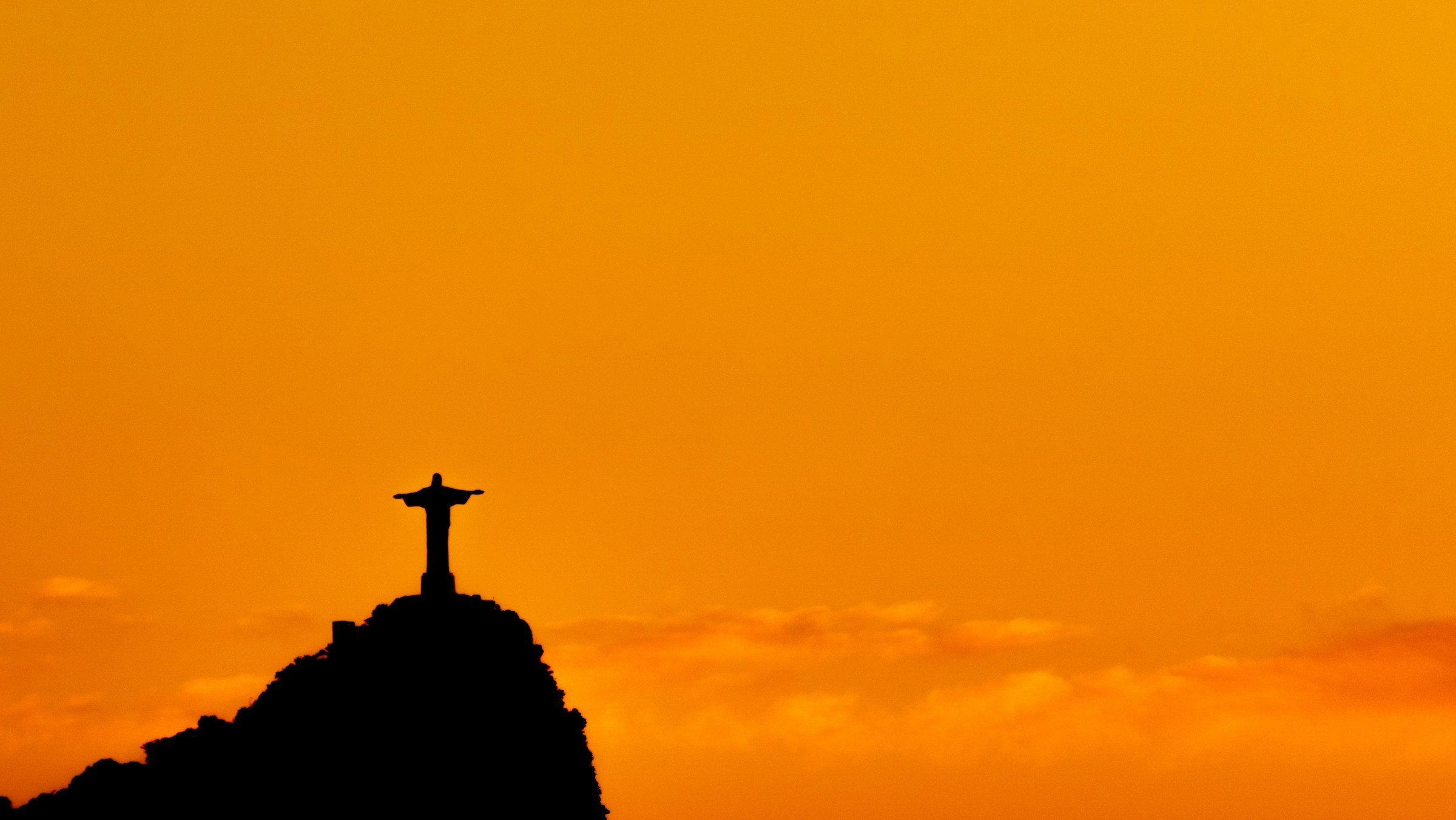
The other issue is that the mountains make neighborhoods invisible from the standard tourist circuit. You can spend a week in Ipanema and Copacabana and never realize that Cosme Velho exists, because it’s hidden behind the ridge. From the beach, you see the Christ statue floating above the forest. You don’t see the neighborhood at the base where people live and commute and buy groceries. The mountains compartmentalize the city into zones that don’t interact unless you make the effort to cross the elevation.
If you liked this, you might like: Cusco, San Jose, Santiago.