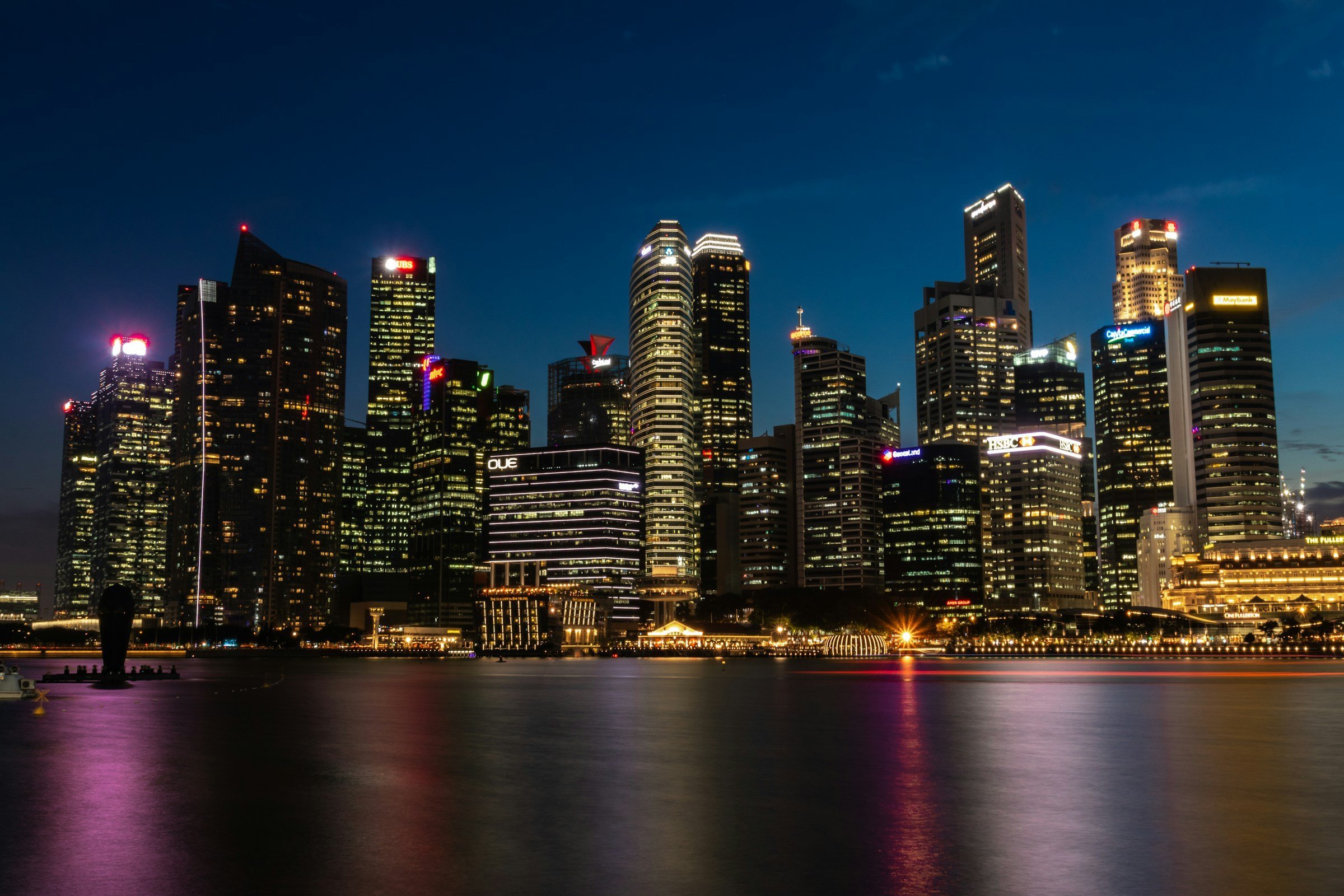
If you think every city grid was imposed after the fact
Most places grew outward from a temple or a port, roads following topography until someone straightened them centuries later. Singapore reversed that sequence. The master plan arrived before most of the buildings. Marina Bay didn’t exist in 1965. The reservoir network was drawn on paper when half the island still had kampongs. Trees you assume are remnants of jungle were planted by the Parks Board in 1967 with species selected for canopy density and root systems that wouldn’t crack pavement.

Singapore
You walk through what looks like organic green corridors. The benches are spaced at intervals a committee agreed upon. The connector bridges between malls have handrail heights set by regulation. Fort Canning Park, which feels old, was landscaped in waves starting in the 1970s. Even the “wild” mangroves at Sungei Buloh were restored, not preserved. They replanted them.
This becomes obvious when you try to find a neighborhood that evolved without oversight. Katong has some prewar shophouses, but the new developments flanking them went through Urban Redevelopment Authority review. Tiong Bahru kept its Art Deco blocks, but the hawker center was remodeled in 2004 with air conditioning and grease traps that meet updated codes. The surprise isn’t that Singapore is planned. The surprise is how completely.
If you expect hawker centers to be chaotic
Street food usually means vendors shouting over each other, grease splatter, stools that wobble. Singapore’s hawker centers have numbered stall assignments, health inspection grades posted in English and Mandarin, and return-your-tray signs above every bin. Lau Pa Sat in the financial district has a wet market aesthetic but also a liquor license and designated smoking zones. Maxwell Food Centre is famous for chicken rice, but the queues are orderly and the woman at Tian Tian will tell you without smiling that they close at 1400 whether or not you got your plate.
The food is still excellent. Hokkien mee at Zion Riverside or laksa at 328 Katong are as good as anything you’d eat off a plastic stool in Penang. But you order at the stall, they give you a number, you sit at a table marked with that number’s range, and the uncle brings it when it’s ready. There’s no jostling. No touts. No one yelling.
This efficiency feels like a trade. You lose the performative chaos, the vendor who remembers you, the argument over whether you asked for extra chili. What you gain is air conditioning, consistent opening hours, and zero risk of food poisoning. After a week you stop noticing the trade. After two weeks you start wondering if the chaos was ever necessary or just something we romanticize because it photographs well.
If you think nature is what happens when humans leave

Singapore
Gardens by the Bay has Supertrees, which are steel frames wrapped in vines chosen for their color gradient against the sky. The vines are irrigated on a schedule. The lighting sequence at night changes seasonally. The Cloud Forest dome holds plants from 1,000 to 3,000 meters in elevation, misted every twelve minutes, kept at 23 degrees Celsius regardless of the weather outside. You are inside a climate-controlled terrarium designed to mimic montane rainforest, and it’s more lush than most actual montane rainforest.
MacRitchie Reservoir has a canopy walk that feels remote until you notice the trail markers every 200 meters and the boardwalk sections rebuilt in 2018 with non-slip composite. The monkeys are wild, but there are fines for feeding them. Pulau Ubin, the island everyone calls “old Singapore,” still has temples and zinc-roofed houses, but the National Parks Board controls what gets demolished and what gets maintained as heritage.
Even the rain trees lining Orchard Road were selected in the 1970s for their umbrella canopy, which shades the sidewalk at the angle that maximizes foot traffic comfort between 1100 and 1400. They look timeless. They are thirty years younger than your parents.
If you assume spontaneity happens in the margins
Busking requires a license, applied for online with a portfolio submission. Protests need a permit issued by the police, allowed only at Speakers’ Corner in Hong Lim Park, and even there you can’t discuss race or religion. Street art in Haji Lane is commissioned. The murals change, but the property owners approve them.
You can still find moments that feel unscripted. An uncle at a kopitiam who sits at the same table every afternoon and will talk your ear off about 1980s racing in Johor if you order a kopi-c. The Indian tailor on Serangoon Road who has your measurements memorized after one visit. The Saturday morning crowd at Tekka Centre, arguing in Tamil over the ripeness of mangoes. But these moments exist inside frameworks.
The uncle’s kopitiam pays commercial rent set by the Housing & Development Board. The tailor’s shophouse survived because it’s in a conservation district with protected facades. Tekka Centre has operating hours and a tenant mix the market authority manages. Nothing is accidental. That doesn’t make the moments fake, but it does mean they happen within tolerances someone decided on.
If you think efficient cities are cold
The MRT runs every four minutes during peak hours. The escalators at Raffles Place station move 20% faster than standard. You can transfer from the Circle Line to the North-South Line at Dhoby Ghaut without seeing daylight. The trains are spotless. The announcements are in four languages. The system has been expanding continuously since 1987 and you can get from Changi Airport to Jurong in under an hour if you time it right.
But efficiency here doesn’t mean anonymity. The tissue packet on a hawker table means the seat is reserved. The auntie at the 7-Eleven near your hotel will remember after two days whether you want your kopi cold or hot. The guy running the roti prata stall at Jalan Kayu will ask where you’re from and then tell you, without irony, that his daughter studied in your hometown.
What Singapore trades is the illusion of disorder. You won’t get lost for three hours and stumble onto a hidden temple. You won’t find a jazz bar in an unsigned basement. The city is legible. Every street name is posted. Every bus route is mapped. That legibility felt sterile at first, but after a week I started seeing it differently. A place where you never have to guess the rules, where the system tells you exactly how it works, where the efficiency isn’t hiding anything because there’s nothing to hide.
If you liked this, you might like: Kuala Lumpur, Bangkok, Tokyo.
Planning the trip? Compare hotel deals before you book.