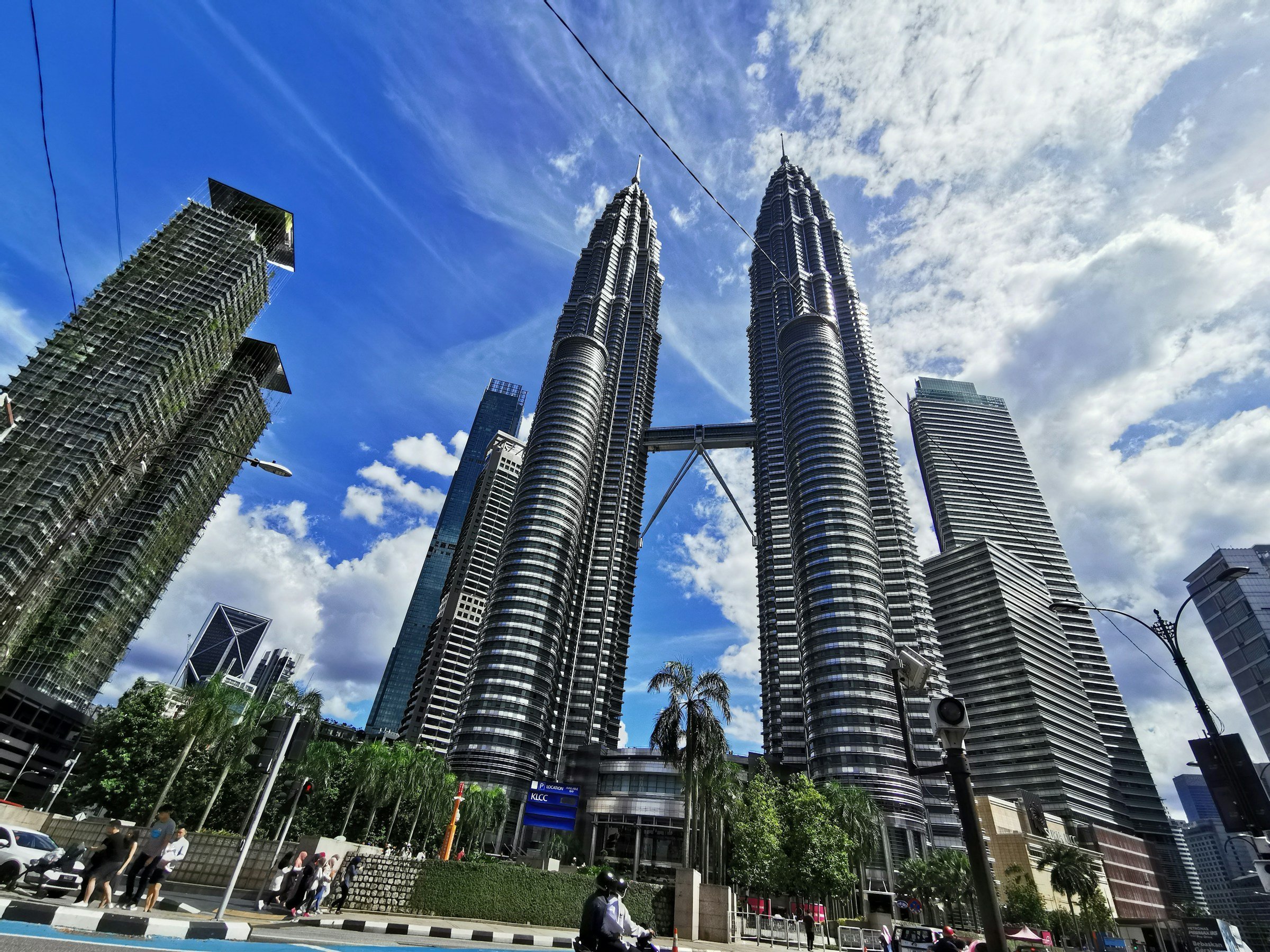
1. The towers from the rooftop of a kopitiam
You drink coffee on the fifth floor of a shop-house in Pudu. The elevator hasn’t worked in years. The coffee costs RM 2.50 (about 60 cents), comes thick with condensed milk, and sits on a formica table that wobbles. Through the window grating, Petronas Twin Towers rise silver, and the distance between this kopitiam and those towers is not just geographic. The waitress who brings the toast has worked this corner since the towers went up in 1998. She remembers when the entire KLCC park was a racetrack, before oil money poured concrete and glass into what is now the most expensive district in the country.

Her salary hasn’t doubled in that time. Rent around Pudu has.
Kuala Lumpur grew vertically on oil revenue. Petronas, the state oil company, funded the towers and the surrounding infrastructure. The gleam of those spires promised development for everyone. What arrived was selective. KLCC became a protected district with underground malls, air-conditioned walkways, a park with imported grass. A few kilometers away, walk-up flats still flood when the monsoon hits hard. The waitress finishes her shift and takes two buses home to Sentul. She has never been inside the Petronas towers. She has seen them from almost every angle of the city.
2. The LRT stops where wealth stops
The Light Rail Transit runs through Kuala Lumpur in lines that tell you what the planners thought mattered. The Kelana Jaya line connects KLCC to the suburbs where middle managers live. It is clean, punctual, air-conditioned to the point of needing a jacket. The stations have tile and escalators. The Sri Petaling line, which serves older neighborhoods south of the city, runs with ceiling fans and longer waits. The trains are the same model but the upkeep is not.
Get off at Masjid Jamek and transfer. You will see the division in commuter faces. Office workers in tailored shirts funnel toward Bukit Bintang. Construction workers and market vendors crowd the opposite platform heading to Sentul or Cheras. Both groups are building the same city. One group sees their wages rise with property values, one does not.
The government announced extensions to connect underserved areas. Those extensions take years longer than lines serving wealthier districts. Funding gets delayed, rerouted, debated in parliament while people keep taking buses that sit in traffic for an hour. A cab driver from Ampang told me he spends RM 400 a month on petrol because the LRT doesn’t reach his neighborhood. That’s a week of groceries.
3. Kampung Baru refuses the bulldozer

Kuala Lumpur
Fifteen minutes from KLCC, wooden houses on stilts line dirt roads. Kampung Baru is a Malay settlement gazetted in 1900, and the land rights are locked in laws that prevent outside developers from buying it. The government has offered buyouts. Residents have refused for two decades. Their stilt houses sit in the middle of the most valuable undeveloped land in Southeast Asia.
Walk down Jalan Raja Muda Musa after dusk. You will smell grilled fish and hear the call to prayer from a surau that predates the towers. Chickens peck in yards. Satellite dishes tilt from rooftops. Behind the kampung, glass high-rises catch the sunset. The contrast is not picturesque. It is political.
The residents know what a buyout means. Compensation that looks generous until you realize no amount buys you back into the city center. They would move to Rawang or Kajang, an hour out, where rent is affordable but jobs are not. The kampung stays because the people who live there understand that once they leave, they do not return. Developers wait. The government drafts new proposals. Kampung Baru plants vegetable gardens.
4. Bangsar money and Cheras wages
Bangsar sells lattes for RM 18 (about four dollars). The cafes have Edison bulbs and menus in English. Brunch costs what someone in Cheras earns in half a day of factory work. The people who serve that brunch often commute from Cheras or further. They take the LRT before dawn to arrive by opening. They clear plates, pull espresso shots, smile through requests for oat milk. Then they take the LRT home after dark.
The wages in hospitality have not tracked with the cost of living in neighborhoods like Bangsar. A waiter makes RM 1,800 to RM 2,500 a month (around $400 to $560). A studio in Bangsar, even a small one, starts at RM 1,500. The math does not close. Workers live far and spend hours in transit, or they split apartments with four or five others, sleeping in shifts.
This is not unique to Kuala Lumpur. But the speed of change here is. The cafes opened in the last ten years. The rent tripled. The wages climbed by maybe fifteen percent. Someone is profiting from the gap. It is not the person making your flat white.
5. Merdeka 118 under construction
The tallest building in Southeast Asia is rising south of KLCC. Merdeka 118 will be 678 meters when finished, second tallest in the world. It is named for independence. The irony is thick. The construction workers building it are Bangladeshi and Nepali, brought in on contracts that cap their wages far below what a Malaysian worker would demand. They sleep in hostels near the site. They send most of their pay home.
I spoke to a Nepali welder near Pasar Seni. He has been in Kuala Lumpur for three years, working on high-rises. He earns RM 1,400 a month (about $315). He shares a room with seven others. He has not been to the top of any building he has worked on. Security does not let construction crews into the finished floors. He will leave Malaysia when his contract ends and he will never see Merdeka 118 the way a visitor will see it, as a landmark, a symbol. He built it from the inside and remained invisible.
The government promotes these towers as proof of arrival, of modernity. And they are. But the arrival is not for everyone. The city grows taller while the people who build it stay at ground level, outside the districts they construct.
If you liked this, you might like: Seoul, Taipei, Tokyo.
Planning the trip? Compare hotel deals before you book.