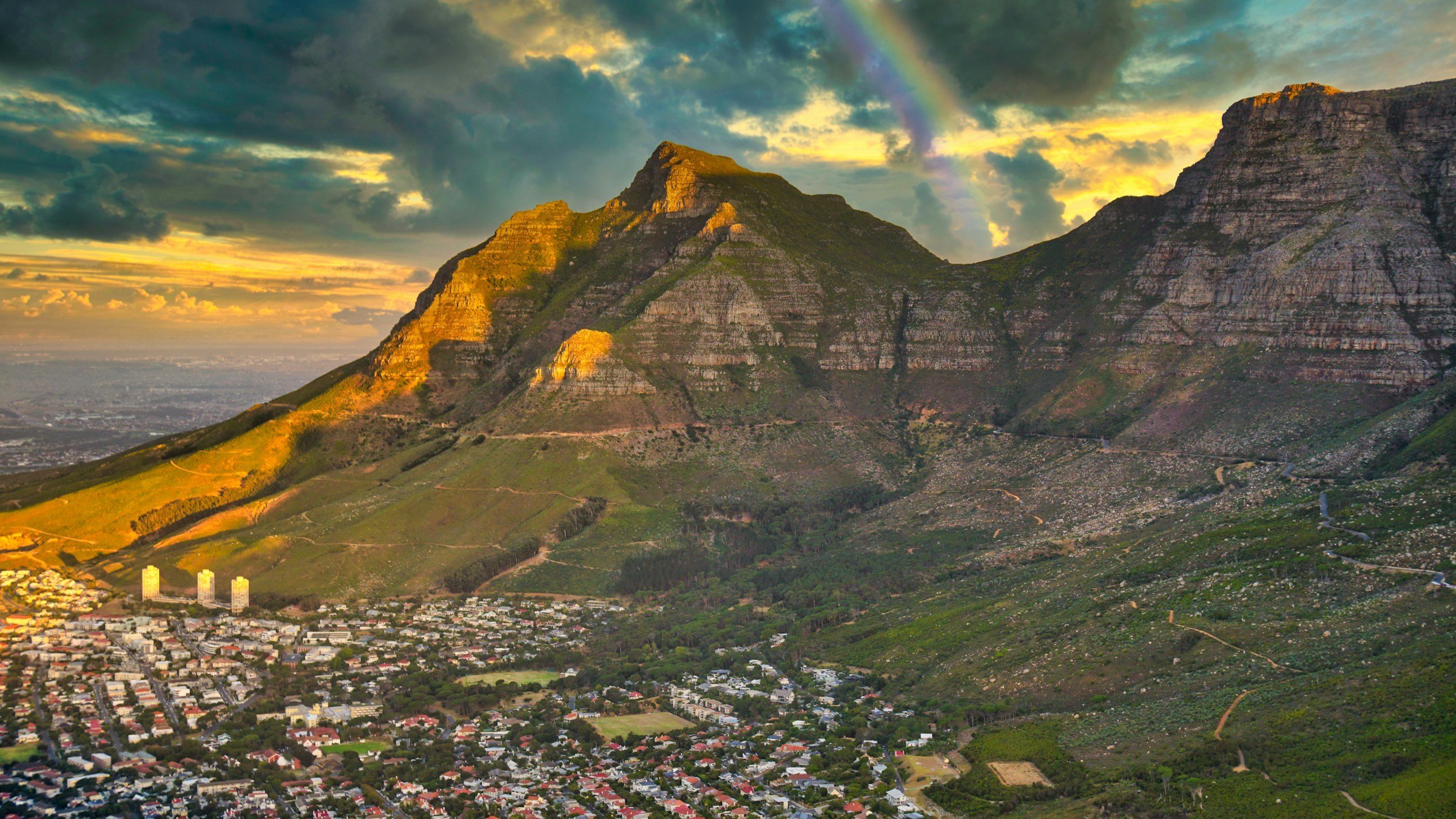
1. The View from Signal Hill Explains Everything
You climb Signal Hill in late afternoon because someone told you the city looks best from up here. They were right about the light and wrong about what you would see. Table Mountain catches gold behind you. The Atlantic breaks white against rocks below. Between mountain and ocean, Cape Town spreads out in a pattern that looks accidental until you understand it was drawn with rulers and racial codes.

Cape Town
The bowl of the City Bowl sits directly below, tight streets and Victorian buildings where white families lived close to money and harbor work. To your left, the Atlantic Seaboard suburbs cling to coastal cliffs: Clifton, Camps Bay, addresses that still cost what they cost. To your right, the Cape Flats stretch brown and flat toward the mountains on the far side, treeless, built on sandy soil that floods when it rains. This is where the Group Areas Act relocated entire communities. Langa, Gugulethu, Khayelitsha. The geography alone tells you who was meant to live where.
A tour guide near the parking lot talks about sunsets. He does not talk about District Six, the mixed neighborhood that used to fill the space between here and Table Mountain until bulldozers cleared it in the 1970s. Sixty thousand people removed. You can still see the empty blocks from up here, undeveloped except for a technical college and a few parks. The absence is the point.
2. The Train Line That Runs Through Philippi
You take the Metrorail south from the city center because the tickets cost 8 rand (about 45 cents USD) and you want to see what lies between the mountain and the townships you read about. The first few stops roll through Salt River and Observatory, old working-class neighborhoods with corner cafes and houses crammed close. People get on and off. Conversation in three languages per carriage.
Then the train crosses the M5 highway and the landscape flattens. Philippi. Vast stretches of informal settlements pressed against the tracks, shacks made from corrugated iron with hand-painted addresses. Electrical wires droop low. The stations have bars on the windows. Fewer people get off here despite the density. They are traveling further out, to Mitchells Plain or Khayelitsha, because even within the Flats there are distinctions.
The commute times explain part of why spatial planning still dictates economic access. Someone living in Khayelitsha spends three hours a day on trains and minibus taxis to reach a restaurant job in Camps Bay. The Southern Suburbs, where old money built homes under oak trees, sit twenty minutes from the city by car. Cape Town never rezoned the distances the apartheid government designed.
3. What They Do Not Say on the Township Tours

Cape Town
The tours leave from the Waterfront in air-conditioned vans. Langa first, the oldest township, built in 1927 to house black workers far enough from the city center that they could be controlled. The guide points out a hostel where men still live in single-sex quarters, a relic of migrant labor policies. He mentions a jazz club, a craft cooperative, a woman who runs a cooking class. All of this is real. None of it explains why Langa exists where it exists.
In Khayelitsha, which means “new home” in Xhosa, the van drives past rows of RDP houses, the small brick homes the government built after 1994. They have running water and electricity, which is progress if your measuring stick starts at 1994. They are also thirty kilometers from job centers, built on the same land the apartheid state used for dumping populations it wanted invisible. Unemployment here runs above forty percent. The tour stops at a daycare center. Children sing. You take photos. The van drives back to the Waterfront and drops you near restaurants where a single meal costs more than a weekly Metrorail pass.
What nobody says in the van: the African National Congress government has built more housing on the same distant land instead of redistribution closer in. Wealthy suburbs near the mountain remain wealthy and near the mountain. The spatial logic holds.
4. The Beaches Where You Notice Who Is Swimming
Clifton has four beaches, numbered one through four, separated by granite boulders. The sand is white. The water stays cold year-round because of the Benguela Current. On any afternoon you will see a particular demographic: thin, sunburned, speaking English or Afrikaans, holding expensive surfboards. This is what proximity to the mountain buys.
Monwabisi Beach sits on the False Bay side, near Khayelitsha. The sand is darker. The water is theoretically warmer but the sewage outfall a kilometer north makes swimming a decision you think about. Families come here because it is close. They set up braais, portable grills, on the grass above the beach. The infrastructure is thin: one ablution block, trash cans that overflow on weekends, no parking attendants. You see the distance reflected in maintenance budgets.
In between, Muizenberg was once the people’s beach, where all races swam during brief integration windows before apartheid formalized. After 1994 it stayed mixed because the town was shabby and rents were cheap. Now the painted bathing boxes get photographed for tourism posters and property developers are buying up blocks. Give it five years. The question is always who can afford to live near beauty.
5. The Garden Route Does Not Start Here
People fly into Cape Town for a reason. The mountain, the vineyards an hour east, the coastal road to Hermanus where whales breach close to shore. All of this is stacked on top of planning decisions that treated people like pieces to be moved and land like something to be divided by race. You cannot see Camps Bay without knowing it was designated a white area under the Group Areas Act. You cannot visit Robben Island, the prison in the bay where Nelson Mandela spent eighteen years, without connecting it to the city you returned to on the ferry.
The nature is real. The injustice is also real. Cape Town sells you the first and expects you not to look hard at the second. The tourists who take only mountain photos and beach photos miss that the two are connected. Apartheid built the city as geography. Democracy has not yet rebuilt it.
If you liked this, you might like: Cairo, Marrakech, Nairobi.
Planning the trip? Compare hotel deals before you book.