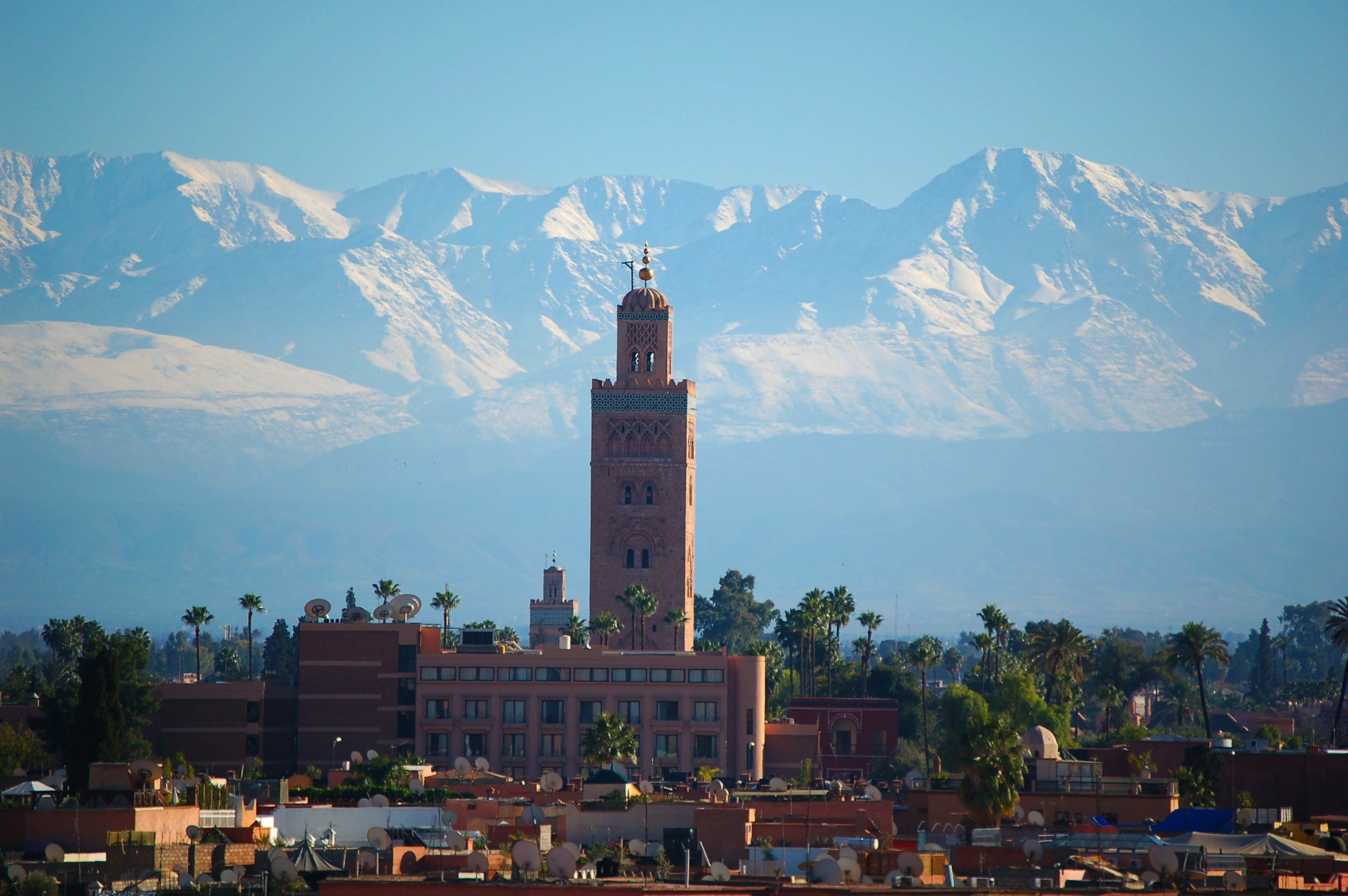
Djemaa el-Fna at First Contact
You walk into the square and the medieval city announces itself. Orange juice vendors work mechanical presses that look fifty years old but function on principles from the 1400s. A man with a monkey on a chain stands next to a woman selling mint by the bundle. Someone is grilling snails in a sauce you can smell from twenty meters away. The snake charmers have positioned themselves where tour groups bottle up near the entrance from Avenue Mohammed V, and they know exactly when to lift the cobra for maximum photo anxiety.

The French built wide boulevards around this. Gueliz, the colonial district, starts three kilometers northwest with its bakeries and wine shops and apartment blocks that could pass for Marseille. South of the medina, the Hivernage resort zone drops international hotels into landscaped plots where nothing medieval survives. But Djemaa el-Fna runs on the same trade grammar it always has. You pay for spectacle or you don’t. Cash moves hand to hand. No card readers, no receipts.
Souk Semmarine and the Arterial Logic
From the square you enter Souk Semmarine, the main artery north. The first fifty meters sell tourist lanterns and slippers with curled toes. Keep walking. The souk organizes itself by guild, a system that predates the Saadian dynasty. Metalwork gives way to leather, leather to spices, spices to fabric. You don’t need a map if you learn what each section smells like.
The thing nobody tells you is that haggling follows neighborhood rules. In the lamp district near the entrance, vendors expect you to walk away twice. Near the spice stalls deeper in, prices start closer to fair and movement is smaller. A merchant selling ras el hanout for 60 dirhams per hundred grams (about $6 USD) might come down to 50, but he won’t chase you into the alley.
The roof is intermittent. Sunlight punches through in shafts that move as the afternoon tilts. When it rains, which it does hard and briefly between November and March, the alleys flood ankle-deep in ten minutes and then dry in an hour. The medina wasn’t designed for drainage. It was designed for shade and defense, and you feel both.
Rahba Kedima and the Apothecary Square
Turn east off Semmarine and you hit Rahba Kedima, a small square where herbalists sell ingredients that wouldn’t clear customs in Europe. Dried chameleons hang on strings. Blocks of argan soap sit in uncovered stacks. A vendor offers a love potion that she promises works within a week, cash only, no guarantees if you bought the wrong herbs from her competitor across the square.
The Criée Berbère, the old slave market, opens off the southeast corner. It’s a carpet auction house now, but the stone benches where people once stood for sale are still there. Tour guides mention it in half a sentence and keep walking. You can sit on the benches if you want. No one stops you.
Rue Riad Zitoun el-Kedim and the Palace Anchors

Marrakech
South from Djemaa el-Fna, this street runs straight to the Bahia Palace and the Saadian Tombs. It’s the tourist highway, which means it’s also the highest-density pickpocket zone in the medina. Keep your phone in a front pocket. If someone bumps you hard from behind, check your bag immediately.
The Bahia Palace costs 70 dirhams ($7 USD) and it’s worth it for the cedar ceilings alone. The tombs cost 70 dirhams and take fifteen minutes unless you read every placard. Both sites close at 17:00 and the ticket booths stop selling thirty minutes before that. The medina doesn’t run on posted hours, but the official monuments do, and they enforce it.
Between the two monuments, small galleries sell paintings and metalwork at prices that assume you’re staying in Hivernage. A framed geometric panel that runs 1,200 dirhams ($120 USD) here will cost 400 dirhams in the northern souks if you know which alley to try. The location markup is real and it’s consistent.
Mouassine and the Fountain Logic
Northwest from the main souk, Mouassine is a residential quarter that tourists miss because it doesn’t connect to anything famous. The Mouassine Fountain, built in the 1500s, still provides water. People fill plastic jugs from the brass taps. The neighborhood mosque shares a wall with a row of spice shops, and the call to prayer bounces between buildings in a way that makes it hard to tell which direction Mecca is if you don’t already know.
This is where the medina stops performing. Kids play soccer in alleys barely wide enough for a donkey cart. Laundry hangs on lines strung between second-floor windows. A woman sells bread from a basket on her doorstep, eight loaves at a time, and she’s out of stock by 10:00 most mornings because her neighbors know her schedule.
The riads here rent cheaper than the ones near Djemaa el-Fna. You can get a room with a courtyard view for 350 dirhams a night ($35 USD) if you book directly and arrive on a weekday. The same setup near the square runs 700 dirhams and the courtyard is smaller.
Bab Debbagh and the Tanneries
East from Mouassine, you eventually hit Bab Debbagh, the gate that leads to the tanneries. The smell reaches you two blocks away. Pigeon dung, cow urine, limestone, and the hides themselves create a stink that sticks to your clothes for hours. Guides offer mint sprigs to hold under your nose. Take them.
The tannery terraces charge 20 dirhams ($2 USD) for roof access, and someone will try to sell you a leather jacket within thirty seconds of arrival. The jackets are real leather and the stitching is decent, but the price starts at 1,500 dirhams ($150 USD) and the guy offering 900 is still making rent on you. If you don’t want a jacket, say so in the first five words or you’ll spend twenty minutes in a negotiation you never intended to have.
The dyeing pits are still hand-operated. Workers stand waist-deep in vats of color, stomping hides like grapes. It’s medieval process unchanged because it works and because industrial tanning requires permits and inspections that the medina economy doesn’t accommodate. You’re watching a guild structure that survived because the French left it alone and the Moroccan government hasn’t found a reason to intervene.
Exit Points and the Colonial Grid
Every gate out of the medina drops you into a different Marrakech. Bab Doukkala to the northwest leads to the bus station and the neighborhoods where rent is affordable. Bab Nkob to the south opens onto Avenue Mohammed V and the path to Gueliz, where the streets run straight and the cafes serve wine in glasses instead of tea in pots.
The contrast is the point. Gueliz has parking and supermarkets and buildings that follow zoning logic. The medina has none of that. It functions on memory and repetition and the assumption that you’ll ask someone if you’re lost. Both systems work. Neither one is trying to become the other.
If you liked this, you might like: Cairo, Nairobi, Cape Town.