If you expected monuments everywhere, the Rideau Canal is a skating path
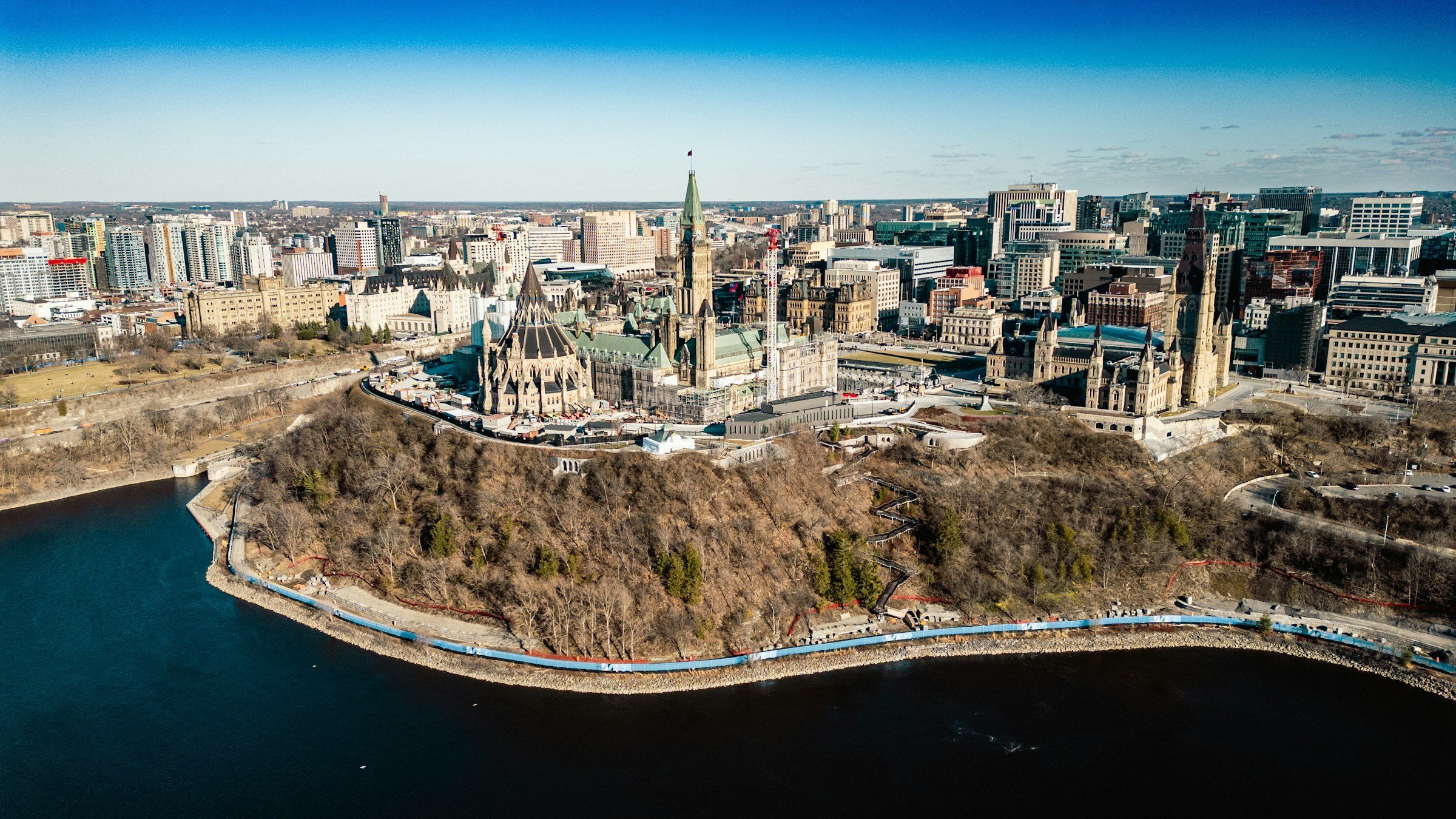
You arrive in Ottawa thinking you’ll see Parliament Hill from every corner. The Peace Tower shows up on postcards, so you expect it to loom over street corners the way Big Ben does in London or the Eiffel Tower does in Paris. Instead, you walk three blocks south from the bus station and the only government building you see is a gray office tower with tinted windows. The canal runs where a river of bureaucrats should be. In winter, people skate to work on seven kilometers of frozen water. In summer, joggers pass where ice was. Parliament sits on its bluff, visible when you look for it, invisible when you don’t.

Ottawa
The surprise is how easy it is to forget the capital part. The Byward Market sells strawberries and cheese curds two blocks from where laws get written. You can eat a BeaverTail (fried dough with cinnamon) while looking at the Chateau Laurier, which looks like a castle but is a hotel. Civil servants line up at shawarma joints on Rideau Street during lunch. The city functions like a mid-sized college town that happens to host the federal government, not a place built around governing.
If you thought bilingualism meant equal signage, listen to who switches languages
Ottawa is officially bilingual. Street signs appear in English and French. Federal employees answer phones in both languages. You expect a city where French and English share space equally, where neighborhoods split cleanly between languages. What you find instead is a city where English dominates most conversations and French emerges in pockets. Gatineau, across the river in Quebec, is where French takes over. In Ottawa itself, you hear French in government offices, in some cafes in the Glebe, occasionally on the bus. But the default is English.
The code-switching happens mid-sentence. A server starts in French, realizes you’re answering in English, and finishes in English without pausing. A group at the next table toggles between languages depending on who’s talking. It’s functional bilingualism, not the cultural standoff you see in Montreal. Nobody cares which language you use as long as the transaction completes. The political part is performed in government buildings. Outside, people just talk.
If you expected grand museums, the War Museum sits in a field by a highway

Ottawa
The Canadian War Museum is one of the best military history museums in North America. It sits next to a Volkswagen dealership and a highway off-ramp in an area that feels like industrial zoning. You take a bus to get there. The building is concrete and angular, designed to look like a bunker. Inside, the exhibits are careful and detailed. Vimy Ridge gets a full recreation. There’s a Mercedes that Hitler rode in. The Holocaust gallery doesn’t flinch. But the location tells you something about Ottawa’s relationship with its own importance. The museum could have been placed on a ceremonial boulevard. Instead, it’s in a neighborhood where trucks deliver restaurant supplies.
The same logic applies to the aviation museum, which is near the airport in a hangar, and the agriculture museum, which is on the experimental farm south of the canal. Ottawa has world-class institutions but doesn’t arrange them like a capital trying to impress. They’re scattered across the city in places that make practical sense. You have to seek them out. Nobody’s curating a monumental walking tour.
If you thought winter would be charming, the cold is a structural fact
The canal freezes and becomes the world’s longest skating rink. This part is true and gets photographed constantly. What doesn’t get mentioned is that the cold in Ottawa is the kind that makes your eyes water and your lungs hurt when you inhale. The temperature drops below -20°C (about -4°F) regularly. Wind comes off the river and the canal and finds every gap in your coat. The city empties out after dark. Buses arrive late because the cold affects the engines. You learn to time your errands so you’re never outside for more than ten minutes at a stretch.
The skating is real. People do commute on the canal. But it’s not leisurely. You skate fast to stay warm. The BeaverTail stands along the ice are the only reason to stop. By late afternoon, the canal is nearly empty except for a few die-hards and tourists who didn’t dress properly. The charm exists, but it’s buried under the physical reality of air cold enough to freeze your phone battery.
If you assumed a capital would feel formal, the Hill is a public lawn
Parliament Hill is open. You can walk up to the buildings. In summer, people spread blankets on the grass in front of the Peace Tower and eat lunch. There’s a changing of the guard ceremony that feels more like a high school marching band performance than a military display. Security exists but doesn’t dominate. You can get surprisingly close to the Centre Block (under renovation, so access varies). There’s no perimeter fence, no buffer zone of empty concrete.
This openness makes the Hill feel less like the seat of power and more like a well-maintained park that happens to have government buildings on it. Tourists take photos. Joggers run past. In winter, people cut across the lawn to avoid the longer sidewalk route. The formality is inside the buildings, where debates happen and laws get drafted. Outside, it’s public space that doesn’t demand reverence. The contrast is deliberate. Ottawa wants to project accessibility, and on the Hill at least, it succeeds.
The city never quite resolves the tension between being a capital and being a place people live. You see it in the architecture, half government stone and half low-rise apartments. You see it in the neighborhoods, where embassies sit next to pho restaurants. Ottawa works as a city precisely because it doesn’t try too hard to perform the capital role. Parliament dominates the skyline from one angle and disappears completely from another. The bureaucrats go home at five. The canal freezes and people skate. Somewhere, laws are being written, but on the street, you’re just in a cold city with good museums and decent shawarma.
Things to do in Ottawa once you have seen the Hill
Parliament takes a morning. The rest of a long weekend can go to these, none of which needs a car to start.
National Gallery of Canada
The glass building on Sussex Drive, with Louise Bourgeois’s giant spider, Maman, standing outside. Inside are the Group of Seven landscapes, Emily Carr and a large Indigenous collection (National Gallery of Canada).
Canadian Museum of History
It sits across the river in Gatineau, which means you technically visit Quebec for the afternoon. The Grand Hall of totem poles faces Parliament through a wall of windows (Canadian Museum of History).
ByWard Market
Produce stalls by day, bars by night. This is where to try a BeaverTail if the canal stands are closed for the season.
Gatineau Park
More than 361 square kilometres of forest and lakes, run by the National Capital Commission. Champlain Lookout sits on the edge of the Eardley Escarpment and looks out over the Ottawa River valley (NCC). Go in late September or early October for the leaves.
The Skateway, measured
The canal rink runs 7.8 km from the National Arts Centre to Dow’s Lake and Hartwells Locks when it is open, which depends entirely on the winter (NCC). Check the ice status the morning you plan to skate.
If you liked this, you might like: Mexico City, Buenos Aires, New York.
Planning the trip? Compare hotel deals before you book.