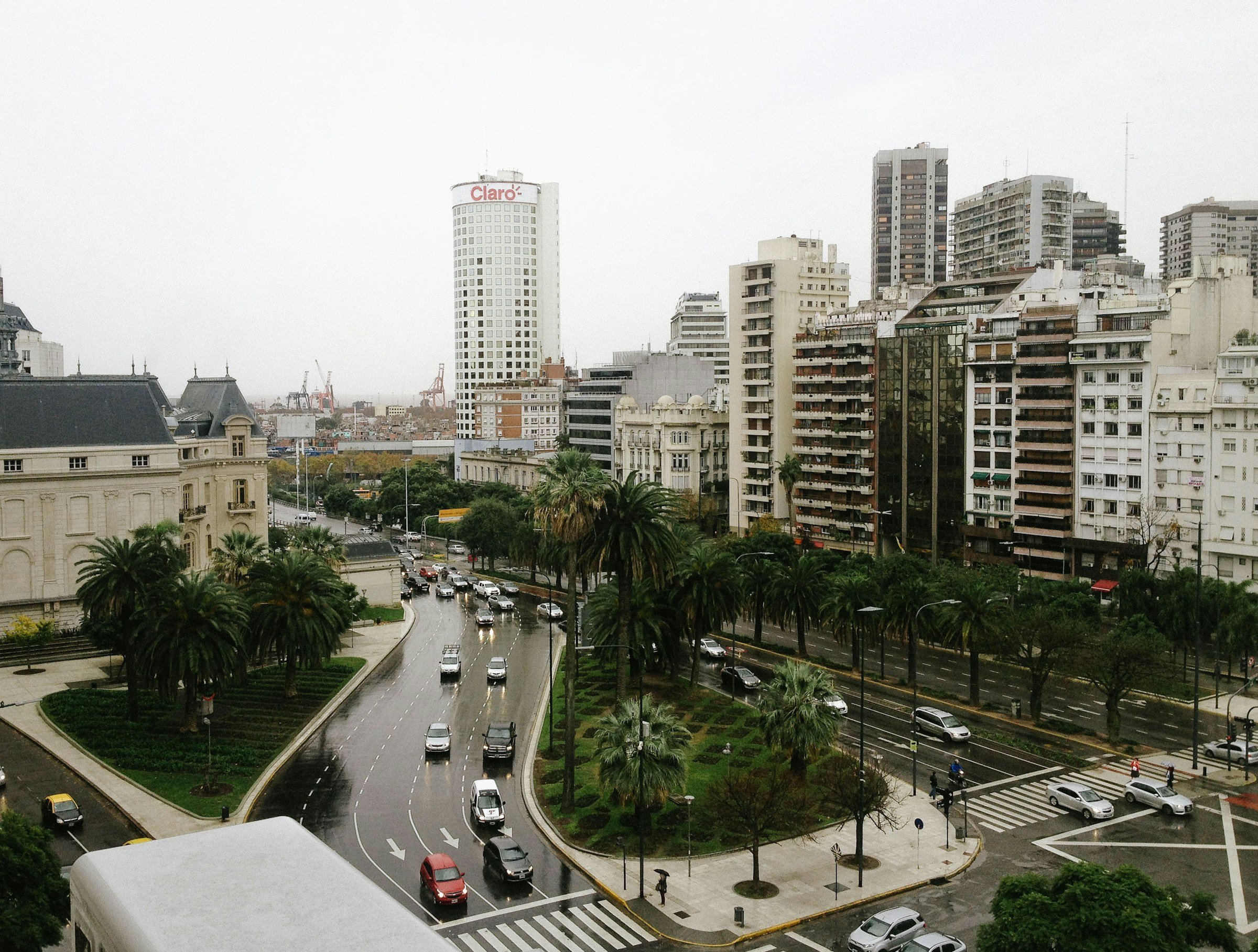
The architecture refuses to acknowledge the continent
Walk from Retiro station toward the Teatro Colon and you pass buildings that could have been airlifted from the 8th arrondissement. The same iron balconies. The same mansard roofs. The same cream-colored stone facades with carved details above every window. You’re 11,000 kilometers from Paris but nobody told the architects.

This wasn’t accident or coincidence. Between 1880 and 1930, Buenos Aires demolished most of its colonial Spanish buildings and rebuilt itself as a European fantasy. Wealthy porteños hired French and Italian architects who had never set foot in South America. They wanted Paris, they got Paris, and now you walk through a city that looks like it belongs on a different continent entirely.
The effect is most concentrated in Recoleta and Retiro. Buildings along Avenida Alvear could pass for Haussmann-era apartments in the 16th arrondissement. The Palacio Paz on Plaza San Martin looks like a Loire Valley chateau dropped onto Argentine soil. Even the street trees (London planes, mostly) were imported from Europe because native species didn’t match the aesthetic.
People call this the “Paris of South America” like it’s a compliment. It’s more accurate to say Buenos Aires is a city that spent a century pretending it wasn’t in South America at all.
The cafes operate on a European clock that makes no economic sense
Cafe Tortoni has been open since 1858. You can sit there for three hours over a single cortado and nobody will ask you to leave. The waiters wear bow ties and long aprons. The interior has stained glass, carved wood panels, and the kind of worn elegance that only comes from actual age rather than design.
This would make sense in Vienna or Prague where cafe culture has deep roots. In Buenos Aires it makes less sense, but the city commits to it anyway. Cafes stay open until 2am or later. People sit and read newspapers for hours. The staff doesn’t rush you, doesn’t hover, doesn’t calculate table turnover rates.
The economics are questionable. Rent in central Buenos Aires is high. Labor isn’t cheap. But porteño cafes operate like it’s still 1920 and people have all afternoon to sit and argue about literature.
You see the same dynamic at Cafe La Biela in Recoleta, where old men sit under the rubber tree and drink espresso for half the day. Or at the London City in San Telmo, which looks like a cafe in Covent Garden that somehow ended up south of the equator. These aren’t tourist traps. Locals actually use them this way.
The staff speaks to you differently too. More formality than you’d get in the rest of Latin America. More distance. The service style mirrors what you’d find in Madrid or Milan, not Mexico City or Bogota.
The entire country eats dinner at a European hour in a non-European timezone
Restaurants don’t open for dinner until 8pm. Most don’t fill up until 10pm or later. On weekends, people sit down to eat at midnight.
This schedule makes sense in Spain where summer sunsets come late and the culture evolved around avoiding afternoon heat. Buenos Aires is at 34 degrees south. The latitude of Cape Town or Sydney. Summer sunsets here are around 8pm, not 10pm. There’s no geographic reason to eat this late.
But porteños eat on a Spanish schedule anyway because the city decided it was culturally European and committed to the bit. You can’t get a proper dinner at 6pm in most neighborhoods. Kitchens aren’t ready. The dining rooms are empty. Show up at 7pm and the staff will seat you but you’ll eat alone while they set tables for the actual service that starts hours later.
This creates problems for visitors used to eating at 7pm or 8pm. You either adapt to the local rhythm or you eat at tourist restaurants in Puerto Madero that cater to foreign schedules. After a few days most people adapt. You start eating lunch at 2pm, snacking at 6pm, and sitting down to dinner at 10pm like it’s normal.
The Italian immigration is louder than the rest of Latin America combined

Buenos Aires
More than half of Argentines have Italian ancestry. You hear it in the surnames, the accent, the way people talk with their hands. Porteño Spanish has an intonation that sounds more Milan than Madrid, a singsong rhythm that linguists trace directly to Italian immigration waves between 1880 and 1950.
The food followed the people. Buenos Aires has more pizza places per capita than almost anywhere outside Italy. Not American-style pizza. Proper fugazza, faina, and pizza a la piedra served in neighborhood spots that have been running since the 1950s. Los Inmortales, Las Cuartetas, El Cuartito. These aren’t upscale restaurants, they’re everyday places where locals eat multiple times per week.
The pasta is equally ubiquitous. Every neighborhood has at least three places making fresh noquis, ravioles, and sorrentinos. On the 29th of each month, families traditionally eat gnocchi. This isn’t an Argentine custom, it’s an Italian one that porteños adopted wholesale.
You see Italian social clubs throughout the city. Associations from specific regions: Calabria, Sicily, Piedmont. These aren’t historical curiosities, they’re active organizations with tens of thousands of members. The city maintains Italian identity more aggressively than most places in Italy.
Meanwhile indigenous Argentine culture is nearly invisible in Buenos Aires. No significant Quechua presence. Very little Guarani influence. The city pushed those identities to the margins and replaced them with an imported European identity that it guards more carefully than Rome does.
The bookstores are plausibly the best in the hemisphere and nobody shuts up about it
El Ateneo Grand Splendid is a bookstore inside a converted theater. The old stage is now a cafe. The theater boxes are reading nooks. The frescoed ceiling is intact. Every tourist article mentions it. Every local will tell you about it within 48 hours of meeting you.
It actually lives up to the hype. Not because of the architecture but because Buenos Aires supports a bookstore ecosystem that shouldn’t exist in an economy this volatile. Avenida Corrientes has a dozen serious bookstores within a few blocks. Not gift shops with some books, actual bookstores with deep inventory in philosophy, literature, and history.
The city publishes more books per capita than most of Latin America. Argentine authors matter here in a way they don’t in comparable cities. Borges isn’t just a name on a street, he’s someone locals have read and have opinions about. Same with Cortazar, Sabato, and Piglia.
This is another European affectation. Buenos Aires wants to be a city of letters, a place where intellectual life matters and bookstores survive despite impossible economics. It mostly succeeds. You can find Spanish editions of obscure French theory in neighborhood bookstores that wouldn’t stock them in Madrid.
The used bookstores on Avenida de Mayo offer even deeper inventory. Philosophy, criticism, rare editions. Prices in pesos make these accessible (maybe 3,000-8,000 pesos for substantial books, roughly 3-8 USD at parallel exchange rates, though that fluctuates monthly). The owners know their stock. They’ll recommend authors, argue about translations, spend 20 minutes helping you find something specific.
The beef consumption is a European habit imposed on South American geography
Argentines eat more beef per capita than almost anyone on earth. Around 50 kilograms per person per year. This isn’t traditional indigenous diet, it’s a product of European cattle ranching that transformed the pampas into pastureland starting in the 1800s.
The parrillas (steakhouses) treat meat with near-religious reverence. Don Julio in Palermo, La Cabrera, El Pobre Luis. These places serve cuts you won’t find elsewhere: entraña (skirt steak), vacio (flank), tira de asador (short ribs). The meat is good because the cattle are grass-fed on massive estancias outside the city.
But the culture around meat consumption is distinctly European. The cuts, the preparation, the side dishes (mostly imported vegetables rather than native Argentine ingredients). Even chimichurri, the ubiquitous green sauce, has more in common with Italian salsa verde than indigenous condiments.
Vegetables play supporting roles at best. Salads are small. The default meal is 400-600 grams of meat with maybe some roasted peppers and a tiny portion of greens. This diet makes sense in pastoral European contexts. In South America, surrounded by incredible biodiversity, it’s a choice to ignore local ingredients in favor of an imported food culture.
The best parrillas aren’t in tourist zones. Go to La Carniceria in Palermo Viejo or El Mirasol in Puerto Madero if you want the full experience. Expect to spend 15,000-25,000 pesos per person (roughly 15-25 USD) for a substantial meal with wine. The meat will be better than most steakhouses anywhere, but you’ll also notice how the entire culinary tradition points toward Europe while standing in the middle of South America.
If you liked this, you might like: Lima, Toronto, Miami.
Planning the trip? Compare hotel deals before you book.