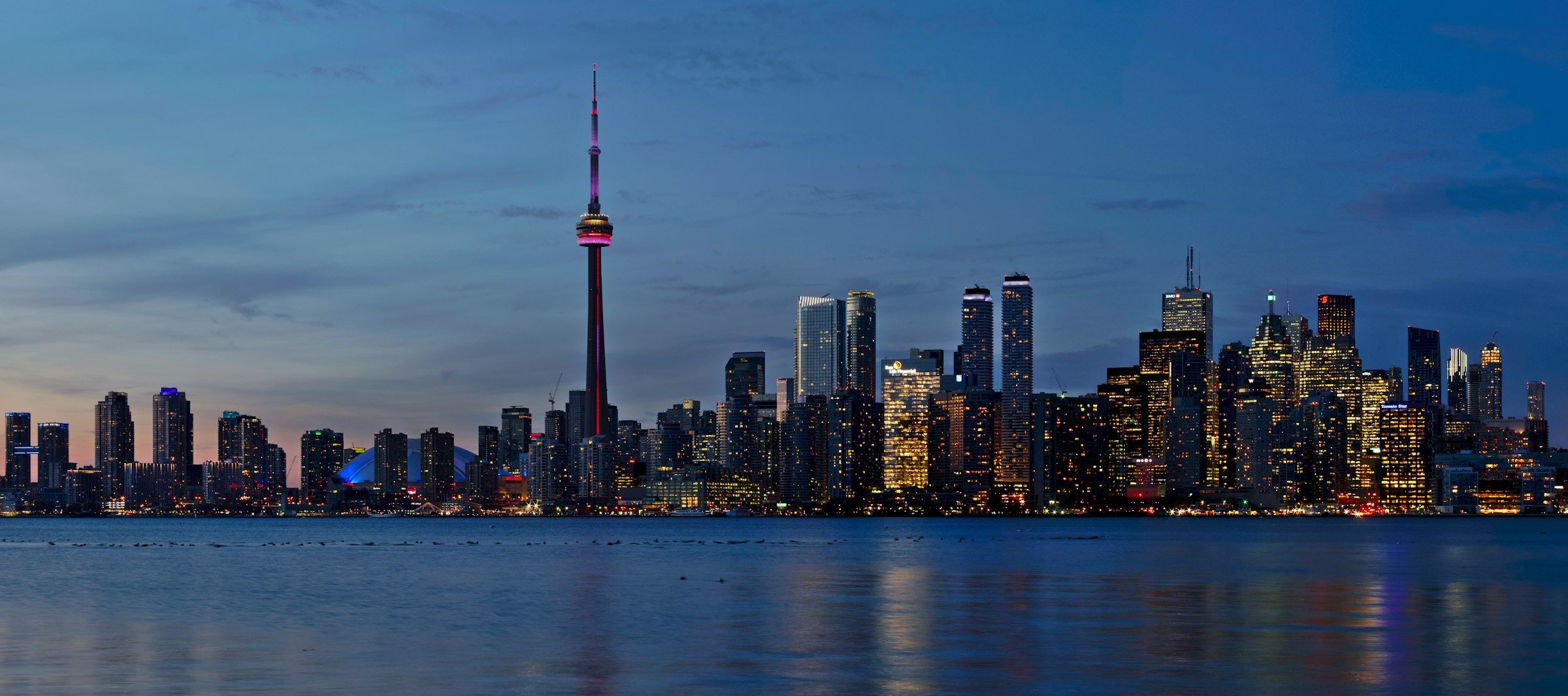
At 19:23 on a Thursday in September, we watched raccoons stage a coordinated raid on the garbage bins behind a Kensington Market café while paying $6.80 for a Portuguese custard tart. Toronto smells like lake water, grilled corn from street carts, and the specific diesel exhaust of TTC buses that have seen better decades.
Chapter 01: Arrival
Pearson International sits 27 kilometers northwest of downtown, connected by the UP Express train that runs every 15 minutes for $12.35 and deposits you at Union Station in 25 minutes. We’ve watched too many travelers waste $70 on taxis for the same journey. The train carriage windows frame an industrial corridor of big-box stores and highway overpasses until the skyline appears, dominated by that unfortunate concrete needle everyone photographs and nobody actually enjoys visiting.
Union Station itself is worth the train fare. The Great Hall ceiling stretches 27 meters high, clad in Italian tile from 1927, and at 06:47 in October the light hits the arched windows in a way that makes jet lag feel almost intentional. From here, Toronto unfolds in all directions: south to the waterfront, north up University Avenue toward Queen’s Park, east and west along King and Queen Streets where the real texture lives.
The subway costs $3.30 per ride, $13.50 for a day pass, and operates on two main lines that form a rough cross through the city. Line 1 runs north-south, Line 2 goes east-west, and both smell like a specific combination of brake dust and Tim Hortons coffee that defines Toronto’s underground. We’ve sent readers here with instructions to ignore the Toronto Transit Commission’s optimistic service announcements and add 15 minutes to any journey estimate.
Our team stayed in the Annex neighborhood, a grid of Victorian houses between Bloor Street and Dupont Street where rent is absurd and the coffee shops close at 17:00 for no clear reason. The area codes to 416 within the old city limits, 437 and 647 for newer numbers, a detail that matters only when you’re trying to decode which neighborhoods locals consider authentically Toronto versus suburbs that got absorbed.

Chapter 02: Why now, and why this particular version of multiculturalism
Toronto’s population speaks more than 180 languages, census data confirms this repeatedly, and the city wears this fact with less smugness than you’d expect from a place that could easily coast on diversity credentials alone. What strikes us after three separate visits is how the multiculturalism manifests in specific, unglamorous ways: Scarborough has the best Tamil restaurants outside Sri Lanka, Koreatown along Bloor West offers 24-hour tofu soup for $11, and you can eat Somali-Italian fusion in Etobicoke because history is complicated and delicious.
The waterfront has undergone massive redevelopment since 2010, with mixed results. Sugar Beach at the foot of Lower Jarvis Street features pink umbrellas and actual sand, opened in 2010, and on summer weekends fills with families who treat Lake Ontario like it’s the Mediterranean despite water temperatures that rarely crack 20°C. The Martin Goodman Trail runs 56 kilometers along the shore, mostly flat, ideal for cycling if you can tolerate the aggressive inline skaters and electric scooter chaos around Ontario Place.
We come to Toronto in September or October when summer humidity breaks and the ravine system that cuts through the city shows off its forest canopy. The Don Valley, Rosedale Valley, and smaller ravines create green corridors that make Toronto feel less like a 2.9-million-person city and more like a collection of neighborhoods that happen to share transit infrastructure. At 18:12 in late September, we walked the Moore Park Ravine trail and encountered exactly zero other humans, just the sound of cicadas and the distant hum of the Bloor-Danforth subway line crossing overhead.
The art scene concentrates around Queen West and Ossington Avenue, where galleries occupy former industrial spaces and charge nothing for entry, unlike the commercial districts that have priced out anything interesting. The Art Gallery of Ontario holds the world’s largest public collection of Group of Seven paintings, Canadian landscape artists from the 1920s who made forests look somehow both nationalist and genuinely beautiful, admission $25 but free Wednesday evenings after 18:00.
Toronto’s music history runs deep: from Yorkville’s 1960s folk scene where Joni Mitchell played coffeehouses, to the Drake and Weeknd association that current marketing leans on heavily, to the actual punk and indie venues along Dundas West where bands still play for $15 cover. The Horseshoe Tavern has hosted everyone since 1947, smells exactly how a good dive should smell, and books acts six nights a week.

At 06:47 in October the light hits Union Station’s arched windows in a way that makes jet lag feel almost intentional
Chapter 03: What to skip, honestly
The CN Tower dominates every skyline photo and every tourist’s mistaken itinerary. At 553 meters tall, completed in 1976, it offers views you can approximate from any number of free rooftop patios while saving the $43 admission. We’ve been up twice, regretted it both times, and now actively discourage readers from making the same expensive mistake. The glass floor induces mandatory selfie behavior in otherwise sensible adults, the restaurant rotates with depressing slowness while serving airport-quality food at triple airport prices, and the whole experience feels designed to extract maximum cash from minimum enjoyment.
The Distillery District markets itself as a historic pedestrian area full of Victorian industrial architecture, which is technically accurate. What the marketing omits: chain restaurants, aggressive busker density, and a Starbucks that somehow feels more corporate than regular Starbucks locations. We walked through on a Saturday in June and counted 14 bachelorette parties in matching t-shirts within 20 minutes. Skip it entirely or visit on a Tuesday morning in February when the desperation is at least honest.
Casa Loma, the castle-style house built between 1911-1914 by financier Henry Pellatt, charges $35 for admission to see how Toronto’s early 20th-century rich spent money badly. The architecture is impressive in that specific way that makes you understand why Pellatt went bankrupt three years after completion. Unless you have a deep fascination with North American attempts at European castle aesthetics, your time is better spent literally anywhere else in the city.
The Eaton Centre shopping mall sprawls across multiple city blocks downtown, sees 52 million visitors annually according to its own statistics, and represents everything efficiently joyless about commercial retail. Yes, it connects to the PATH underground walkway system. Yes, it stays warm in winter. Neither of these facts makes shopping at Hudson’s Bay or Foot Locker more interesting than the independent shops along Queen West or College Street.
Avoid the harbor tour boats that depart from Queen’s Quay unless you specifically enjoy recorded audio information delivered at conversation-blocking volume while trapped with 200 other people. The Toronto Islands ferry costs $9.11 return and lets you explore at your own pace, offers better views, and doesn’t force narration about shipping container statistics.

Chapter 04: One perfect day
Start at 07:30 at St. Lawrence Market’s north building for the Saturday farmers market, operational since 1803 in various forms. Buy a peameal bacon sandwich from Carousel Bakery for $7.85, the correct Toronto breakfast, and eat it while wandering past vegetable vendors who take both credit cards and strong opinions about tomato seasonality. The building’s yellow brick exterior looks best in morning light, and by 08:30 you’ve beaten the crowds that make shopping impossible after 10:00.
Walk west along Front Street to Berczy Park, a small triangle of green space with a fountain featuring 27 dog sculptures and one cat, installed in 2017, inexplicably delightful. From here, continue west to University Avenue and north toward Queen’s Park, where the Ontario Legislative Building sits in Victorian Gothic Revival style completed in 1893. The grounds are free, open 24 hours, and in autumn the maple trees perform exactly as Canadian maple trees should.
Cut through the University of Toronto campus, specifically through King’s College Circle where the architecture dates to the 1850s and students rush between lectures with the particular anxiety of people paying $15,000 per year in tuition. Exit at Bloor Street and walk west to the Royal Ontario Museum, which charges $23 admission but rewards the cost with an Egyptian collection rivaling smaller European institutions and a crystal addition by Daniel Libeskind that locals still argue about 15 years after completion.
Lunch in Koreatown: walk west on Bloor to Christie Station and choose any restaurant advertising tofu soup or Korean BBQ. We’ve tested eight places along this strip and never eaten poorly. Expect $18-24 per person with banchan side dishes that keep appearing whether you ordered them or not.
Spend afternoon hours in Kensington Market, the neighborhood bounded roughly by College Street, Spadina Avenue, Dundas Street West, and Bathurst Street. This area has cycled through immigrant communities since the early 1900s: Jewish, Portuguese, Caribbean, Latin American, each wave leaving restaurants and shops that subsequent waves adapted rather than replaced. Buy cheese at Global Cheese, vintage clothes from any of the cramped storefronts along Kensington Avenue, and coffee from Jimmy’s Coffee on Portland Street where the espresso costs $3.80 and tastes like someone cares about ratios.
At 17:45, walk south on Bathurst Street to the Queen West gallery district. Most galleries close at 18:00 but several stay open Thursday through Saturday evenings. Even closed gallery windows offer better art viewing than the CN Tower offers anything viewing.
Dinner in Little Portugal along Dundas Street West near Ossington: pick any place with grilled sardines on the menu, expect $16-22 for a plate that comes with potatoes and nostalgia, and settle in for the specific Portuguese approach to customer service that values efficiency over North American friendliness standards. We favor Piri Piri Grillhouse for the half-chicken at $14.95 and the fact that they don’t try to make the space Instagram-worthy.
End at 21:30 at the Dakota Tavern on Ossington Avenue, a country and roots music venue that books acts six nights weekly, charges $10-15 cover, and pours decent whiskey for $8. The room holds maybe 100 people, the sightlines work from anywhere, and we’ve never left disappointed with the booking choices.

Dr. Mondo’s prescription
- Book west-end neighborhoods: the Annex, Little Italy, Little Portugal. Downtown hotels charge Toronto prices for business traveler amenities you won’t use
- Buy a Presto card for $6 plus load value for transit. Paper tickets mark you as tourist and cost more per ride
- September 15 to October 20 offers ideal weather: 15-22°C, autumn color, summer humidity gone, winter bleakness not yet arrived
- Eat Portuguese, Tamil, Korean, Somali. Skip anywhere marketing itself as fusion or elevated casual
- The ravine trail system offers 300+ kilometers of paths. Download a map, wear decent shoes, accept that you might encounter raccoons with territorial attitudes
- Free museum Wednesdays: ROM after 18:00, AGO after 18:00, most smaller galleries waive admission one evening weekly
- The Toronto Islands ferry to Ward’s Island runs year-round, 15-minute crossing, quieter than Centre Island
- Trinity Bellwoods Park is where locals actually spend summer afternoons. Bring wine in a coffee cup, nobody cares about the bylaws