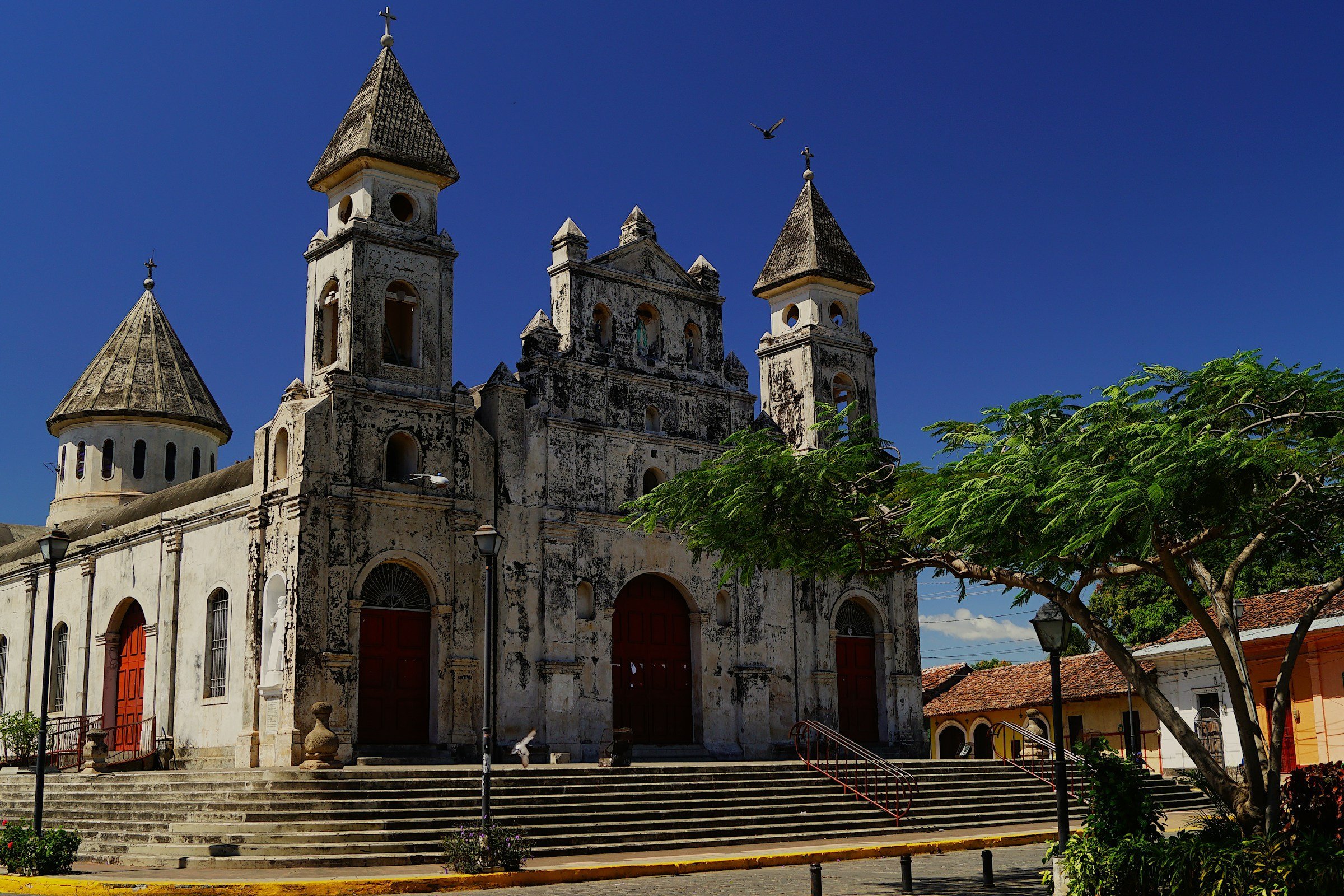
You arrive in Granada and the first thing you notice is how the paint peels in long vertical strips from colonial facades, exposing layers of color underneath like tree rings. Yellow over pink over blue over white. The buildings look less restored than paused mid-decay, the Spanish grid still intact but softened at the edges. Walk from the bus terminal toward the cathedral and you pass structures that would be museum pieces in Antigua or Cartagena but here function as hardware stores, cell phone repair shops, places selling bulk rice. The revolution happened, the wars ended, and Granada stayed Spanish but forgot to renovate.

Granada
The cathedral faces Parque Central with that typical colonial confidence, all mustard-yellow walls and white trim, but up close you see the stucco crumbling near the base. Inside, the nave feels incomplete. Wooden pews that don’t match. A ceiling that looks temporary. You learn later that William Walker, the American filibuster who declared himself president, ordered the city burned in 1856, and what stands now is the third or fourth version of the same blueprint. The wars kept interrupting the rebuilding. By the time the Sandinistas took power, then lost it, then the economy collapsed, Granada had been sacked so many times that restoration became a low priority. The effect is a city that looks permanently under construction in reverse.
The Streets Behind the Postcard Blocks
Calle La Calzada runs from the park to the lake and every guidebook photo of Granada comes from this six-block stretch. Painted ox-carts as planters, cafe tables with umbrellas, horse-drawn carriages waiting for tourists. It delivers exactly what the brochures promise, which makes the streets one block over strange by contrast. Calle Atravesada runs parallel and the buildings there show the same bones but without the fresh coats of paint. You see families sitting in doorways, laundry strung across interior courtyards visible through iron gates, dogs sleeping in the shade of walls that haven’t been retouched since the 1980s. The grid is so rigid that moving one block east or west toggles between two versions of the same city.
I walked Calle Estrada on a morning when the heat was already pressing down and passed a church with scaffolding that looked decades old, rust spreading across the metal pipes. A woman sold mangoes from a cart. Two men repaired a motorcycle in the street. The architecture framing all this was pristine in plan: symmetrical windows, tile roofs, courtyards you glimpsed through gated entries. But the paint was gone, the stucco showed bare patches, the wooden doors were splitting. It felt less like poverty than suspension, as if the city had been running one budget since 1860 and kept fixing only what broke completely.
What the Lake Did
Lake Nicaragua sits at the end of La Calzada, brown and enormous, with Las Isletas scattered just offshore. You can hire a boat for 400 cordobas (USD $11) and the driver will thread through the 365 islands, pointing out expensive weekend houses built by Managua families on the stable islets. Some islands hold single homes. Some hold single trees. The wealthy built here because Granada itself became uncertain during the war years. The lake offered distance.
What nobody mentions is how the lake smells faintly of algae and gasoline, or how trash collects in certain coves, or how the famous freshwater sharks that used to swim up the San Juan River from the Caribbean are mostly gone now, killed off by overfishing and a failed plan to dig a canal. The boat tour is worth taking but not for the reasons advertised. You take it to understand how the geography pinned Granada between the lake and the volcan, leaving only one direction for growth, and how that limitation kept the colonial core from sprawling into anonymous modernity. The city couldn’t expand, so it compressed, layers of history stacked in place.
Why the Ruins Feel Inhabited

Granada
Most colonial ruins are roped off or converted into museums. In Granada they remain in use. Iglesia de la Merced, with its bright yellow baroque facade, lets you climb the bell tower for 20 cordobas (USD $0.55). The stairs are original stone, worn concave in the centers by centuries of footsteps. At the top you see the grid of the city, the terracotta roofs, Mombacho volcano smoking faintly to the south. Below, a wedding is setting up in the nave. Someone is arranging white chairs. The church works as both monument and venue, the sacredness intact but casual, no velvet ropes or tickets with fixed hours.
The same pattern repeats at Convento San Francisco, now a museum with pre-Columbian statues arranged in the courtyard. You walk through freely. Schoolkids in uniforms run past the stone idols. A guide offers a tour but doesn’t insist. The building is functional, not frozen. This is the specific texture of Granada: everything old is still in service, and the service has worn the old things smooth. You don’t look at colonial architecture here, you use it.
I met a Canadian woman who had moved to Granada to teach English. She rented a house three blocks from the park for USD $300 a month, three bedrooms with high ceilings and a courtyard, the kind of place that would cost $3,000 in Oaxaca or San Miguel de Allende. She said the first month she kept waiting for the restoration to start, for someone to paint her street or repave the stones, and then she realized it wasn’t coming. The city had settled into its current state. The war interrupted development just long enough that when peace came, there was no money to catch up. So the colonial core persisted not through preservation but through inertia.
The Specific Calculus of Visiting
Granada offers little that requires advance planning. You walk. You eat grilled meat at Parque Central for 150 cordobas (USD $4). You sit in Cafe de las Sonrisas, staffed entirely by deaf workers, and order a Flor de Cana rum with lime. The heat makes afternoon movement difficult, so you return to your guesthouse and lie under a fan. Evening comes. The park fills. You walk again.
What you come to understand is that Granada’s appeal is its incompletion, the way it offers a colonial city without the colonial industry. Antigua sells the same architecture but polished until it looks like a theme park. Granada sells nothing. It simply continues, peeling paint and all, a Spanish city where the present never quite caught up to erase the past because the present ran out of money halfway through. You walk streets that feel arrested in 1982 or 1912 or 1856, the layers visible and unrestored, and the effect is not decay but honesty. This is what a colonial city looks like when it stops trying to be a museum and just remains itself, crumbling slowly, still inhabited, still functioning, the stones worn smooth by use.
If you liked this, you might like: Asuncion, La Paz, Montevideo.
Planning the trip? Compare hotel deals before you book.