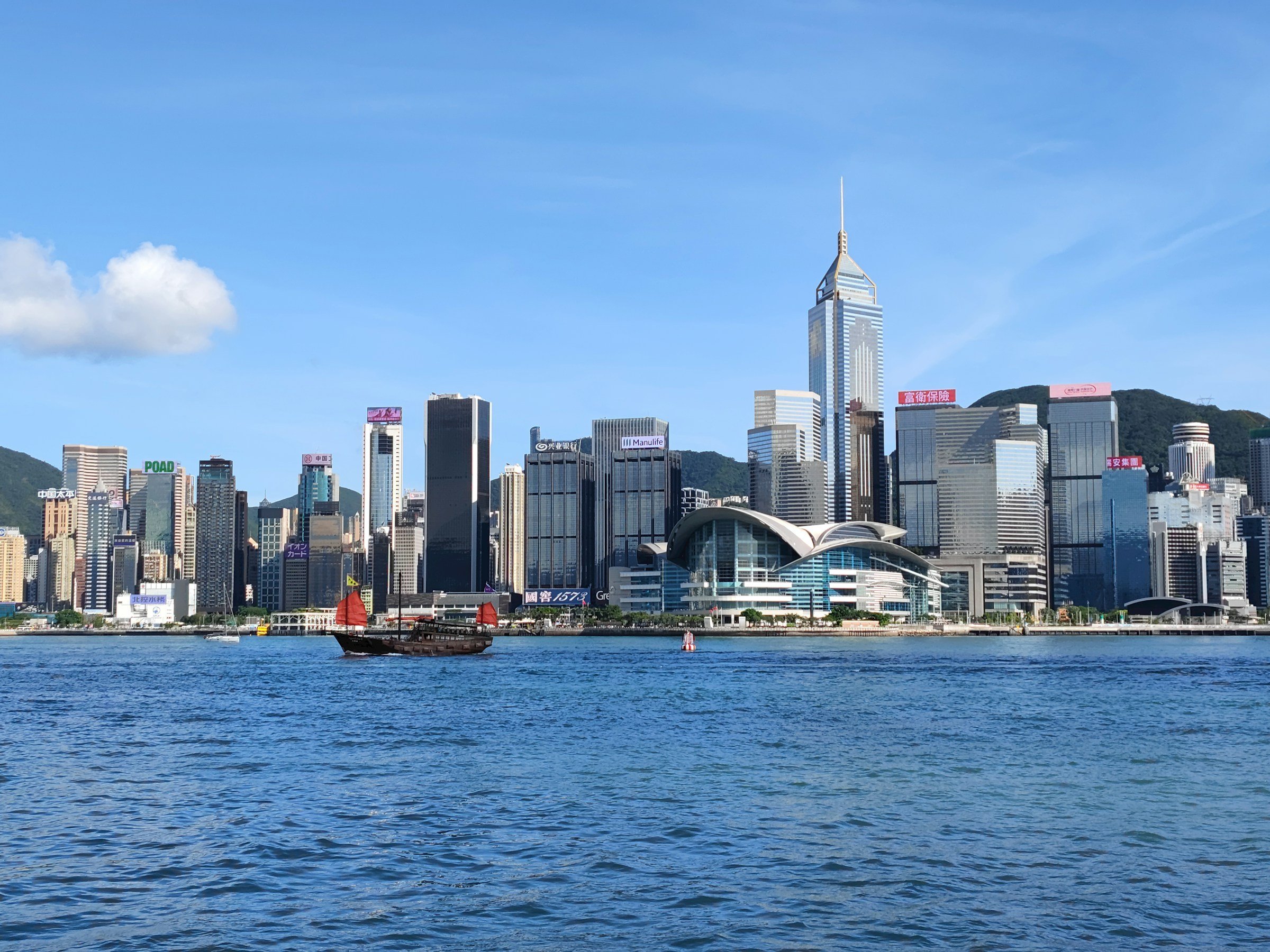
You eat three floors above the kitchen and five below the landlord’s mother
Most Hong Kong restaurants occupy one slot in a twenty-story stack. You take a narrow staircase or a freight elevator with accordion gates to reach the dining room. The kitchen might be two floors down, connected by a dumbwaiter that clanks while you eat. Above you, someone’s laundry drips on a bamboo pole jutting from a window. The restaurant itself has no street presence, just a weathered sign pointing upward and a phone number peeling off the glass.

Hong Kong
This arrangement makes no sense until you see the property math. Street-level space in Mong Kok runs HKD 200,000 per month (USD 25,600). Third-floor space costs half that. So the dumpling place moves upstairs, and you learn to look for vertical signs rather than storefronts. Temple Street has a seven-story building where each floor is a different restaurant. You smell Sichuan peppercorns on floor three, then roast goose on floor five. No one shares a menu or a name.
After a week you stop expecting restaurants to be on the ground. You expect them in the air, wedged between a law office and a tutoring center, reachable only if you know.
The wet market spans four vertical layers and you enter mid-stack
Wan Chai Market isn’t a market in the Western sense. It’s a municipal tower built in the 1980s where the fish sellers occupy the basement, the vegetable vendors take the ground floor, the butchers work on the second floor, and the cooked food stalls fill the third. You enter on the ground floor from Queen’s Road East, buy bok choy, then escalator up to buy char siu, then escalator down to buy shrimp. The entire supply chain is vertical.
The basement fish section floods when it rains hard. You walk on grated metal floors with seawater sloshing underneath. The vendors wear rubber boots all day. Eels swim in blue plastic tubs, and the grouper is live until you point. The smell is iodine and bleach and Cantonese conversation echoing off concrete.
On the third floor, the cooked food stalls serve what the floors below just sold. You eat fish ball noodles at a Formica table bolted to the floor. The woman running the stall boiled the stock on a camp burner at 6am, and now it’s lunch. The window overlooks a construction site where they’re tearing down a four-story building to put up a forty-story one.
You do not come here for atmosphere. You come because the shrimp is HKD 80 per catty (USD 10.25) instead of HKD 150 at ParknShop, and because this is how seven million people feed themselves on 1,104 square kilometers.
Footbridges let you walk three stories above the street for half a kilometer
Central District has a second-level pedestrian network that connects office towers, malls, and transit stations without ever touching the ground. You exit the MTR at Central, escalator up to the footbridge level, and walk enclosed skywalks to IFC Mall, then across to the Jardine House bridge, then over to Exchange Square. You can cover eight blocks and never cross a street.
The bridges have their own ecology. Filipina domestic workers gather here on Sundays because it’s covered and doesn’t block street traffic. They spread cardboard, sit in groups of thirty, eat packed lunches, and turn the walkways into a weekly village that dissolves by evening. The footbridges also have beggars, buskers, and women handing out tissue packs with ads printed on them.
At ground level, the streets of Central are dim and truck-heavy. Deliveries happen down there. The pedestrians are up here, in air-conditioned tubes with polished floors. It’s a class division built into the infrastructure. Office workers in heels never have to step on asphalt.
I’ve walked the entire Central footbridge network on humid days just to avoid sweating through a shirt. It’s not public space in any democratic sense. It’s corporate space that tolerates the public because excluding them would be a PR problem.
Apartment blocks stacked fifty-high share a single street address with twelve different lobbies

Hong Kong
Mei Foo Sun Chuen in Kowloon is a residential estate with 99 towers, each 20 stories or taller, all built between 1965 and 1978. Over 80,000 people live there. The towers share a street address but have separate lobbies labeled Phase 1 through Phase 8. You meet someone for dinner and they say “Mei Foo, Phase 4, Tower 18”. If you get Phase wrong, you’re ten minutes away on foot through labyrinthine courtyards.
Inside the towers, hallways are narrow and painted industrial beige. Each floor has eight or twelve units, doors so close you hear your neighbor’s TV through the wall. The older buildings have no elevators past the 12th floor. You walk the rest. Residents in their seventies do this daily with grocery bags.
Living here means accepting that your home is a cell in a hive. You don’t have a yard or a porch or a driveway. You have 450 square feet (42 square meters) and a window that looks at another tower fifteen meters away. Laundry goes on a pole you shove out the window using a bamboo rod.
Yet people raise families here. Kids do homework in bedrooms the size of a parking space. Three generations share two bedrooms and negotiate bathroom schedules. The compromise is affordability, HKD 18,000 per month (USD 2,300) instead of HKD 35,000 in a newer building. Vertical density isn’t aspirational. It’s survival.
Escalators move 60,000 people uphill daily because the city refused to flatten
The Central-Mid-Levels Escalator is the longest outdoor covered escalator system in the world, 800 meters of moving stairs climbing from Central up to Conduit Road. It rises 135 meters and takes twenty minutes if you stand still. Commuters walk while the stairs move, cutting the time in half.
The escalator was built in 1993 because Mid-Levels, the residential zone clinging to the slopes above Central, has no flat streets. Roads switchback at brutal grades. Before the escalator, you took a bus that crawled uphill in traffic, or you climbed hundreds of stone steps in tropical heat. Now you ride a machine that operates downhill in the morning and uphill after 10am.
The route passes through SoHo, where restaurants open directly onto the escalator. You smell garlic and roasting meat while you ascend. People hop on and off at each street exit. There’s no turnstile, no fare. It’s a public vertical conveyor for a hillside too steep to develop horizontally.
At the top, you step off into a neighborhood where apartments cost HKD 60,000 per square meter (USD 7,700). The escalator doesn’t erase the class divide. It mechanizes it.
Coffin homes stack six adults in a room where one double bed would barely fit
In Sham Shui Po, subdivided flats split old apartments into wire-cage sleeping berths. Each berth measures roughly 1.5 square meters. You cannot stand. You crawl in, lie down, and store belongings in plastic bins shoved underneath. The berths stack two or three high. A single 400-square-foot unit becomes housing for twelve people, each paying HKD 2,500 per month (USD 320).
This isn’t illegal. It’s licensed as a bedspace apartment. The landlord provides one shared bathroom and a hot plate in the hallway. You cannot cook anything that smells because everyone’s berth has only a curtain for privacy. Arguments about noise, shower time, and whose food is whose happen constantly.
People living here aren’t unemployed. They work in kitchens, drive trucks, clean offices. Hong Kong’s median rent is 40% of median income, so the working poor end up in cages. The waiting list for public housing is six years.
You won’t see these units unless you specifically seek them out, and your tour guide will not mention them. The government calls them “inadequate housing” and tracks 225,000 people living in subdivided units, cage homes, and rooftop shacks. Vertical density, taken to its coldest conclusion, is a cage with a padlock.
The same city that stacks luxury apartments forty stories high also stacks poverty into bunk beds made of chicken wire. That’s what happens when you run out of ground.
If you liked this, you might like: Bangkok, New Delhi, Hanoi.
Planning the trip? Compare hotel deals before you book.