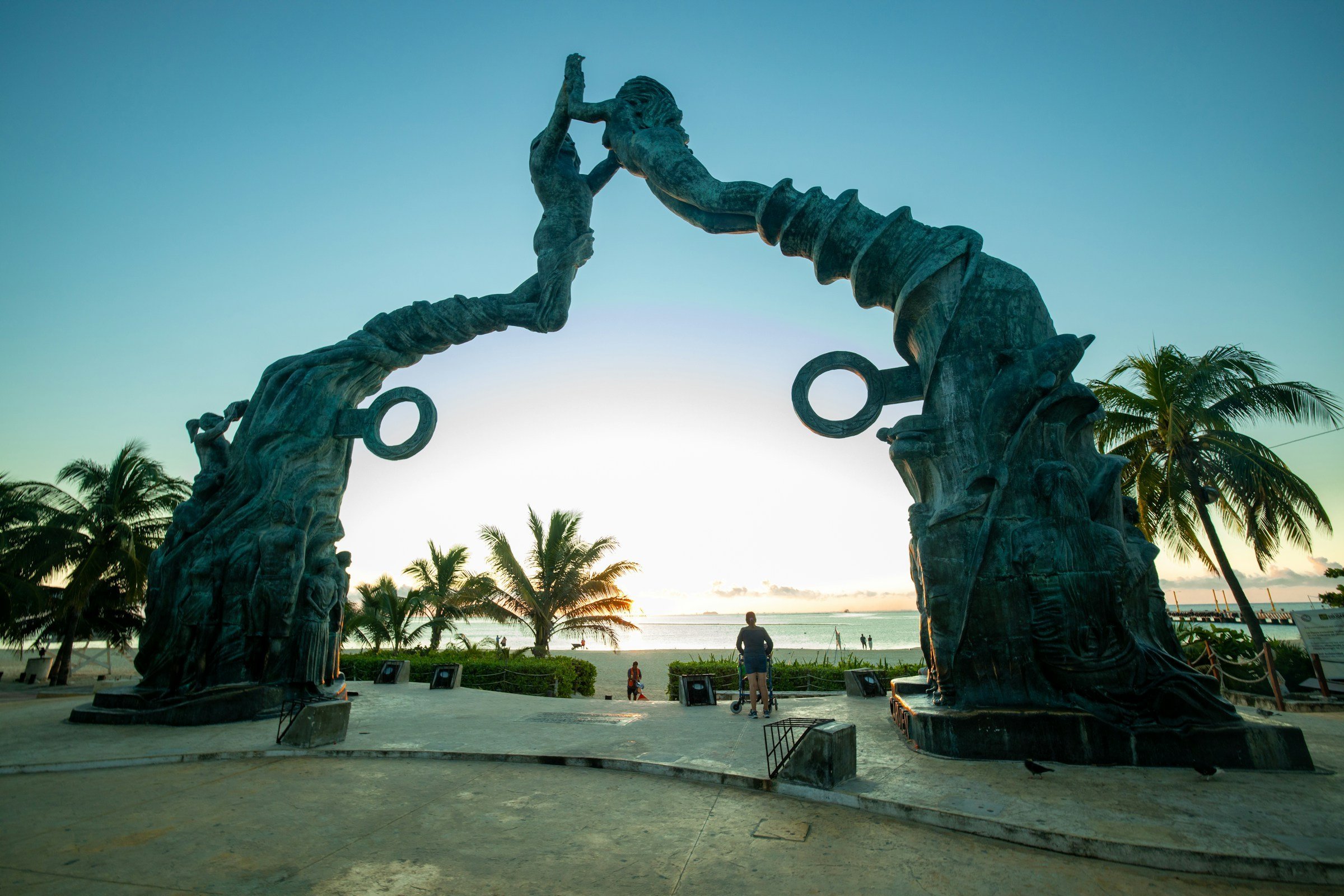
The Grid That Ate The Shore
Quinta Avenida runs parallel to the beach for kilometers. You walk it and every tenth storefront sells the same mass-produced hamacas from Oaxaca, the same silver jewelry that came out of a factory in Taxco, the same “Mayan” calendar replicas stamped in a workshop near the airport. The street grid here wasn’t drawn by centuries of footpaths converging at a well or a market. It was surveyed in the late 1980s when developers looked at empty coastline between Cancún and Tulum and saw subdivision potential.

The thing nobody tells you is that Playa del Carmen has no center that predates its tourism function. There is no colonial plaza because this was never a colonial town. There is no indigenous ceremonial ground because the ceremonial grounds are thirty kilometers inland. What you are walking through is a retail corridor purpose-built for cruise ship passengers who have four hours before the ship leaves and a credit card with no foreign transaction fees.
Fifth Avenue ends where the all-inclusive properties begin. North of Constituyentes Avenue the resorts form an unbroken wall of security gates and wristband-check stations. You cannot walk the beach continuously because private property extends to the high-tide line and guards redirect you back to the street. The public beach access points are narrow gaps every eight hundred meters, clearly marked in a way that tells you how negotiated their existence was.
The grid continues west from the beach into neighborhoods that look like residential zones but function as service infrastructure. Colonia Ejidal is where the housekeepers and groundskeepers live, where a one-bedroom apartment rents for $8,000 MXN ($470 USD) monthly while hotel rooms on the beach go for $280 USD nightly. You ride the colectivo at shift change and it fills with women in white polo shirts embroidered with resort logos, men in black slacks carrying kitchen clogs in plastic bags. These vans run every seven minutes during morning and evening peaks because the labor has to move on schedule.
Economic Geology
The cenotes near Playa del Carmen have wooden stairs, admission kiosks, and lockers that cost $1.50 USD. Cenote Azul charges $150 MXN ($9 USD) to swim in water that was free to access when it was just a sinkhole in the jungle. The stairs are convenient if you have bad knees. The lockers mean you can leave your phone somewhere while you swim. But the effect is that natural geography now operates on the same ticketed logic as a theme park ride.
Xcaret, eight kilometers south, makes this logic explicit. It is an eco-park built over what used to be a sacred inlet where Mayan traders launched canoes to Cozumel. You pay $119 USD for the basic ticket, $189 USD if you want the buffet and the lockers and the night show with fire dancers. The park’s promotional materials call it a celebration of Mayan culture. The actual Mayan archaeological site, Xcaret ruins, is a thirty-minute walk from the parking lot and has no signs pointing to it because it generates no revenue.
The reef offshore used to extend much farther. Decades of sunscreen runoff and anchor damage killed the coral in the swimming zones. The dive shops now take you to Cozumel or down to the cenotes where the visibility is better. Shore diving in front of Playa del Carmen is possible but unrewarding. You see sand, urchins, and the occasional nurse shark that looks as bored as you feel.
What thrives here is commercial infrastructure. Playa has three Starbucks within six blocks of each other. It has a Mega grocery store that looks identical to the Mega in Guadalajara or Monterrey. It has a Liverpool department store, a Coppel, a Walmart. The standardization is the point. You can arrive here and navigate using the same retail landmarks that organize space in Querétaro or Phoenix.
The Wristband Economy

Playa del Carmen
All-inclusive resorts operate on a closed-loop economic model. You pay a single price in advance, you receive a plastic wristband at check-in, and that wristband becomes currency for everything inside the property. Food, drinks, kayaks, beach chairs, towels. The model works because it removes the friction of decision-making. You never have to calculate whether another beer is worth $6 USD or whether the fish tacos justify their price. The wristband makes everything feel free even though you pre-paid for it months ago.
The resorts concentrate tourist dollars in a way that minimizes economic leakage. Staff wages are low because the positions require minimal skill. The food is sourced through bulk contracts with suppliers who deliver to every property along the coast. The entertainment is provided by contracted performance groups who rotate between resorts. A small percentage of guests leave the property to eat at restaurants on Fifth Avenue, but most stay inside the gate because leaving means confronting prices, tipping decisions, and the possibility of getting ripped off by a taxi driver.
Locals who grew up here before the development boom describe a town that was ninety-percent empty beach and ten-percent fishing village. The old pier where boats left for Cozumel is now a tourist ferry terminal with three competing companies running identical catamarans every hour. The ticket sellers wear polo shirts in different colors but sell the same round-trip passage for $400 MXN ($24 USD). The competition is theatrical.
What Persists
The colectivo vans that run down Avenida Juárez are the one piece of infrastructure that predates tourism and still functions on local logic. You stand on the corner, a van stops, you pay $12 MXN ($0.70 USD), and it takes you west into neighborhoods the resorts never mention. Colonia Ejidal. Misión del Carmen. Villas del Sol. Streets with no English signage where a taco costs $16 MXN ($1 USD) and tastes better than anything on Fifth Avenue because the taquero is cooking for neighbors who will call him out if the al pastor is dry.
The mercado on Avenida 30 sells produce trucked in from Campeche and Tabasco. Mangoes for $20 MXN ($1.20 USD) per kilo. Chiles that have actual heat instead of the tourist-safe versions served in hotel buffets. You shop here and people look at you because tourists do not shop here. They shop at Mega where the aisles are wide and the prices are twenty percent higher and everything is labeled in two languages.
What replaced local geography is not inherently worse. It is simply legible to a different set of users. The grid works if you are here for six days and need to find a pharmacy, a dive shop, and a place that serves pancakes. It fails if you want to understand what this coastline was before the hotels arrived, because that coastline is now a sales proposition. The beach is a product. The cenotes are products. Even the jungle is a product, carefully pruned and marked with trails and offered in three-hour guided tour packages that start at $79 USD.
If you liked this, you might like: Guatemala City, Panama City, Cartagena.